
CAP: Reconstructing Social Ties Through the Lens of Unsupervised Face Recognition
Link prediction of multimedia social network via unsupervised face recognition
The paper introduces an unsupervised framework for predicting links in multimedia social networks by analyzing photo albums. It proposes the "Constraint Affinity Propagation" (CAP) algorithm, which reformulates link prediction as a Kernel Set Discovery problem to identify album owners and their relationships based on face co-occurrence.
TL;DR
Is it possible to map an entire social network simply by looking at a collection of unlabeled photo albums? This paper introduces a method to do exactly that. By treating face recognition as an unsupervised "Kernel Set Discovery" problem and applying Constraint Affinity Propagation (CAP), the researchers can identify the owner of an album and predict their friendships based on who they appear with in photos, all without needing manual tags.
Context & Motivation
In the era of Web 2.0, platform growth often depended on understanding user relationships. While most link prediction methods rely on text-based metadata or explicit "friend" requests, this 2009 work explores a more challenging frontier: Visual Link Prediction.
The core difficulty lies in the "in-the-wild" nature of photos. Shadows, angles, and poor resolutions make standard face recognition fail. More subtly, standard clustering algorithms (like K-means) often get confused by lighting: two different people in the same photo share the same illumination, making them look more "similar" to an algorithm than the same person in two different settings. The authors' key insight was to turn an anatomical impossibility—one person being in two places in the same photo—into a mathematical constraint.
Methodology: The Core of CAP
The authors break the problem into two distinct stages: WhoAmI (identifying the album owner) and Link Prediction (recovering the edges).
1. The Kernel Set Discovery Problem
Instead of traditional clustering where every data point must belong to a group, the authors use Kernel Set Discovery. They only care about the "core" set—the album owner—and treat other faces as noise.
2. Constraint Affinity Propagation (CAP)
The standout technical contribution is the modification of the Affinity Propagation algorithm. Affinity Propagation works by passing "messages" (Responsibility and Availability) between data points until exemplars (centroids) emerge.
The authors introduce a Hard Constraint: If two faces and appear in the same photograph, their similarity is set to .
This ensures that the message-passing mechanism never allows these two instances to be clustered into the same person, effectively forcing the algorithm to handle diverse lighting and "wild" conditions more intelligently.
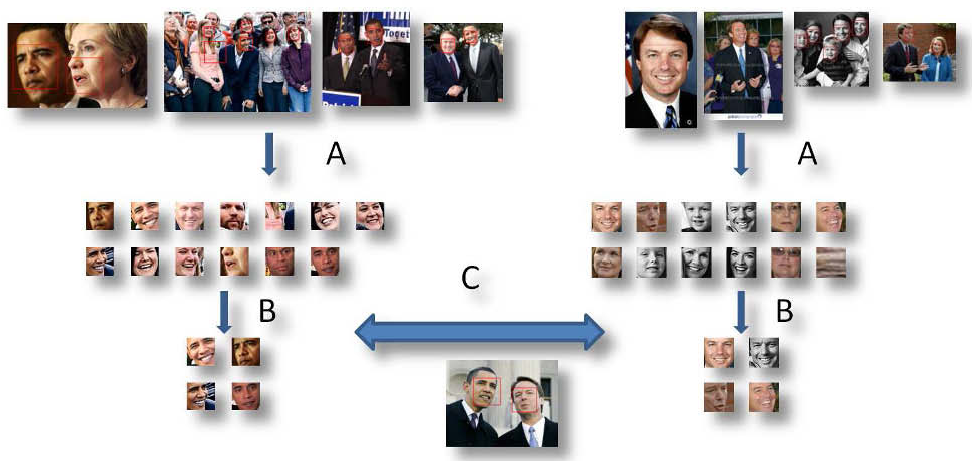 Figure 1: The process from face extraction to Kernel Set Discovery and final friendship graph construction.
Experiments & Results
The researchers tested their approach on two fronts: a controlled synthetic dataset (AT&T) and a messy, real-world Facebook dataset.
- Synthetic Performance: CAP dominated the baselines, achieving a 90% recall in discovering friend connections. This suggests that when faces are clear, the constraint-based clustering is highly effective at mapping social circles.
- Facebook Real-World Challenge: Faces in Facebook albums include detection errors and extreme variations. Even so, CAP reached an accuracy of 55.9% for "WhoAmI" tasks, outperforming standard Affinity Propagation (53.2%) and Density-based methods (41.2%).
 Table 1: Quantitative comparison across Density-based, Kernel K-means (KK), Affinity Propagation (AP), and the proposed CAP.
Critical Analysis & Future Outlook
Conclusion
The paper successfully proves that social structure is encoded within the pixels of our photo albums. The CAP method provides a robust way to extract this structure by utilizing logical constraints that standard algorithms overlook.
Limitations & Future Work
- Feature Depth: The 2009 study used raw pixel vectors (64x64). Modern applications would likely replace this with Deep Face Embeddings (like FaceNet), which would drastically improve the accuracy in "wild" conditions.
- Computational Complexity: Affinity Propagation is , which might struggle with massive social networks consisting of millions of photos without further optimization or hierarchical clustering.
- Future Vision: The authors anticipated the shift toward more robust features. Today, this work serves as an early ancestor to automated tagging systems and privacy research regarding how much "hidden" social information we reveal when uploading photos.
Senior Editor's Note: While this paper predates the Deep Learning revolution, its "Constraint-based" logic remains a masterclass in applying physical-world priors to solve abstract clustering problems.