
Beyond Dictionaries: Unsupervised Graph-Based Patterns for Multilingual Emotion AI
Unsupervised graph-based pattern extraction for multilingual emotion classification
The paper introduces an unsupervised graph-based framework for multilingual emotion classification in microblogging. It utilizes node centrality and clustering to extract emotion-bearing patterns (e.g., "SW_CW_SW") without relying on predefined lexicons, achieving state-of-the-art performance across English, French, Spanish, and Indonesian.
TL;DR
Researchers have developed a novel, unsupervised graph-based framework that bypasses the need for manual lexicons to classify emotions in microblogs. By treating language as a dynamic network and identifying "Subject" and "Connector" words via graph topology, the system achieves over 83% accuracy in English and adapts seamlessly to French, Spanish, and Indonesian, even correcting for severe data imbalances in rare emotional categories.
Background & Motivation: The "Dictionary" Bottleneck
In the world of Emotion Analysis, researchers have long been tethered to manually curated dictionaries like LIWC or NRC. While these are "gold standards," they suffer from three fatal flaws in the social media era:
- Stale Vocabulary: They miss internet slang, misspellings (e.g., "yayyyyy"), and evolving emojis.
- Language Barrier: Building a new dictionary for every language (French, Spanish, Indonesian) is a massive financial and human resource burden.
- Rigidity: They often fail to capture the "contextual bridge" between words that actually conveys emotion.
The authors of this paper argue that the structure of an opinion—rather than just the presence of specific words—is the key to unlocking multilingual emotion detection.
Methodology: The Anatomy of an Emotion Graph
The core innovation lies in Graph Aggregation and Unsupervised Pattern Extraction.
1. Graph Aggregation
How do you separate "Fact" from "Emotion"? The authors constructed two graphs:
- (User Graph): Derived from emotional tweets.
- (News Graph): Derived from factual news accounts.
By subtracting from , they isolated an Emotion Graph () containing arcs highly representative of opinionated data.
2. Identifying Subject vs. Connector Words
Using the topology of , the system identifies two types of tokens:
- Connector Words (CW): High Eigenvector Centrality. These are the "narrative glue" (e.g., "my", "is", "very").
- Subject Words (SW): High Clustering Coefficient. These are emotion-rich terms that tend to cluster together around connectors (e.g., "baobei", "yayyyy").
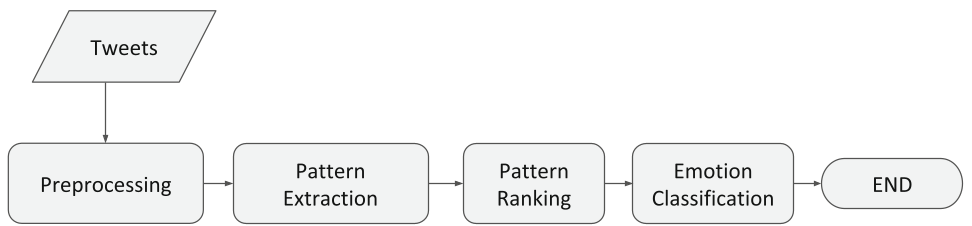 Figure 1: The system workflow—from raw tweets to graph-based pattern classification.
3. Wildcard Pattern Bootstrapping
Instead of simple unigrams, the system generates patterns like SW_CW_SW and replaces subject words with wildcards (e.g., * is so *). This allows the model to handle "unseen" words during inference, drastically improving coverage.
Experiments: Breaking the Language Barrier
The system was tested across multiple languages. The FULL unsupervised approach consistently outperformed traditional baselines that used millions of manual annotations.
The Indonesian Challenge: Minority Class Boosting
Indonesian microblogging is famously informal and presents a "data imbalance" problem—users rarely tweet about "Fear" or "Disgust" compared to "Joy." To solve this, the authors introduced Adjusting Pattern Weights (APW), a mechanism that uses an extended TF-IDF measure to "punish" common patterns and "promote" rare, highly specific emotional indicators.
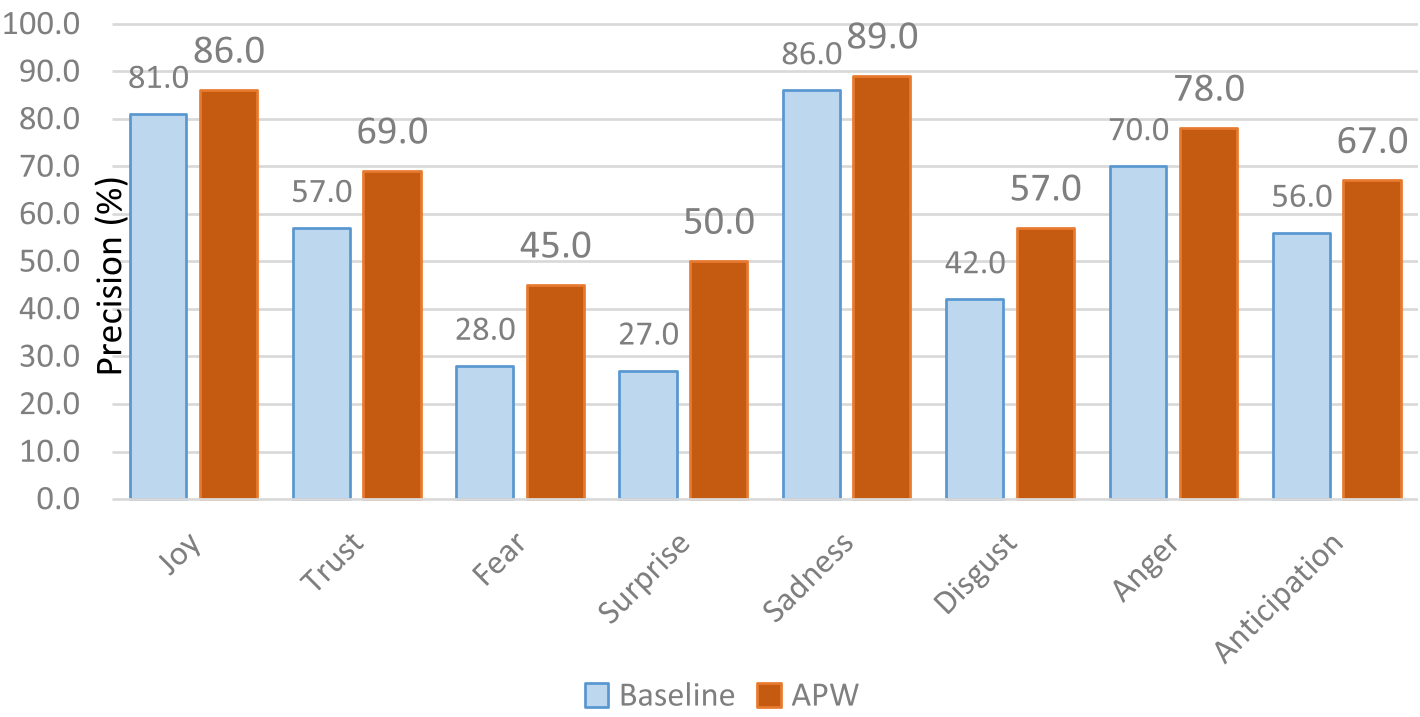 Figure 2: Performance gains in Indonesian emotion detection using the APW technique.
Key Results:
- English: 83.3% accuracy (beating the 57% baseline).
- French/Spanish: Maintained high stability (80-84%) even with reduced pattern sets.
- Indonesian: Achieved an 89% overall precision after minority class boosting.
Critical Insight: Why This Works
The brilliance of this work is its Inductive Bias. It assumes that while the words for emotion change across languages, the graphical relationship between subject-heavy terms and grammatical connectors remains relatively constant. By leveraging Eigenvector Centrality, the model discovers "stop-words" and "slang-connectors" dynamically, making it a truly "zero-effort" framework for domain adaptation.
Conclusion & Future Outlook
This paper proves that we don't need massive labeled datasets or expert linguists to build effective multilingual AI. The next frontier? Integrating these graph-based patterns into Transformer architectures to provide a "structural anchor" for large language models, potentially reducing the hallucination of sentiments in small-corpus languages.
Takeaway: Stop building dictionaries; start building graphs.