
Graph-Based Pattern Extraction: A Language-Agnostic Leap for Emotion Classification
Unsupervised Graph-Based Patterns Extraction for Emotion Classification
The paper proposes an unsupervised, graph-based framework for extracting emotion-bearing patterns from Twitter. It utilizes a novel bootstrapping process to identify "connector words" and "emotion words" to form patterns with wildcards, achieving 83.3% accuracy in English emotion classification and demonstrating high cross-lingual adaptability.
TL;DR
Researchers have developed a fully unsupervised system that learns to "feel" across languages. By treating social media streams as complex graphs and subtracting factual noise, the system extracts high-precision emotion patterns without needing human-made dictionaries. It achieves over 80% accuracy in English, French, and Spanish, proving that structural patterns are often more powerful than raw word lists.
The "Dictionary" Bottleneck
For years, emotion classification has leaned heavily on lexicons like LIWC (Linguistic Inquiry and Word Count). While effective, these dictionaries are "static" and "expensive"—they require years of psychological expertise to build and struggle with the slang-heavy, rapidly evolving landscape of social media. Furthermore, a dictionary built for English is useless for French or Spanish without massive translation effort. The core motivation of this paper is to bypass the need for human supervision entirely.
Methodology: The Art of Graph Subtraction
The authors' insight is brilliant in its simplicity: Emotions are what remains when you remove facts.
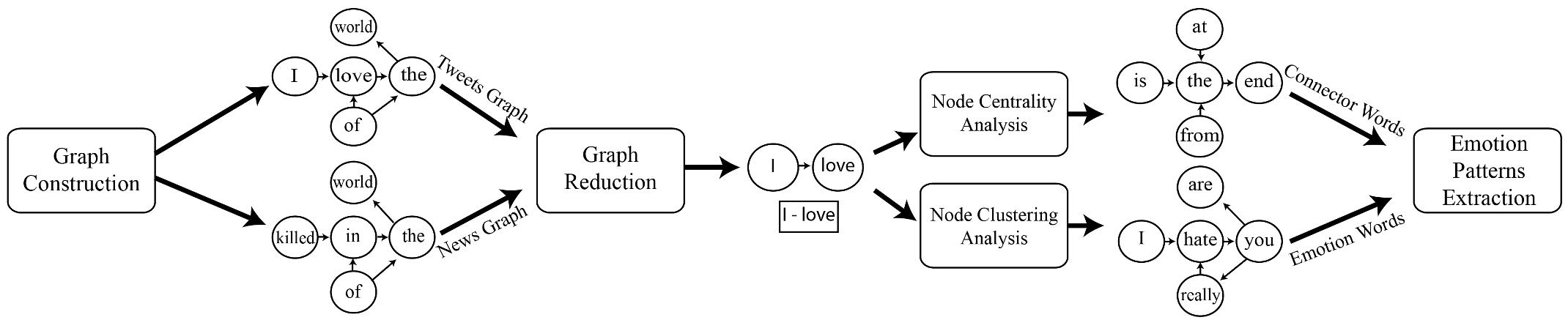
1. Graph Aggregation
The process begins by building two directed graphs:
- (User Graph): Captures the flow of social tweets.
- (News Graph): Captures factual structure from newspaper accounts.
By subtracting the weights of the News Graph from the User Graph, the system isolates sequences that are unique to opinionated, emotional speech.
2. Identifying Building Blocks
Instead of using Part-of-Speech tagging, the authors use network statistics:
- Connector Words (Stop-words): Identified via Eigenvector Centrality. These are nodes that are important because they link to other important nodes, acting as the "glue" of language.
- Emotion Words: Identified via Clustering Coefficients. The intuition is that emotion-related terms tend to cluster together when linked by common connectors.
3. The Power of Wildcards
The extracted patterns use wildcards (e.g., "I am feeling .*") to capture diversity. A pattern's "Emotion Degree" is calculated not just by frequency, but by Diversity—how many different unique emotion words it can capture.
Experimental Results: Outperforming the Experts
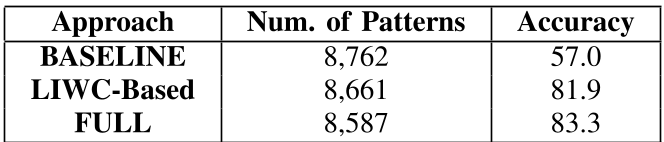
The results from the "FULL" unsupervised approach are striking. When compared against traditional models and hand-crafted lexicons, the graph-based method consistently comes out on top or remains highly competitive.
Key takeaways from the evaluation:
- Unsupervised > Supervised: The FULL unsupervised model (83.3%) actually performed better than the version using the LIWC dictionary (81.9%).
- Multilingual Dominance: While standard classifiers like MNB and SVM crashed when moving from English to Spanish/French (dropping as low as 51.9%), the graph-based approach stayed robust, hitting 84.0% in French.
Critical Insight & Conclusion
The success of this method lies in its focus on structure over vocabulary. By using wildcards and graph centrality, the model captures the template of an emotion rather than just the keywords.
Limitations: The current approach is tailored for short-form content (Tweets). Its effectiveness on long-form academic or technical prose remains unproven, as the structural "patterns" of emotion may be more diluted in longer texts.
Future Outlook: This work paves the way for truly global sentiment mirrors. By leveraging "the wisdom of the crowd" (hashtags) and graph theory, we can now build emotion-aware systems for low-resource languages without ever hiring a translator.