
Unmasking the Void: How Polarized Conversations Evolve on Untempered Social Media
Examining Untempered Social Media: Analyzing Cascades of Polarized Conversations
This paper presents a large-scale analysis of Gab, a fringe social media platform, by constructing and analyzing 3.7 million "conversation cascades." Using 34 million posts, the researchers identify five distinct structural patterns of online interaction and deploy Susceptible-Infected (SI) and Bass models to predict how these polarized conversations evolve and gain virality.
TL;DR
Fringe social media platforms like Gab have become digital bastions for "unfettered" speech, often serving as breeding grounds for radicalization. This research analyzes 34 million Gab posts through the lens of conversation cascades, identifying five specific structural patterns of interaction. The study reveals that the most viral and dangerous topics—such as White Supremacy and Antisemitism—follow predictable structural evolutions that can be modeled with up to 84% accuracy using epidemic growth frameworks.
The Rise of Fringe Echo Chambers
When mainstream giants like Twitter and Facebook deplatform extremist groups, the "alt-right" moves to fringe outlets like Gab. Unlike mainstream platforms, Gab's lack of moderation creates a unique environment where homophily (the tendency to associate with similar others) is supercharged. This paper moves beyond just looking at what is said to how it spreads, treating conversations as evolving physical structures.
Methodology: The Anatomy of a Cascade
The researchers define a Conversation Cascade () as a directed graph where nodes are posts and edges represent replies or quotes.
1. Structural Templates
The core of the methodology lies in identifying five archetypal patterns (Types A through E) that represent different levels of user engagement:
- Type A: Simple linear conversations.
- Type B/C: Mid-level branching with varying user participation.
- Type D: The "Viral" state—deep, wide, and highly branched.
- Type E: The "Echo Chamber"—deep but with very few unique users, indicating intensive back-and-forth between a small group.
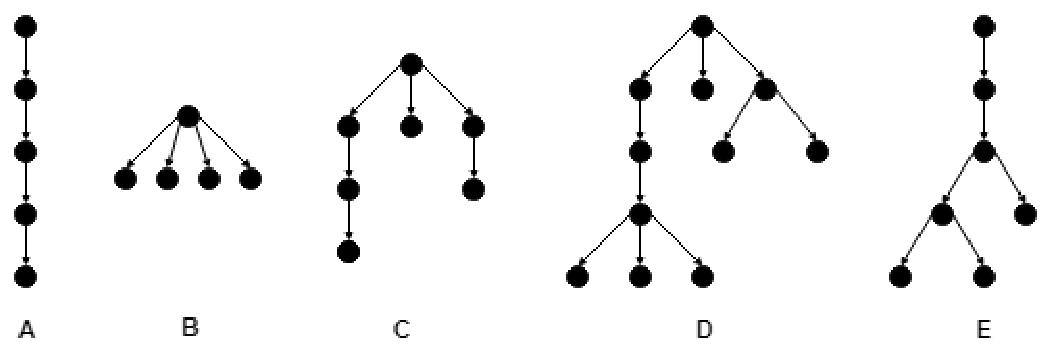 Figure 1: The five structural templates of Gab conversations.
2. Topic Discovery via Hashtag Graphs
To correlate structure with content, the authors developed a semi-automated algorithm. By building a weighted graph of hashtag co-occurrences, they could propagate labels from a small set of manually identified hashtags to thousands of others. This identified six major themes: Conservatism, Anti-Semitism, White Supremacy, Freedom of Speech, Anti-Islam, and Conspiracy Theories.
Evolution Modeling: Predicting the Spread
One of the most profound insights of this study is the Pathways of Evolution. Every conversation begins as a Type A (linear) thread. The researchers found that controversial topics are more likely to evolve into more complex, viral structures (Type D).
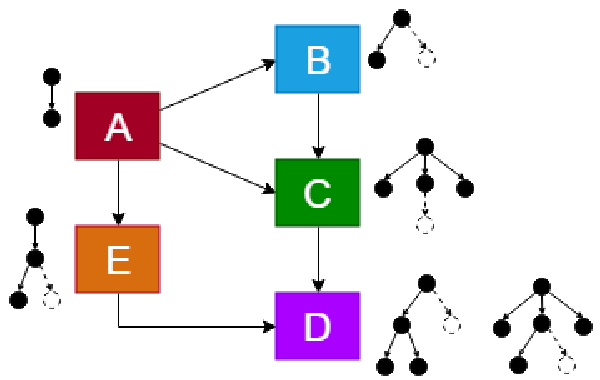 Figure 2: The state diagram showing how conversations transform from linear threads to complex viral cascades.
To model this, they adapted the Susceptible-Infected (SI) and Bass Diffusion models. By treating "evolution" as an infection event, they modeled the rate at which threads transition between types.
- Average evolution time: 1.5 days.
- Minimum "trigger": Usually 3 replies are enough to push a thread into a new structural state.
Key Results: Where the Heat Is
The data confirms a chilling reality: Controversial topics are the stickiest.
- Antisemitism cascades had an average size of 47.58—nearly three times the size of "Freedom of Speech" cascades.
- High Tie Strength: Users engaging in hate speech are more likely to have frequent, repeated interactions with one another, creating a "hardened" core of radicalized individuals.
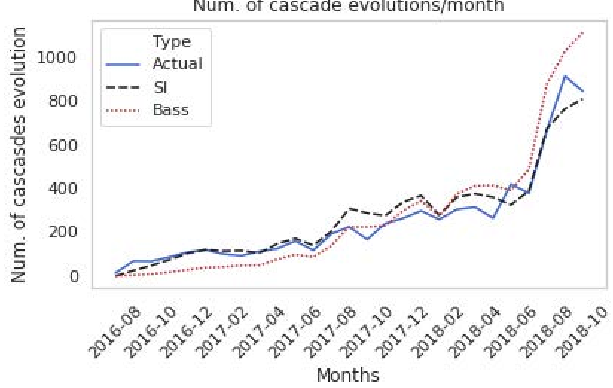 Figure 3: Fitting the SI and Bass models to Gab's empirical data to predict conversation growth.
Critical Insight & Conclusion
This paper shifts the focus from content moderation to structural intervention. By demonstrating that viral hate speech has a specific "structural signature" (often starting in Type E echo chambers before exploding into Type D cascades), the authors provide a blueprint for automated systems to flag potentially dangerous events before they reach critical mass.
While the models are highly accurate for simple transitions, they struggle with more complex, late-stage evolutions (). Future work should look at the "mutation" of content—how a conversation about a news event gradually shifts into a conspiracy theory as it moves across structural types.