
Unveiling Truth: How Liquid Democracy Navigates Misinformation
Unveiling the Truth in Liquid Democracy with Misinformed Voters
This paper investigates the Optimal Delegation Problem (ODP) in Liquid Democracy, where voters transitively delegate votes to maximize the probability of electing a "ground truth" alternative. Using an uncertain dichotomous choice model, the authors establish strong inapproximability results while providing a polynomial-time 1/2-approximation algorithm for specific network conditions.
TL;DR
Liquid Democracy (LD) allows voters to delegate their voting power transitively. This paper explores the Optimal Delegation Problem (ODP): how to structure these delegations to ensure a group chooses the "correct" answer. The authors find that while misinformed voters make the problem theoretically "hard" to approximate, high network connectivity and simple heuristics can still outperform traditional direct voting.
Background: The Promise and Peril of Delegation
In a world of specialized knowledge, Liquid Democracy offers a middle ground between direct and representative democracy. You vote on what you know and delegate to a "guru" for what you don't. However, if a community is plagued by misinformation (voters with accuracy < 0.5), the wrong guru might accumulate massive voting weight, leading to a "tyranny of the misinformed."
The Core Problem: Complexity & Hardness
The authors strengthen the case against easy solutions for ODP. By reducing the Minimum Set Cover problem to ODP, they prove that if voters can be misinformed, finding the best delegation structure is not just hard—it is practically impossible to approximate within a factor of unless .
The intuition is that in a poorly connected network, element voters must find a "cover" of set gurus. Finding the smallest set of gurus to represent the truth is as hard as the most difficult set-covering problems.
 Fig 1: A social network (left) transformed into an acyclic delegation graph (right), where gurus accumulate the weight of their followers.
Methodology: Heuristics and the "Best Guru"
Despite the theoretical gloom, the paper offers a beacon of hope:
- Direct Democracy vs. LD: If the average accuracy is under 0.5, direct democracy fails as grows. LD, however, can succeed by concentrating weight on a few experts.
- Best Guru Strategy (BGS): In a strongly connected network, simply giving all power to the single most accurate reachable voter provides a 1/2-approximation.
- Local Search: The authors propose centralized and decentralized heuristics (like "Emerging" delegation) where voters delegate to neighbors they perceive as more expert.
Experimental Insights
The simulations across different graph models (Erdős-Rényi, Barabási-Albert, Watts-Strogatz) reveal three critical findings:
- LD Scalability: Unlike Direct Democracy, the "score" (probability of truth) for LD increases as the number of voters increases, because the pool of potential experts grows.
- The Connectivity Dividend: Higher network density (more edges ) consistently leads to better outcomes across all heuristics.
- Robustness to Noise: Even when we only have "approximate" knowledge of voter accuracy (parameter
prec), LD remains effective.
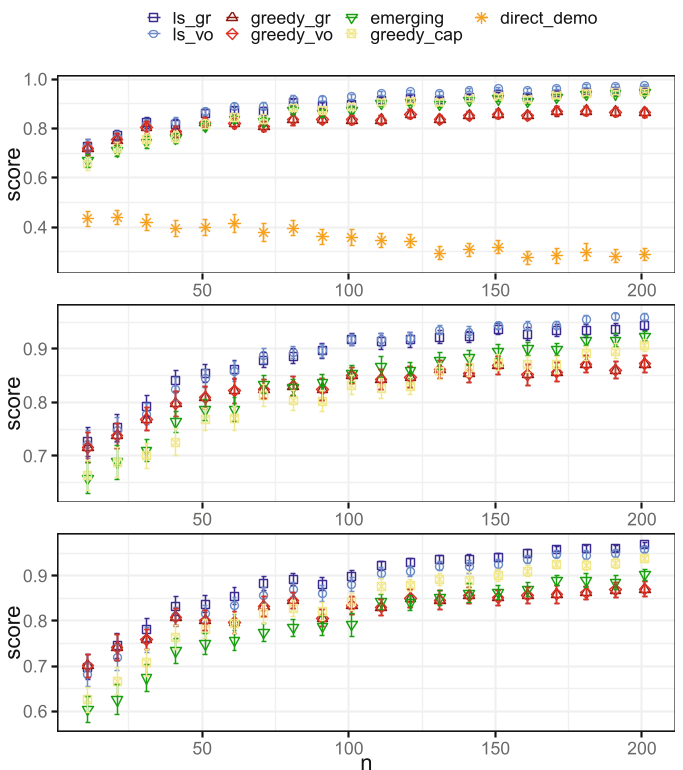 Fig 2: Collective score vs. number of voters. Note how all LD heuristics (top lines) significantly outperform Direct Democracy (bottom line) as the population grows.
Critical Analysis & Future Outlook
The paper's strongest contribution is bridging the gap between "hard" theoretical bounds and "optimistic" simulation results. It proves that while we can't find the best delegation graph easily, we don't necessarily need to. Simple local rules—where people delegate to those they trust and respect—often approximate the optimal truth-revelation.
Limitations: The model assumes accuracy is a fixed probability. In reality, accuracy is often correlated with social status or topic-specific biases, which might lead to "echo chambers" not fully captured here.
Takeaway for the Future: For digital governance, the message is clear: Network connectivity is as important as voter education. By ensuring a highly connected social graph, we enable individual expertise to "flow" to the top, effectively filtering out the noise of misinformation.