
Up-and-Down Routing: Harnessing the Nested Hierarchy of Mobile Social Networks
Up-and-Down Routing through Nested Core-periphery Hierarchy in Mobile Opportunistic Social Networks
This paper introduces the Up-and-Down Routing protocol for Mobile Opportunistic Social Networks (MOSNs), leveraging a discovered Nested Core-Periphery Hierarchy (NCPH). It utilizes a distributed labeling scheme for message "uploade" to the network core and space-efficient Bloom-filter-based routing hints for "downloading" to destinations, achieving SOTA performance in delivery delay and ratio.
TL;DR
Routings in Mobile Opportunistic Social Networks (MOSNs) often struggle with the "curse of dynamics"—where keeping track of moving nodes is too expensive. This paper reveals that MOSNs possess a Nested Core-Periphery Hierarchy (NCPH). Use this structure, the authors propose an Up-and-Down Routing protocol: messages climb to the "Core" (active nodes) and then use "Bloom-filter hints" to descend to the destination, achieving high delivery rates with minimal storage.
Problem & Motivation: The Trap of Local Maximums
In an MOSN, your phone only connects to others by chance. Traditional social routing (like BubbleRap) directs messages to "popular" nodes (high degree). However, popularity is often local. A message can get "trapped" at a locally popular node that has no path to the global core or the destination.
The authors observed that social contacts aren't just hierarchical; they are nested. Even if you remove the most peripheral nodes, the core-periphery structure remains intact. This stability is the key to creating a "trap-free" path to the network's most influential nodes.
Methodology: The Up-and-Down Logic
1. Defining the NCPH
The paper introduces a Distributed Labeling Scheme. Nodes evaluate their "effective weighted degree" (sum of contact frequencies with unlabeled neighbors). By iteratively labeling and "peeling" the periphery, the network identifies a central Root Node.
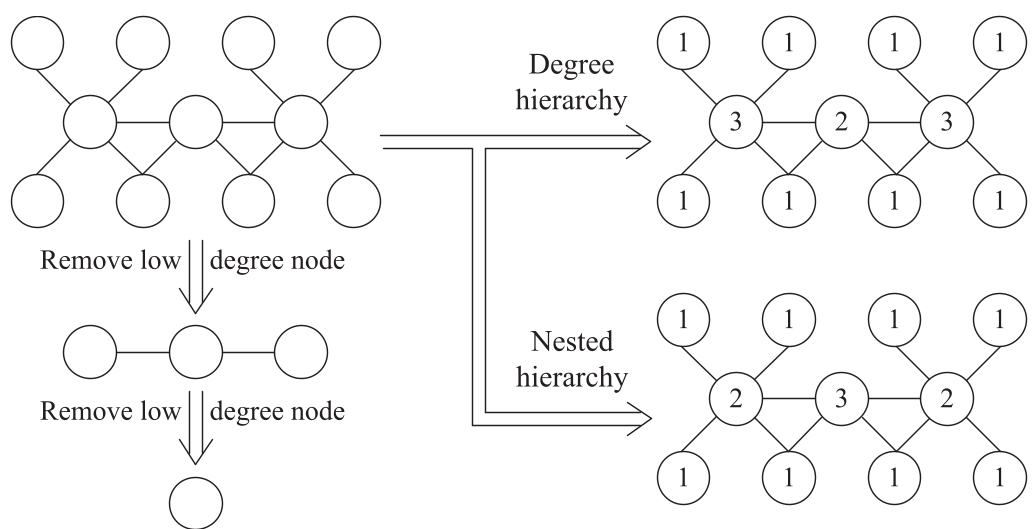 Figure 1: Unlike simple degree hierarchies, NCPH ensures that there is always a neighbor with a higher label, preventing local traps.
2. The Two-Phase Protocol
- Upload Phase (Single Copy): The source forwards the message to any neighbor with a higher NCPH label. This is extremely cost-efficient, using only one copy to reach the "highways" of the network core.
- Download Phase (Multi-Copy): Once the core is reached, the protocol needs to find the specific destination. Since the core cannot store perfect routing tables for thousands of nodes, they use Bloom-filter-based routing hints. These hints provide an estimated "delivery delay" to descendants.
3. Bloom-Filter Hints: Compression with Accuracy
To solve the storage bottleneck, the authors extend Bloom filters to store weighted values (contact frequencies). While this introduces a small "False Positive" rate (thinking a node is a descendant when it isn't), the authors mitigate this by using multiple copies in the download phase.
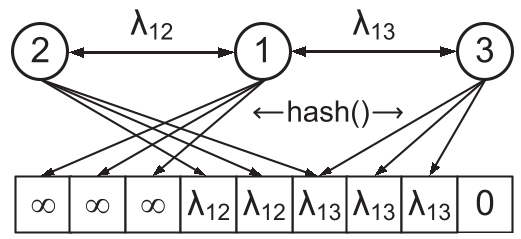 Figure 2: The Bloom-filter hint architecture for efficient neighbor tracking.
Experiments & Results: Efficient Scaling
Testing on the Sigcomm trace and synthetic models, the Up-and-Down protocol demonstrated a clear advantage:
- Performance: It matched the delivery ratio of "Epidemic" routing (flooding) but at a fraction of the communication cost.
- Diminishing Returns: The authors found that increasing message copies beyond 4-6 provided negligible gains, proving the protocol's efficiency.
- Robustness: Even with compressed hints (saving 50%+ storage), the system maintained high reliability because of the directional constraints of the hierarchy.
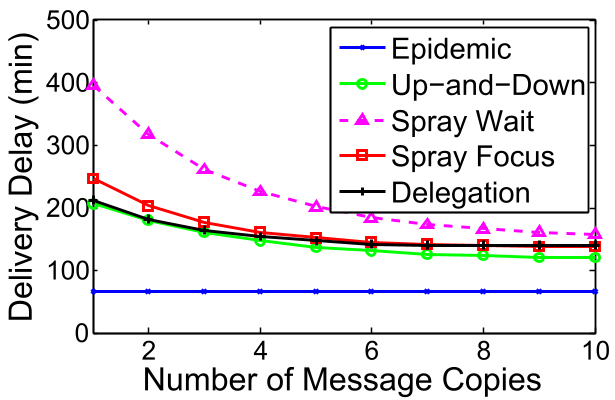 Figure 3: Comparison of Delivery Delay and Ratio across different protocols.
Critical Analysis & Conclusion
Takeaway
The genius of this work lies in recognizing that structure is more reliable than status. By moving away from "node popularity" to "nested hierarchy," the authors solved the routing trap problem. The use of Bloom filters to handle the "downward" journey is a pragmatic bridge between theoretical social structures and real-world hardware constraints (limited RAM/Storage).
Limitations & Future Work
- Hotspot Issue: The core nodes (roots) bear the brunt of the traffic. While they are usually "active" nodes (likely having more power), this could lead to battery depletion in mobile devices.
- Scalability: In massive networks, multiple roots might emerge. The authors suggest "virtual connections" between roots, but the overhead of maintaining these in a highly dynamic MOSN remains a challenge.
This paper provides a robust blueprint for future 5G/6G device-to-device (D2D) communications where infrastructure might be unavailable.