
Efficient Update Propagation in Decentralized Social Networks: Bridging the Freshness Gap
Update Management in Decentralized Social Networks
The paper proposes a novel update management technique for decentralized social networks (P2P) using a dual-cache structure (Data and Path caches). By augmenting path replication with parent-child metadata, it creates a directed acyclic graph to propagate updates lazily, achieving high data freshness even in unstructured peer-to-peer environments.
Executive Summary
TL;DR: This research introduces a structured approach to managing data updates in unstructured Peer-to-Peer (P2P) networks, common in decentralized wikis and blogs. By utilizing a "Path Cache" (metadata) alongside traditional "Data Caches," the system builds a directed delivery graph that pushes updates lazily but effectively, ensuring high data freshness without the massive overhead of global state management.
Academic Context: This work sits at the intersection of Content Delivery Networks (CDN) and P2P systems. It moves beyond simple "search and replicate" strategies by treating the replication path as a persistent routing infrastructure for future updates.
The Problem: The Chaos of Unstructured Networks
In decentralized social networks like Wikipedia or community blogs, data is dynamic. However, most P2P architectures are designed for static file sharing. In unstructured networks, finding a replica is hard enough; updating thousands of scattered replicas is a nightmare.
Prior solutions fall into two problematic camps:
- Eager/Quorum Maintenance: Too expensive; requires knowing exactly how many replicas exist.
- Flooding: Destroys network bandwidth by blindly broadcasting updates.
- TTL (Time-to-Live): Leads to "Pull" delays where users see old data until a timer expires.
The authors' insight is simple: The path used to find the data in the first place is the best path to deliver an update.
Methodology: The Path Cache Paradigm
The core innovation is the Path Cache. While standard caching stores the "what" (the data), this system stores the "whence" (the path).
1. Building the Update Tree
When a peer discovers data via a random walk, it doesn't just copy the data; it records its Parent (the peer it got data from) and its Children (the peers it sent data to).
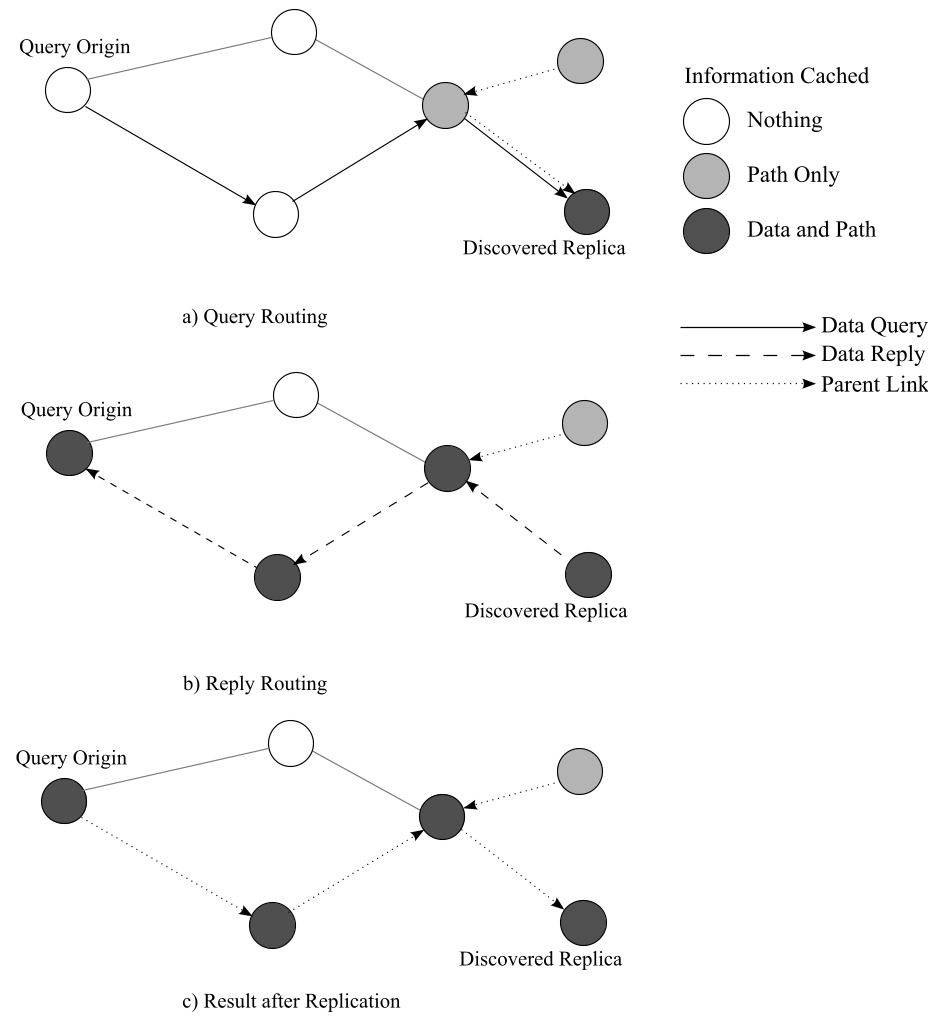 Fig 1: As data is returned along the search path, a Directed Acyclic Graph (DAG) is naturally formed, rooted at the Master Peer.
2. Metadata vs. Payload
Data objects (e.g., a Wikipedia page) are heavy, but metadata (Parent/Child IDs) is light. By maintaining a separate Path Cache, a peer can keep the "routing instructions" for hundreds of items even after the actual data is evicted from memory. This ensures the update "pipeline" remains unbroken.
3. Lazy Push Updates
When the Master Peer updates a document, it pushes the new version to its children. Each child updates its local copy and forwards it further down the graph. Version numbers are used to prevent cycles or out-of-order updates.
Performance and Experimental Results
The authors tested their system against real-world traces from Wikipedia and MetaFilter (a community blog representing "flash crowds").
- Data Freshness: In Zipf-distributed workloads (where some items are very popular), roughly 85.5% to 97.7% of queries returned perfectly fresh results, depending on the update-to-query ratio.
- Flash Crowds: For the MetaFilter trace, the median "hop count" to find data was zero, meaning the path-based caching adapted so quickly that most users found fresh data in their local cache.
- Policy Matters: The researchers found that FIFO (First-In-First-Out) or LFU (Least Frequently Used) eviction for the Path Cache outperformed "Sink-First" strategies. Removing "Sinks" (nodes with no children) surprisingly led to isolated "islands" of stale data when network churn occurred.
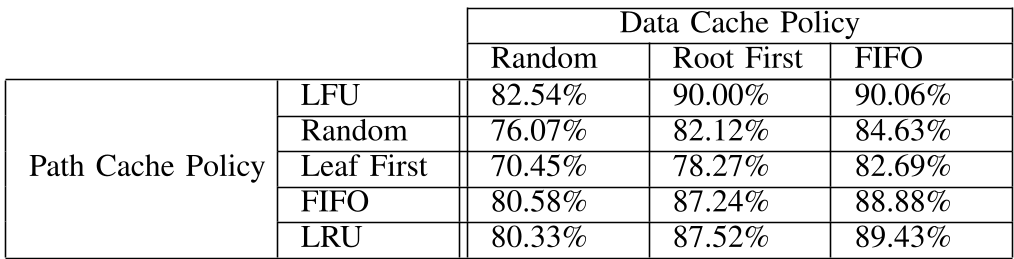 Table 1: Comparison of different Data and Path Cache eviction policies. LFU/FIFO combinations yielded the highest freshness.
Critical Insight: Why This Works
The brilliance of this approach lies in its deterministic exploitation of randomness. By using the random walk path as a backbone, the system avoids the need for a global directory or aDHT (Distributed Hash Table). It turns the "lucky" search path into a "structured" delivery route without the rigid maintenance costs of a structured Chord or Kademlia network.
Conclusion & Future Outlook
This paper demonstrates that high data freshness is achievable in decentralized networks through clever metadata management. For developers of modern decentralized social protocols, the takeaway is clear: don't just cache the content; cache the graph topology that connects the content to its source.
Limitations: The model assumes non-malicious behavior. In a real-world P2P environment, "Path Poisoning" (where a node claims to be a parent but drops updates) would need to be addressed via cryptographic proofs or reputation systems.