
UPP: Reclaiming Data Sovereignty in the Age of Social Networking
UPP: User Privacy Policy for Social Networking Sites
This paper introduces the User Privacy Policy (UPP), a standardized framework and XML-based protocol designed to empower social networking site (SNS) users to control their data. It categorizes data sensitivity and viewer intimacy to enable granular privacy and tracking specifications that act as a "contract" between users, providers, and third parties.
TL;DR
The User Privacy Policy (UPP) is a proposed technical framework that shifts privacy control from SNS providers back to users. By utilizing a structured XML-based policy, UPP allows users to define not just who sees their data, but how that data can be used, shared, or tracked, effectively creating a binding digital contract for personal information.
The "Ownership" Crisis in Modern SNS
Social Networking Sites (SNS) operate on a fundamental paradox: they thrive on sharing but fail significantly at protecting the sharer. The authors identify a critical "Privacy Gap" where existing tools (like Facebook’s audience selector) only solve the visibility problem but ignore the propagation and usage problems. Once a friend sees your photo or an app accesses your profile, you lose control.
The motivation for UPP stems from three core risks:
- Direct Risks: Identity theft and phishing (Security).
- Social Risks: Damage to reputation via "harmful" tags or photos (Credibility).
- Systemic Risks: Unwanted commercial profiling by providers and third parties.
Methodology: The UPP Framework
The genius of UPP lies in its multidimensional taxonomy. Rather than treating all data and all "friends" equally, it creates a matrix of trust and sensitivity.
1. Data Classification
The paper categorizes user data based on the potential impact of its exposure:
- Healthy: Nicknames, hobbies (low risk).
- Harmless: Demographic data (risks profiling).
- Harmful: Embarrassing photos (risks reputation).
- Poisonous: SSNs, financial info (risks security).
2. The Relationship Hierarchy
Viewers are divided by intimacy: Best Friends, Normal Friends, Casual Friends, and Visitors.
3. XML Policy Specification
The UPP translates these abstract levels into a machine-readable format. A POLICY element defines the OWNER, the RECEIVER (who gets the data), and the ACCESS-RIGHTS.
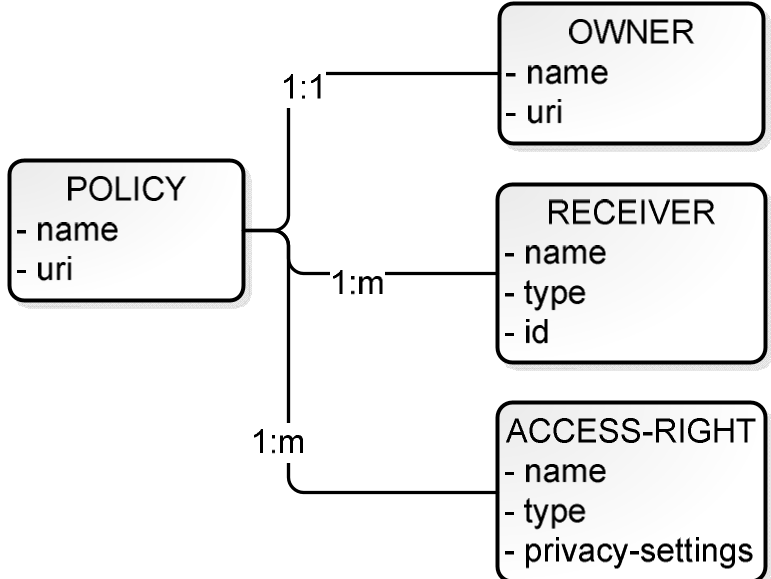
Figure 1: The structural components of a UPP POLICY element, showing how receivers and access rights are bound to the data owner.
Why UPP is different from P3P
The authors draw inspiration from P3P (Platform for Privacy Preferences Project) but note a critical evolution: P3P was a "take it or leave it" declaration by websites. UPP is issued by the data owners. In UPP, anyone—be it a friend or a 3rd-party app—who wants to access the data is technically and legally "obliged" to abide by the attached policy.
Survey Insights & Evidence
The paper’s survey (n=144) provides empirical evidence for the necessity of UPP:
- The "Stranger" Danger: 25% of users have strangers in their friends list.
- Secondary Disclosure: 26% admit to sharing others' photos without consent.
- Tracking Anxiety: 70% fear SNS providers selling their data.
These findings justify the UPP's Tracking Levels (Strong, Weak, No Tracking), which can prevent a user's name from appearing in a friend’s "Friend List" or being tagged in photos by others.
Critical Analysis: The Road Ahead
While UPP provides a robust logical framework, the authors acknowledge a significant hurdle: Usability. Manually configuring XML policies is beyond the average user. The industry value of this work lies in its blueprint for automated privacy assistants that could generate these policies based on simple user preferences.
Future Outlook: The integration of UPP with cryptographic enforcement (e.g., Zero-Knowledge Proofs or Digital Signatures) could theoretically allow users to sue for breach of contract if their UPP is violated by a service provider.
Conclusion
UPP is not just a technical format; it is a manifesto for User-Centric Privacy. By standardizing how privacy metadata is attached to shared content, it provides a path toward a social web where sharing a photo doesn't mean surrendering its future.