
UBLF: Scaling Influence Maximization via Tight Algebraic Upper Bounds
On the Upper Bounds of Spread for Greedy Algorithms in Social Network Influence Maximization
This paper introduces the Upper Bound based Lazy Forward (UBLF) algorithm to solve the Influence Maximization (IM) problem in social networks. By deriving tight and convergent theoretical upper bounds for influence spread under Independent Cascade (IC) and Linear Threshold (LT) models, the method significantly prunes the search space of greedy algorithms.
TL;DR
Influence Maximization (IM) is a cornerstone of viral marketing, but its gold-standard solution—the Greedy algorithm—is notoriously slow due to its reliance on thousands of Monte-Carlo simulations. This paper presents UBLF (Upper Bound based Lazy Forward), an algorithm that uses a newly derived algebraic upper bound to prune over 95% of these simulations. It achieves up to a 10x speedup over the state-of-the-art CELF without sacrificing a single point of influence accuracy.
The Bottleneck: The "Cold Start" of Greedy Algorithms
The IM problem asks: Which nodes should we activate to maximize the expected spread? While a simple greedy approach provides a approximation guarantee, it suffers from two major inefficiencies:
- Estimation Cost: Every marginal gain requires ~10,000 Monte-Carlo (MC) trials.
- The Initialization Trap: Even "Lazy Forward" variants like CELF must calculate the initial spread for every node in the network to build a priority queue. In a network of millions, this "initial step" is where speed goes to die.
The authors' core insight is simple yet profound: If we can mathematically prove a node's maximum possible influence (its upper bound) is lower than a known candidate's actual spread, we don't need to simulate that node at all.
Methodology: From Markov Recurrence to Matrix Inversion
The paper derives upper bounds for both the Independent Cascade (IC) and Linear Threshold (LT) models.
1. The IC Model Bound
The spread is decomposed into the sum of probabilities that any node is activated at any time step . By analyzing the recurrence (where is the propagation probability matrix), the authors prove: This formula represents the "Limit of Convergence." It essentially views influence as a "Voter Model" where opinions can oscillate, providing a slightly looser but much easier-to-calculate ceiling for the IC model.
2. The UBLF Algorithm
UBLF integrates this bound into the CELF framework. It calculates the algebraic upper bounds first—which only involves vector-matrix power iterations (much faster than MC)—and uses these to rank nodes.

If the top node's simulated spread exceeds the upper bound of the second node, the second node (and all others below it) can be safely ignored for that iteration.
Experiments: Massive Pruning in Action
The authors tested UBLF against CELF, MIA, and StaticGreedy on datasets like Twitter (33k nodes) and a Small-world synthetic graph (200k nodes).
Key Result: Call Reduction
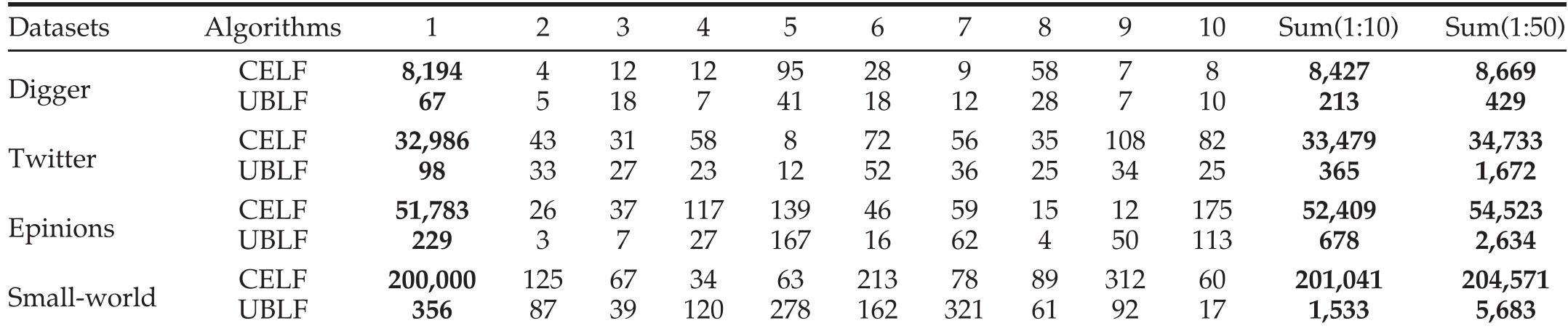
The most striking evidence is the reduction in Monte-Carlo calls. In the Twitter dataset, CELF required 32,986 calls in the first iteration. UBLF required only 98.
Efficiency vs. Spread
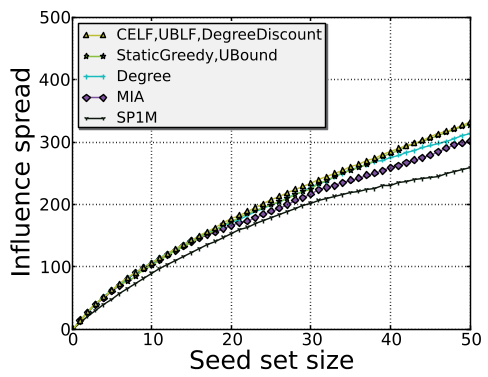
As shown below, the influence spread (the quality of the seeds) remains identical to CELF, because UBLF is a lossless pruning technique. However, the runtime (bottom charts) is consistently lower across all seed sizes.
Critical Insight & Analysis
The "tightness" of this bound depends on the propagation probabilities being relatively small (e.g., ). Fortunately, in real-world social networks, the probability of one person influencing another is typically very low (often set to or in literature).
The beauty of UBLF is that it bridges the gap between Heuristics (fast but no guarantees) and Greedy Algorithms (guaranteed but slow). It uses a "Heuristic-like" calculation (Matrix inversion/Power iteration) to provide a "Greedy-strength" result.
Future Outlook
While UBLF masters the upper bound, the authors note that deriving lower bounds remains an open challenge. Additionally, as we move toward "Continuous-Time" diffusion models, adapting these discrete matrix algebraic bounds will be a high-value research direction for real-time social analytics.
Takeaway: If you are still running brute-force CELF on large graphs, you are wasting 95% of your compute. Algebraic pruning is the modern standard for Influence Maximization.