
Beyond the Digital Kill Switch: Balancing Autonomy and Security in Mild Cognitive Impairment
Upside and Downside Risk in Online Security for Older Adults with Mild Cognitive Impairment
This paper explores the cybersecurity and privacy challenges faced by older adults with Mild Cognitive Impairment (MCI) and their spousal caregivers. Through dyadic interviews, the researchers identify a spectrum of safeguarding strategies and propose a framework of "Upside and Downside Risk" to balance online safety with personal autonomy.
TL;DR
For older adults with Mild Cognitive Impairment (MCI), losing Internet access isn't just a technical inconvenience—it’s a loss of self. This paper from CHI '19 argues that current security "fixes" often do more harm than good by prioritizing safety over autonomy. By introducing the lens of Upside vs. Downside Risk, the authors propose a new era of "collaborative security" where tools are designed for fluctuating cognitive abilities rather than binary competence.
The "Declinist" Trap in Online Security
Traditional cybersecurity treats cognitive decline as a "problem to be fixed" or a "vulnerability to be patched." In the medical model of aging, the solution to a phishing risk is often to take the computer away. However, this creates a Downside Risk: while the user is safe from scams, they are now "wheelchair-bound" digitally—cut off from grandchildren on Facebook, banking independence, and mental stimulation.
The authors argue for Upside Risk: accepting a slight increase in potential exposure to ensure the user retains the "upside" of social engagement and dignity.
Methodology: The Dyadic Lens
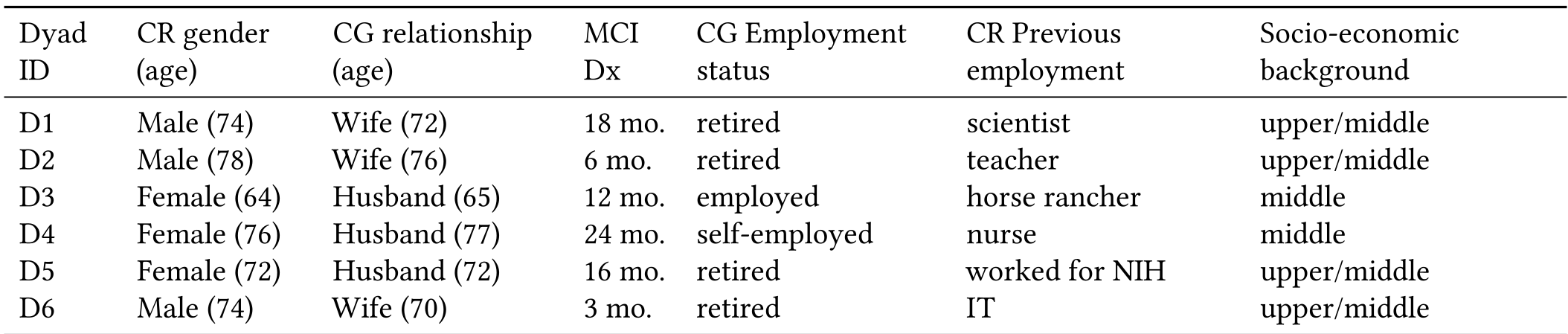
The researchers interviewed couples (dyads) where one partner has MCI. This approach is critical because, in MCI, the "user" is not an individual, but a partnership. They found that these users are often highly literate—meeting on Match.com or using Zappos—but struggle with the "nuanced scam," such as fake "cure" emails or accidental "dislikes" on sensitive social media posts.
The Spectrum of Safeguarding
The research identified five specific strategies used by families to manage risk, each sitting on the spectrum between autonomy and control:
- The Hover (Downside Risk): Constant physical oversight. Total loss of privacy.
- Selective Access: Restricting the UI to only 2-3 "safe" icons (e.g., Solitaire and Skype).
- The Interactor: The caregiver performs all tasks on behalf of the patient.
- The Checker (Upside Risk): The patient performs the task (e.g., booking travel), and the caregiver verifies before the final "buy" button.
- Automation: Using saved passwords and auto-bill pay to remove the "cognitive load" of security.
Methodology and Visualizing Collaboration
The paper suggests that software should move away from the "One User, One Password" model. Instead, it proposes UI settings that facilitate Shared Decision Making.
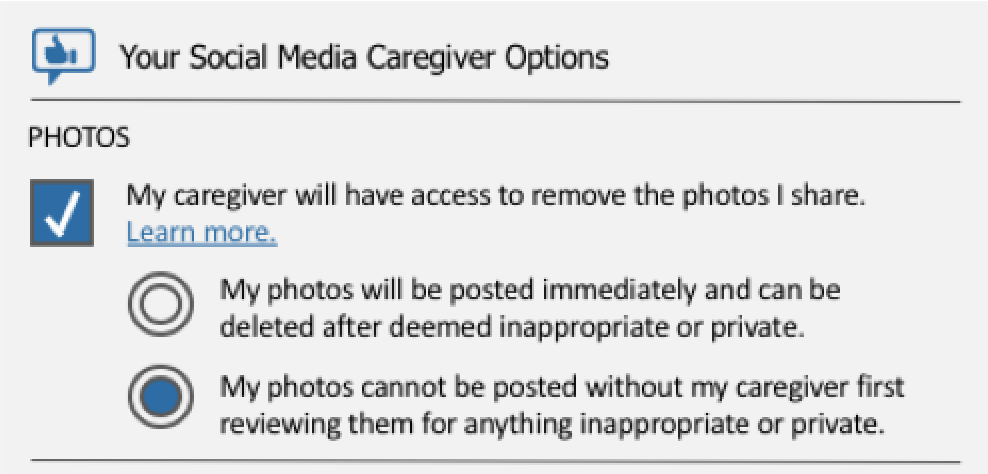 Figure 1: Proposed UI for collaborative social media management, allowing "Upside Risk" (the user posts, but the caregiver can review) versus "Downside Risk" (the caregiver must approve every post).
Similarly, for banking, the authors suggest tiered controls:
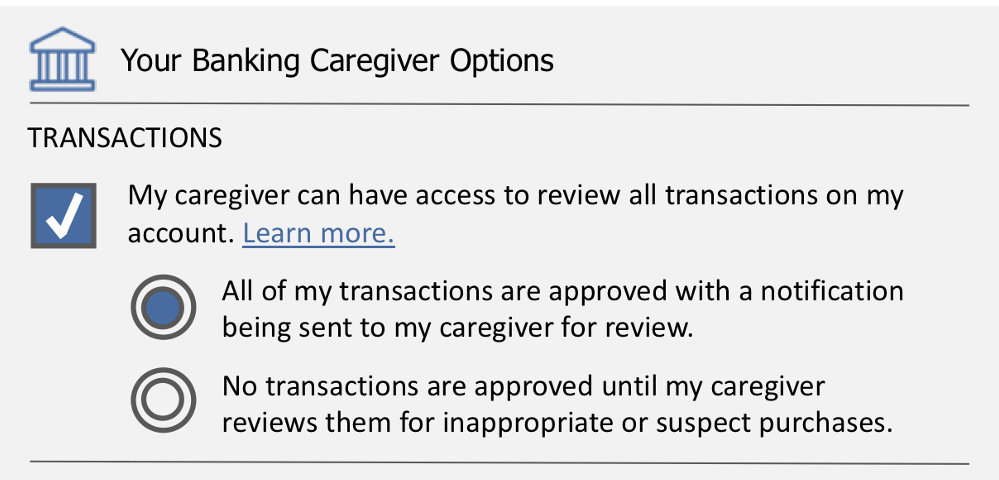 Figure 2: Financial interface options where "Upside Risk" allows the user to maintain account control with transparent oversight.
Critical Insight: The "Digital Will" Gap
One of the most striking findings was the lack of proactive planning. While all participants had physical wills and powers of attorney, none had a plan for their digital assets or passwords.
The technical community often treats "Privacy" and "Security" as barriers. However, for an MCI patient, Privacy by Design means building the "hooks" for transition before they are needed, allowing a person to gracefully hand over segments of their digital life without a sudden, traumatic "kill switch" being flipped by a worried relative.
Conclusion & Future Outlook
This work challenges the "Medical Model" of HCI. As our population ages, we need systems that recognize that identity is social and collaborative.
- Takeaway: Stop building "Single-User" systems for populations that depend on caregivers.
- Limitation: The study was small (6 dyads) and focused on middle-class US couples; cultural variations in "autonomy" versus "filial piety" remain unexplored.
- Future: We need technical standards for "Caregiver Accounts" that don't violate Terms of Service (ToS) or trigger "unauthorized access" alarms under the CFAA.