
Paying it Forward: How Upstream Reciprocity Boosts Academic Success
An Upstream-Reciprocity-Based Strategy for Academic Social Networks Using Public Goods Game
This paper introduces an Upstream-Reciprocity-Based (UR) strategy for Academic Social Networks (ASNs) modeled via the Public Goods Game (PGG). It demonstrates that "paying it forward" behavior significantly enhances scholarly productivity and creates evolutionary stable collaboration patterns.
TL;DR
In the high-stakes world of academic publishing, is it better to be a selfish "free-rider" or a cooperative altruist? This paper proves that Upstream Reciprocity (UR)—the act of helping someone because you were recently helped—is not just a moral choice, but a winning professional strategy. By modeling coauthorship as a Public Goods Game (PGG), the authors show that "paying it forward" leads to more citations, more publications, and a more stable research career.
The Logic of Academic Altruism
Academic Social Networks (ASNs) are typically studied through the lens of what is happening (recommendations, predictions). However, they rarely address the why of human behavior. Scholars face a dilemma: every coauthored paper is a common pool of resources. While everyone wants the highest quality paper, there is a rational temptation to contribute the least effort while reaping the full benefits of the publication.
The authors argue that Upstream Reciprocity solves this. Unlike "Tit-for-Tat" (direct exchange), UR creates a chain of gratitude. If Author A helps Author B, Author B is then more likely to help Author C.
Methodology: The Public Goods Game (PGG)
The researchers chose the PGG because over 80% of modern papers involve three or more authors. They transformed the PGG into an iterative game played over a scholar's career.
The Strategy Matrix
To handle the complexity of 3-player interactions, they developed a strategy matrix where scholars decide to cooperate () or defect () based on the actions of their two previous collaborators.
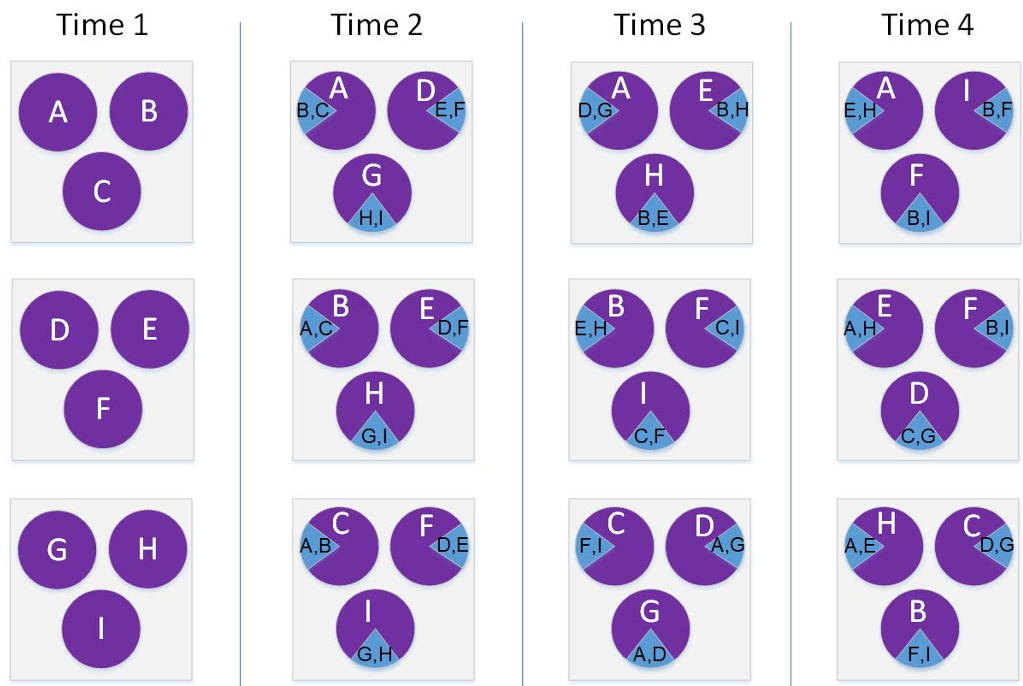 Fig 1: The flow of interactions in the iterative PGG model.
The study compares two classic game theory adaptations:
- TFT (Tit-for-Tat): Cooperate if others do; defect if they don't.
- WSLS (Win-Stay-Lose-Shift): Stay with a strategy if it yields a "win," otherwise switch.
Evidence from Real-World Data
Using the Microsoft Academic Graph (MAG) dataset (2015-2019), the authors identified real-life "Upstream Reciprocators" in coauthorship networks. The results were striking:
- Higher Yield: UR scholars consistently outperformed non-UR peers in total publication count.
- Greater Impact: UR scholars received significantly more citations.
- Behavioral Cascades: When one scholar acts cooperatively, it triggers a chain reaction, increasing the likelihood that their collaborators will also adopt a UR strategy.
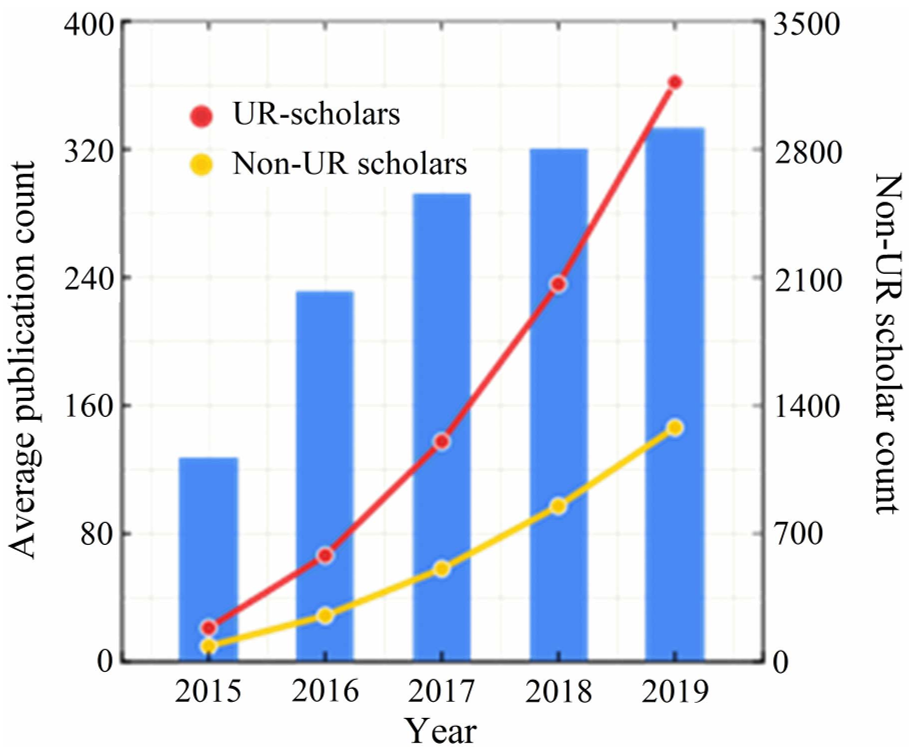 Fig 2: Comparative analysis of publication and citation counts between UR and non-UR scholars.
Evolutionary Stability: Can Altruism Survive?
Through complex mathematical simulations (Simplex graphs), the paper explores if UR can survive an invasion by "Defectors" (free-riders).
The findings suggest that a Lenient Approach (being forgiving of occasional defection) is the most robust. If a critical mass of approximately 75% of the population starts as cooperative, the entire network eventually converges toward a state of absolute cooperation.
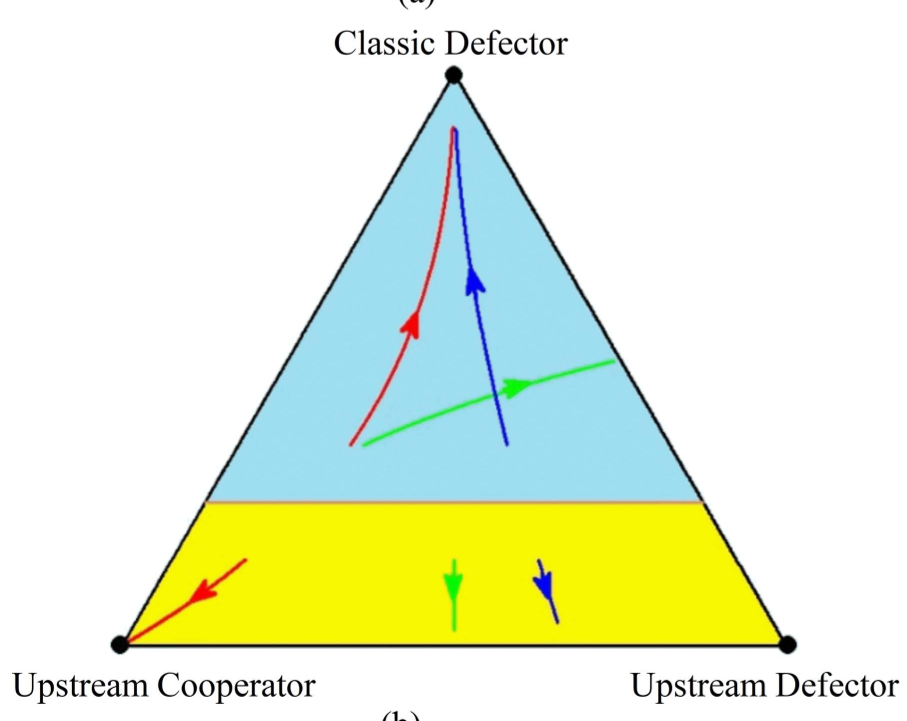 Fig 3: Simplex graphs showing the evolutionary trajectories of TFT and WSLS strategies.
Critical Insights & Conclusion
This work demonstrates that the structure of our scientific collaborations is not just defined by who we know, but how we treat them.
Key Takeaways:
- Reputation isn't everything: Unlike Indirect Reciprocity which relies on "gossip" or reputation, Upstream Reciprocity works simply through the "state of mind" of the individual who was helped.
- Strategic Forgiveness: A "lenient" strategy (TFT with forgiveness) is more likely to lead to long-term stability and high-yield output than a strict "eye-for-an-eye" approach.
- Limitation: The model currently focuses on 3-player games. As "Big Science" moves toward papers with hundreds of authors, the complexity of these matrices will require more advanced computational modeling.
By "paying it forward," scholars aren't just being nice—they are building a more resilient and productive academic ecosystem.