
Google Fiber in Kansas City: Socio-Spatial Equity or Corporate Welfare?
Urban governance and big corporations in the digital economy: An investigation of socio-spatial implications of Google Fiber in Kansas City
This paper investigates the rollout of Google Fiber in Kansas City, analyzing its socio-spatial implications through urban governance, digital divide impacts, and novel data mining. Using Exploratory Spatial Data Analysis (ESDA), it reveals that while the project achieved unexpected equity in service distribution to younger, lower-income, and minority neighborhoods, it relied heavily on significant regulatory concessions and "corporate welfare."
TL;DR
This study dissects the inaugural rollout of Google Fiber in Kansas City, revealing a paradox: while the project successfully brought ultra-high-speed internet to disenfranchised, lower-income, and minority neighborhoods, it was built upon a foundation of massive taxpayer-funded concessions and exclusive regulatory favors that potentially distorted the local digital market.
Contextualizing the Digital Mecca
When Google announced its "Think Big with a Gig" challenge in 2010, it triggered a frenzy among 1,100 US cities. Kansas City won the prize, becoming a "Broadband Mecca." However, the academic reality is more complex. The paper positions this event within the shifting discourse of urban governance, where global digital giants (Google, IBM, Cisco) are increasingly replacing or "assisting" underfunded local governments in providing essential public infrastructure.
Motivation: The Redlining Risk
Historically, private ISPs engage in "cream-skimming"—installing infrastructure only where the ROI is highest (affluent, white neighborhoods), leading to "electronic redlining." The authors sought to determine if Google Fiber followed this discriminatory pattern or if its unique "Fiberhood" selection process—driven by pre-registration targets—actually bridged the gap.
Methodology: Gaming the "Check Your Address" Tool
Because telecommunications firms are notoriously secretive about their network footprints, the researchers developed a clever data-mining workaround.
- Grid Sampling: They divided Johnson and Jackson Counties into 10-acre grid cells.
- Automation: Using AutoHotkey, they queried Google's own address verification tool for thousands of random points.
- Spatial Analysis: They mapped the "Haves" vs. "Have-Nots" and performed t-tests on demographic data (Esri 2015 estimates).
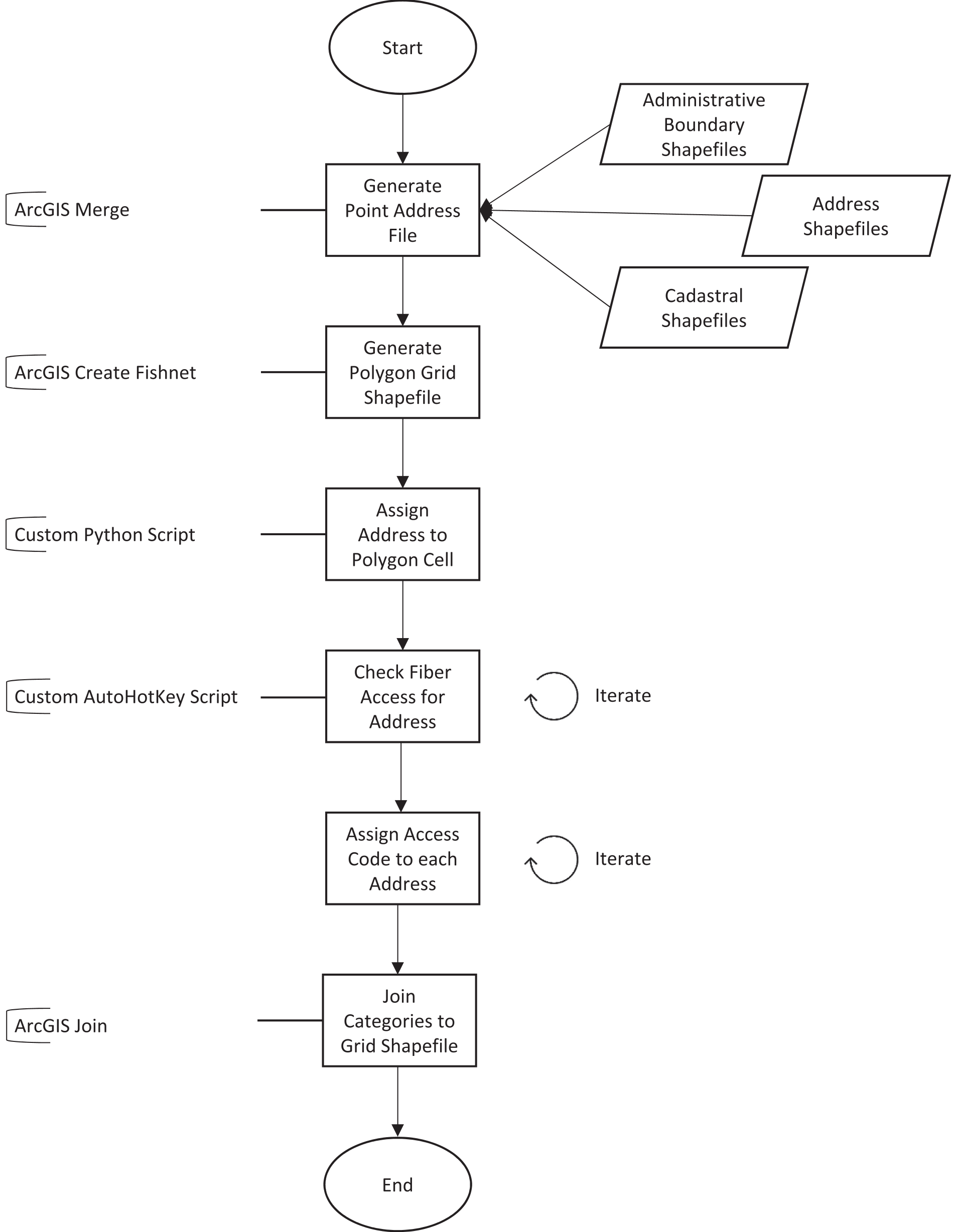 The automated data harvesting algorithm used to bypass corporate data secrecy.
Findings: An Inverted Reality
The results were statistically significant and surprising. Unlike traditional market-forced broadband plans, Google Fiber’s footprint in Kansas City favored:
- Higher Minority Populations: Serving areas with 12.2% more minorities than non-served areas.
- Lower Incomes: Served areas had a median household income ~$5,300 lower than unserved areas.
- Younger Demographics: The "Haves" skewed younger by nearly 3 years on average.
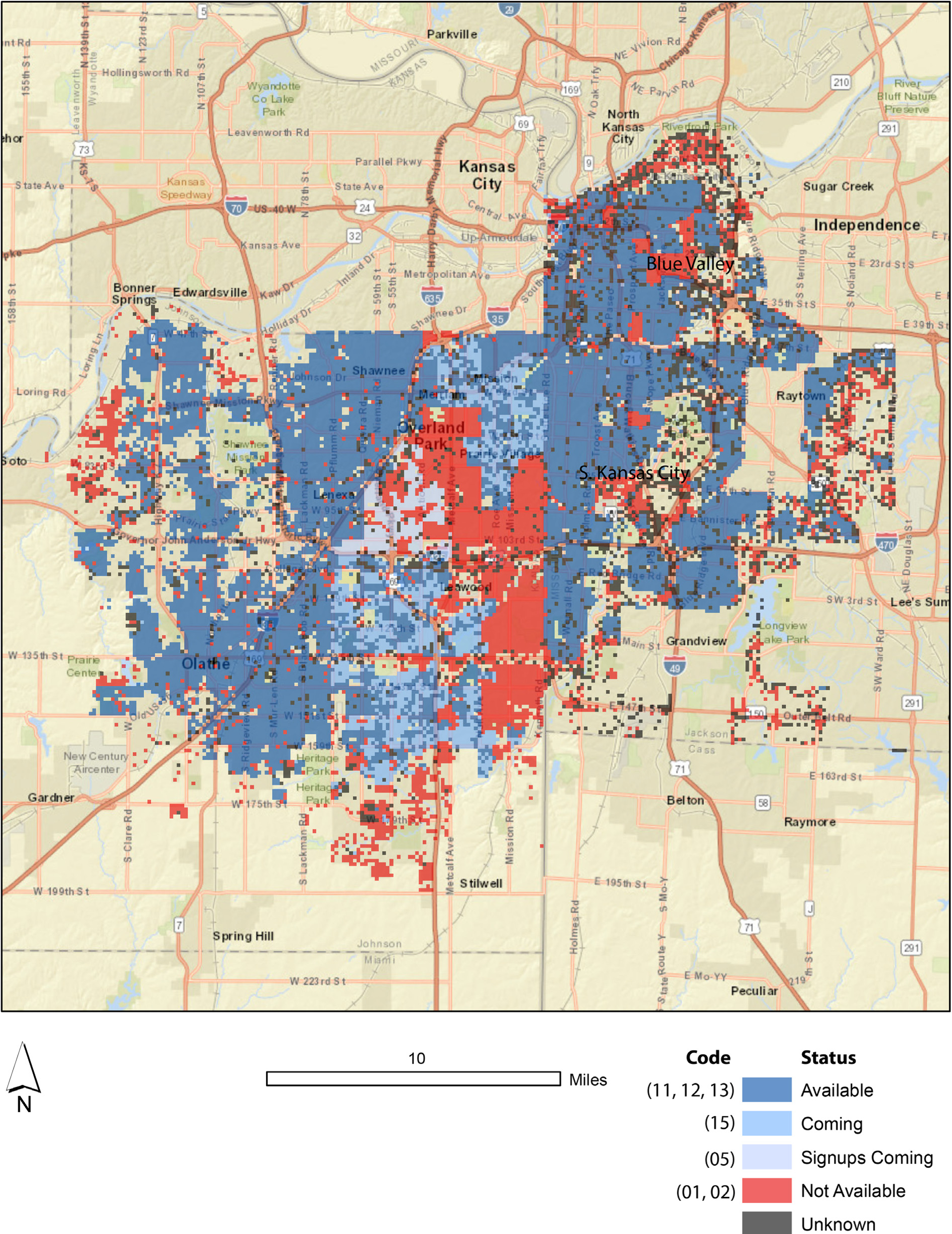 Geovisualization of Fiber availability in Johnson and Jackson counties, revealing clear delineations along municipal and socio-economic lines.
The Hidden Cost: The "Corporate Welfare" Debate
While the socio-spatial distribution suggests a win for equity, the Urban Governance analysis reveals a staggering level of municipal concession.
- Zero Rent: Kansas City provided free access to city-owned conduits, poles, and buildings.
- Subsidized Labor: Taxpayers funded extra city staff specifically to expedite Google's permits.
- Competitive Bias: The city’s "exception management" for Google created an unlevel playing field for existing ISPs (AT&T, Time Warner), raising questions about long-term market health and the sustainability of "exclusive" infrastructure deals.
Critical Insight & Conclusion
The "success" of Google Fiber in Kansas City was not a purely technological or market triumph; it was a grassroots marketing victory. Initial rollouts showed a stark divide (the "Troost Avenue" line), which Google only bridged after deploying 60 employees to minority neighborhoods to solve non-technical barriers like the lack of credit cards for the $10 registration fee.
Takeaway for Future Cities: Private partnerships can solve the digital divide, but only if local governments demand equitable distribution clauses and open-access rules up front. Without these, cities risk spending taxpayer money to build a proprietary network that creates a new corporate monopoly under the guise of "innovation."
Limitations
The study was limited by data access (some counties refused records requests) and the inherent "snapshot" nature of spatial data. As Google Fiber moves toward wireless delivery under Alphabet, the fixed-fiber socio-spatial dynamics described here may shift.