
Designing Digital Twins of Urban Social Fabric: A Data-Driven Approach
A Model for Urban Social Networks.
The paper introduces a data-driven framework for generating geo-referenced, age-stratified synthetic urban social networks using publicly available demographic data. By distinguishing between intra-household (kinship) and friendship ties, the model achieves a realistic social fabric and demonstrates its utility by simulating SIR epidemic spreads in the city of Florence, Italy.
TL;DR
This research presents a robust framework for generating synthetic urban social networks that look and act like real cities. By leveraging open-source demographic data and social mixing patterns, the authors create a model that balances kinship cliques with distance-decaying friendships. Using Florence as a testbed, they demonstrate how this network can predict the "who" and "where" of an epidemic spread.
Problem & Motivation
Why is it so hard to model a city's social network? Most researchers face a "data gap." You either use simple random graphs that lack the spatial "clumpiness" of a real city, or you need highly invasive data like GPS traces or private phone logs.
The authors argue that a middle ground is needed. They recognize that social ties aren't just random; they are constrained by where you live (geography), how old you are (demographics), and how outgoing you are (fitness). The challenge is to reconstruct these "strong ties" using only aggregated, publicly available data.
Methodology: The Three Pillars of Friendship
The core of the paper is a probabilistic edge-drawing mechanism. While households are built via a heuristic (grouping parents and children in tiles), friendships are formed based on a specific probability formula:
- Age-Based Mixing: Uses matrices (like Polymod) to ensure that 20-year-olds are more likely to befriend other 20-year-olds than 80-year-olds.
- Spatial Penalty (): Represents the "friction of distance." A higher means you are much less likely to have friends in the next town over.
- Social Fitness (): A Lognormal variable assigned to each person. This accounts for the fact that some people are naturally "social butterflies" while others are "loners," leading to a heavy-tailed degree distribution.

Experimental Results & Insights
The authors applied their model to the city of Florence (approx. 363,000 residents). Their topological analysis yielded several key findings:
- Small World, Big Impacts: Even with a low average of 10 friends per person, the network is highly connected, with over 99% of the population belonging to a single "giant component."
- The Power of : When (high spatial penalty), the network becomes highly "assortative"—hubs (well-connected people) tend to congregate in the city center where population density is highest.
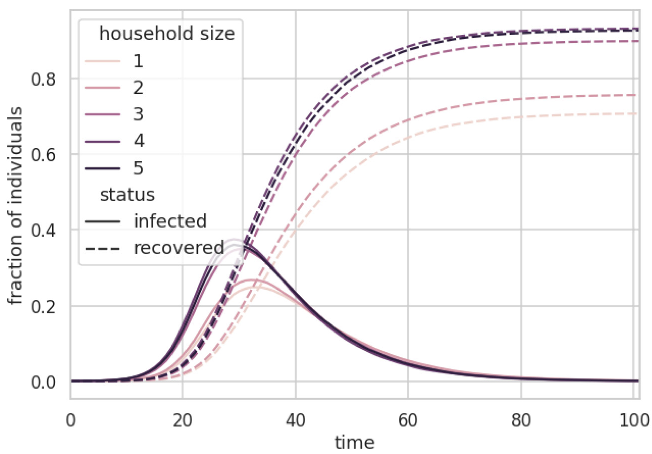
- Epidemic Drivers: In a SIR (Susceptible-Infected-Recovered) simulation, the model showed that younger age groups drive the epidemic. Even if an infection starts in a peripheral, elderly neighborhood, it quickly migrates to the younger, more "connected" center, which then accelerates the spread across the entire city.
Critical Analysis & Conclusion
Takeaway
The value of this work lies in its operability. By releasing the tool as open-source and basing it on UNSD/ISTAT standards, any researcher can generate a social graph for their own city to test urban policies or health interventions.
Limitations & Future Work
The model is currently static. In the real world, social networks evolve—people move, make new friends, and age. The authors acknowledge that the next step is layering dynamic interactions (e.g., temporary workplace contacts) on top of this static "strong tie" backbone. Additionally, the intrinsic link between population density and "social advantage" (central dwellers having more friends) is a fascinating sociological byproduct that requires more empirical validation.
Final Thought
As we move toward "Smart Cities," models like this serve as the essential connective tissue between simple demographic tables and complex agent-based simulations.