
SMARTY: Redefining Sustainable Mobility through Urban and Social Sensing
Urban and social sensing for sustainable mobility in smart cities
The paper introduces SMARTY (SMARt Transport for sustainable citY), an Intelligent Transportation System (ITS) that integrates urban sensing and "social sensing." It leverages low-cost environmental sensors and real-time social media data mining to optimize urban mobility and promote sustainable transport in smart cities.
TL;DR
The SMARTY project (SMARt Transport for sustainable citY) presents an innovative Intelligent Transportation System (ITS) platform. By combining low-cost physical sensor networks with "Social Sensing"—the mining of real-time social media updates—the system provides a holistic view of urban traffic, pollution, and events. Early results show a 93.73% accuracy in detecting traffic incidents via Twitter data.
Problem & Motivation: Beyond Fixed Sensors
Modern cities face a paradox: as urban populations grow, traditional infrastructure becomes increasingly inadequate and polluting. Existing environmental monitoring is often "punctual"—relying on a handful of expensive, high-precision stations that leave massive blind spots in the urban fabric.
The authors argue that a smart city shouldn't just rely on static hardware. It should tap into the human element. When an accident occurs, people tweet about it long before it reflects in official traffic sensors. The challenge lies in converting this "noisy" social data and "imprecise" low-cost sensor data into reliable, actionable intelligence for route planning and public service management.
Methodlogy: The Dual-Sensing Framework
The SMARTY architecture is built on two primary pillars of data acquisition:
1. Urban Sensing (Physical Infrastructure)
Instead of few expensive stations, SMARTY deploys a massive number of low-cost, battery-powered sensors.
- Opportunistic Gathering: To solve the connectivity problem, sensors use short-range ZigBee (IEEE 802.15.4) to transmit data to "mobile collectors" mounted on city buses.
- Participatory Action: Citizens can connect their own personal weather or gas sensors to the SMARTY grid via home Wi-Fi, expanding the map without increasing public infrastructure costs.
2. Social Sensing (Human Intelligence)
This module treats every citizen with a smartphone as a "sensor."
- Text Mining Pipeline: The system fetches Status Update Messages (SUMs), tokenizes them, performs stemming (root word reduction), and utilizes Part of Speech (POS) tagging to understand context.
- Event Inference: By clustering classified messages geographically, the system can infer accidents or demonstrations in real-time.
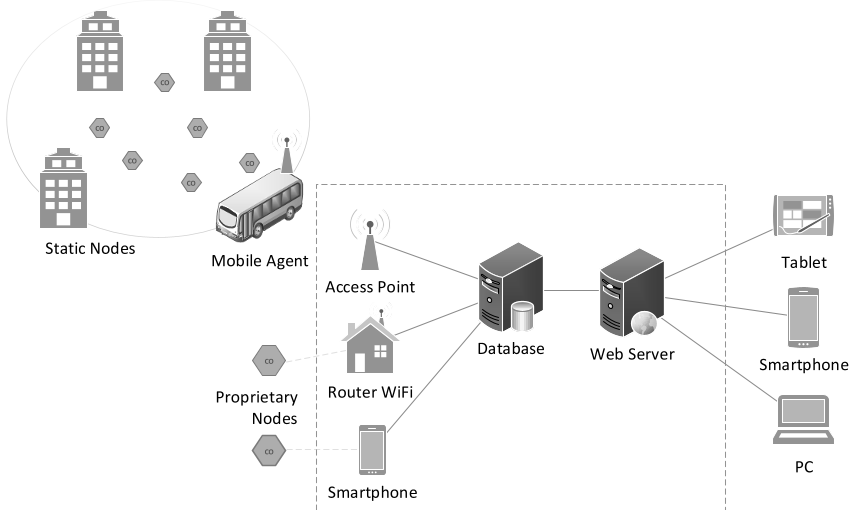 Fig 1: The SMARTY Platform Overview showing the integration of Urban and Social sensors.
Methodology Detailed: From Tweets to Traffic Alerts
The text mining process is critical for the "Social Sensing" module. The raw text must be transformed into a structured format that a machine can classify.
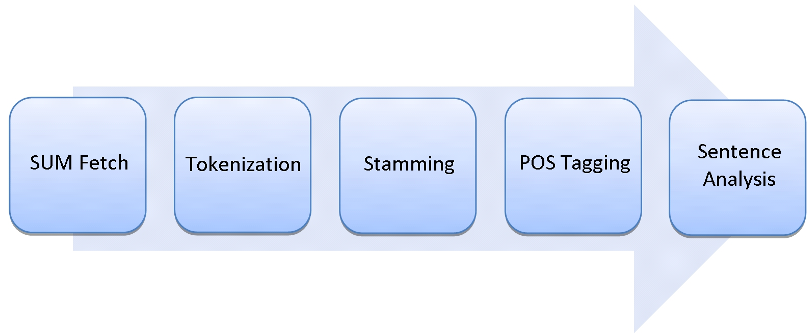 Fig 2: The multi-stage text mining process applied to social media updates.
The pipeline converts a stream of characters into "phrases" which are then processed by Data Mining algorithms. The authors specifically highlight the use of Multi-objective Evolutionary Fuzzy Systems, which offer a crucial advantage over "black box" AI: Interpretability. These systems provide linguistic rules that explain why a particular set of data led to a specific traffic alert.
Experiments & Results
In their preliminary evaluation, the team focused on the Social Sensing module's ability to filter the noise:
- Dataset: 1,000 tweets (balanced between traffic-related and unrelated).
- Classifier: C4.5 Decision Tree algorithm with ten-fold cross-validation.
- Performance: Achieved 93.73% accuracy.
This high success rate proves that even with simple classifiers, the linguistic patterns of traffic incidents are distinct enough to be used as a reliable secondary data source for ITS.
Critical Analysis & Conclusion
Takeaway: The real breakthrough of SMARTY isn't just the sensors; it is the integration of heterogeneous data. By combining hard data (CO2 levels) with soft data (social sentiment), the platform moves toward a truly "Cognitive City."
Limitations:
- Data Scarcity: Social sensing depends heavily on user density; rural or less-digitized areas might yield insufficient data.
- Battery Life: While low-cost sensors are flexible, the paper notes they are battery-powered, which introduces long-term maintenance overhead.
Future Outlook: The integration of Big Data and Cloud Computing (using frameworks like Apache Mahout, as suggested by the authors) will be essential as the project scales from a pilot in the Tuscany region to a full-scale metropolitan deployment. This research sets a precedent for using Evolutionary Fuzzy Systems to provide transparent, human-readable logic in urban management—a key requirement for public sector accountability.