
Beyond the Checklist: Incentivizing Cybersecurity through Information Economics
How might the US federal government motivate contractor vigilance in fi rmware, software, and hardware design and network security?
This paper proposes an incentive-based framework for Department of Defense (DoD) cybersystem acquisition, moving away from static compliance checklists toward a proactive cybersecurity model. By applying information economics principles—specifically addressing moral hazard and adverse selection—the authors design a structure of financial rewards and penalties to motivate contractors to produce more secure hardware and software.
TL;DR
The US Department of Defense (DoD) faces a critical challenge: how to ensure contractors prioritize security in an era of asymmetric warfare. This paper argues that static compliance is a failing strategy. By leveraging Information Economics, specifically the theories of Moral Hazard and Adverse Selection, the authors propose a framework that uses financial incentives and rigorous vendor screening to force a "Separating Equilibrium"—effectively pricing low-security "Lemon" firms out of the most sensitive national security projects.
The "Market for Lemons" in Defense Acquisition
The core motivation for this research stems from a classic economic problem: Asymmetric Information. When the government (the Principal) hires a contractor (the Agent), it cannot perfectly observe the contractor's internal security effort or their true technical prowess.
- Moral Hazard: Once a contract is signed, a firm might cut corners on secure coding or network defense because those actions are "hidden" and expensive.
- Adverse Selection: If the government can't distinguish between a high-security firm and a low-security firm, it tends to pay an "average" price, which eventually drives high-quality firms out of the market, leaving only the "Lemons."
Methodology: The Incentive Framework
The authors build their solution on the Grossman-Hart formulation. They propose shifting from a "fixed-price" or "cost-plus" model to an Incentive-Fee structure where the contractor's utility () is directly tied to whether the system is successfully protected () or compromised ().
Part 1: Combating Moral Hazard
The paper introduces a mathematical constraint where the government must reward the agent enough to prefer the "optimal effort" level over a "low effort" compliance level.
 The objective is to minimize the expected cost of hacks while maximizing contractor effort.
Part 2: Screening and Signaling
To solve Adverse Selection, the government needs a signal. The authors suggest using historical security performance and aggregated Common Vulnerability Scoring System (CVSS) metrics. By requiring higher quality scores () for more sensitive systems and offering higher fees () for those scores, they create a scenario where only high-ability firms find it profitable to compete for high-sensitivity systems.
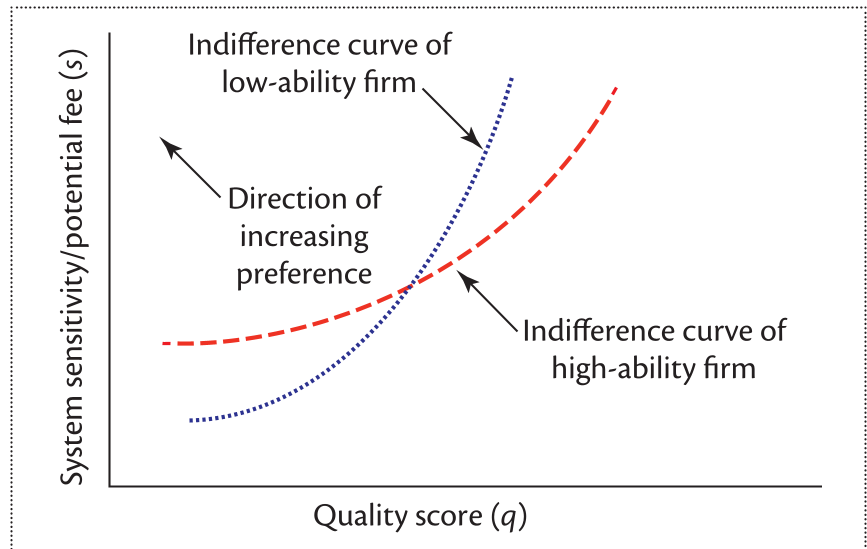 Figure 1: High-ability firms (red) have flatter indifference curves, meaning they can achieve higher security quality at a lower marginal cost than low-ability firms (blue).
Achieving a Separating Equilibrium
The ultimate goal is the Separating Equilibrium (Figure 2). By setting the incentive fee function correctly, the government ensures that:
- High-ability firms choose a high quality signal () to earn a high fee.
- Low-ability firms find it too expensive to "fake" high quality and settle for lower-sensitivity projects ().
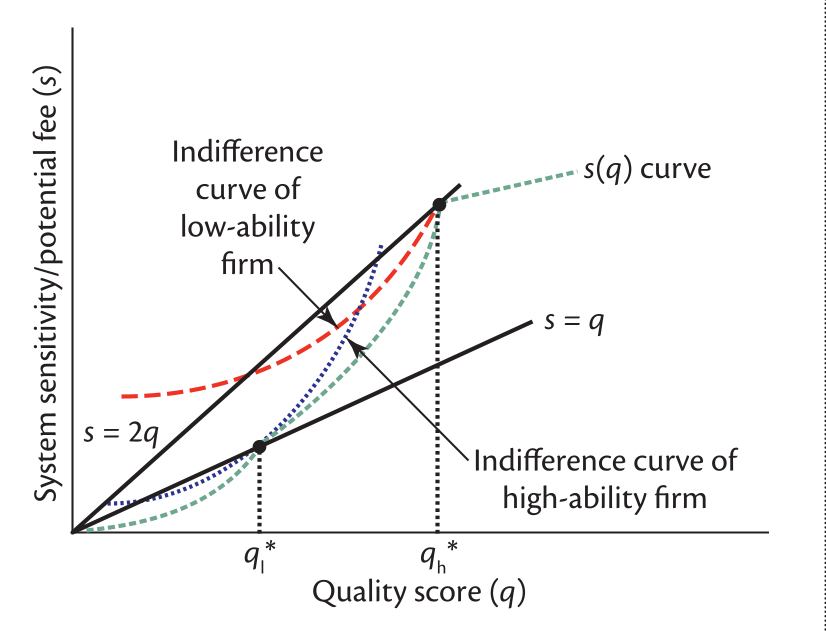 Figure 2: Properly set fees () as a function of quality () allow the government to distinguish between types of contractors.
If the fee is set too low, we risk a Pooling Equilibrium (Figure 3), where both types of firms provide the same mediocre quality, and the government still can't tell them apart.
Critical Insights & Future Outlook
This work represents a vital pivot in Cyber-Aeronautics and general defense acquisition. Instead of punishing failures after the fact (which is difficult due to detection lags), it focuses on ex-ante incentives.
Limitations:
- Detection Reliance: If a hack isn't detected or reported (despite legal requirements), the incentive fails. The authors suggest using penetration testing results as a "proxy" for protection.
- Adversarial Adaptation: Adversaries are not static; they may change their strategies specifically to help "Lemon" firms appear secure until a critical moment.
Conclusion: The DoD has decades of experience in incentive-fee contracts for cost control; applying this to cybersecurity is the logical next step. By making "security prowess" a competitive advantage that directly impacts the bottom line, the government can transform the industrial base into a more proactive defense force.