
U.S. Public Opinion on AI Governance: The Trust Gap in the Age of Automation
U.S. Public Opinion on the Governance of Artificial Intelligence
This paper presents a large-scale empirical study (N=2000) on U.S. public opinion regarding AI governance, identifying 13 key challenges. It reveals that while 82% of Americans demand careful AI management, trust in the institutions responsible for this governance—particularly government and social media giants—remains low to moderate.
TL;DR
A comprehensive study of 2,000 Americans reveals a striking paradox: while there is overwhelming consensus (82%) that AI needs strict management, the public deeply distrusts the very institutions—government and big tech—tasked with that oversight. Data privacy and cyber-attacks are the top concerns, while university researchers remain the last bastion of public confidence.
Background: Beyond Technical Safety
AI governance is often treated as a technical or legal optimization problem. However, this paper argues that AI has entered the realm of mass politics. Much like the historical debates over Genetically Modified (GM) foods and nanotechnology, the future of AI will not just be decided by its performance metrics, but by whether the public grants it a "social license" to operate.
The Hierarchy of AI Risks
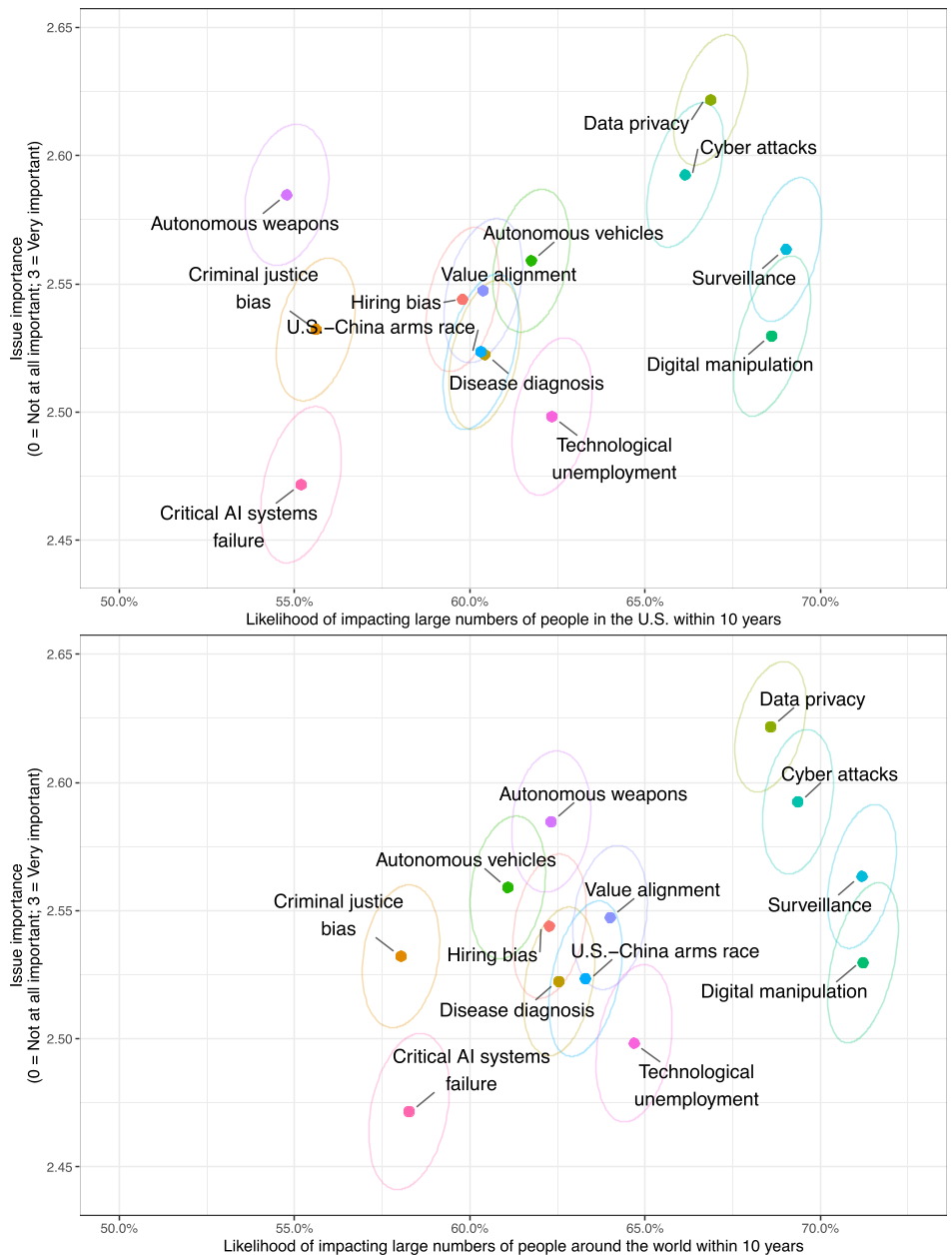
The researchers mapped 13 governance challenges based on two metrics: Perceived Likelihood (will this happen?) and Issue Importance (does it need management?).
- The Top Tier (Urgent): Data privacy, AI-enhanced cyber attacks, surveillance, and digital manipulation. These are seen as both highly likely and critically important.
- The Middle Tier: Autonomous vehicles, technological unemployment, and the U.S.-China AI arms race.
- The Statistical Outliers: Interestingly, "Critical AI systems failures" (existential risks) were rated as less important than day-to-day harms, likely because the public applies "probability weighting"—treating low-probability high-harm events as less urgent than certain, smaller harms.
The Crisis of Institutional Trust
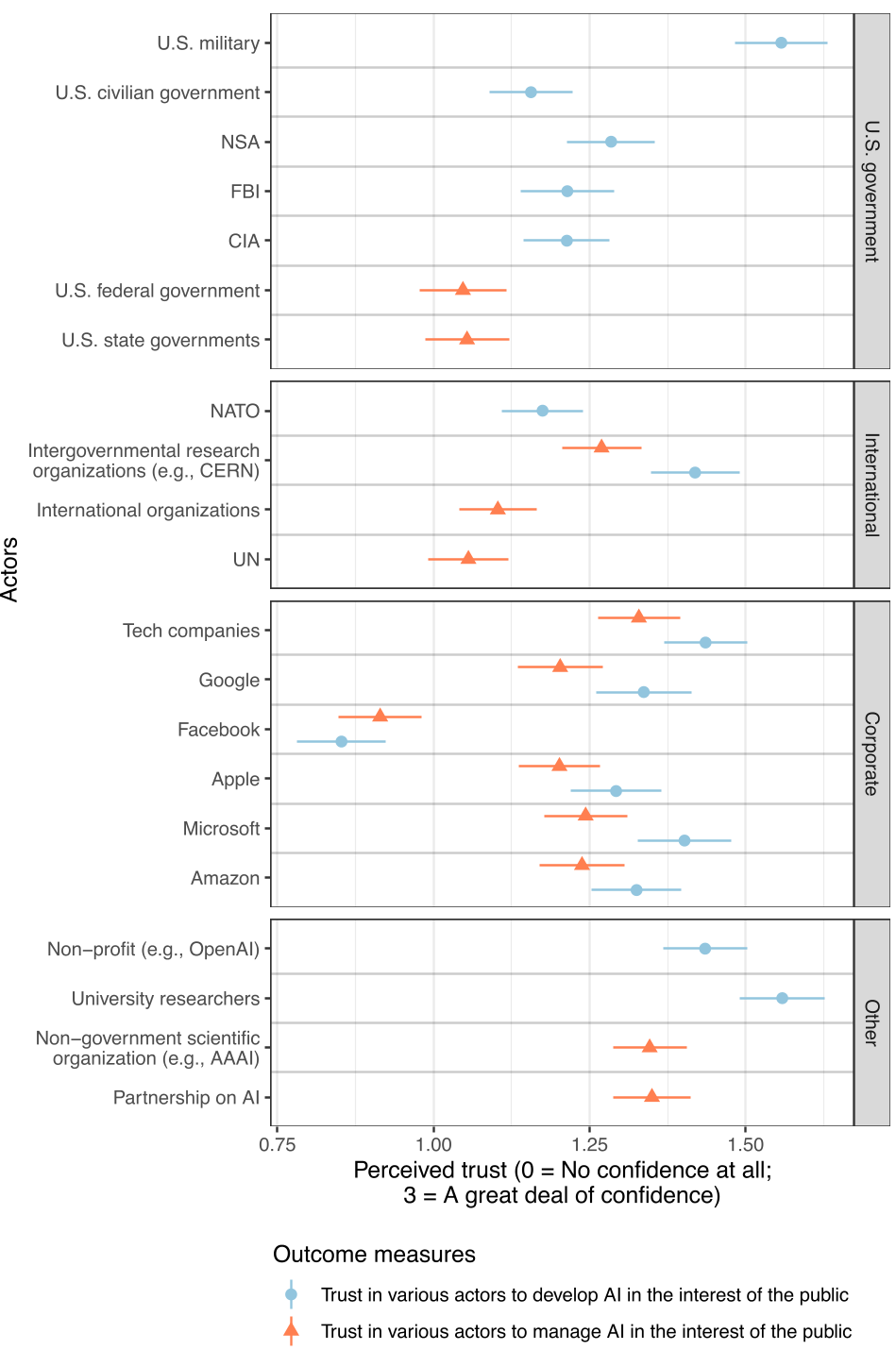
The most provocative finding lies in who the public trusts. In a climate of rising skepticism, tech companies (with the notable exception of Facebook) are actually trusted more than the federal government to manage AI development.
- The Trust Leaders: University researchers and the U.S. Military.
- The Trust Laggards: The U.S. Federal Government and the UN.
- The Pariah: Facebook. Respondents expressed significantly lower trust in Facebook than any other entity, likely a residual effect of the Cambridge Analytica scandal and general data privacy concerns.
Deep Insight: Demographics and the "Expert Bias"
The study reveals a fascinating Inductive Bias among those with technical backgrounds. Individuals with Computer Science (CS) or Engineering degrees consistently rated every AI risk as less important than the general public did. Similarly, younger generations (under 38) were far more optimistic and less concerned about governance than those over 73. This suggests that "familiarity" with the technology may lead to a decrease in perceived risk—or perhaps a blind spot regarding societal externalities.
Methodology and Analysis
The researchers used a Pre-registered Analysis Plan to avoid "p-hacking," a standard of rigor often missing in social science AI studies. By using a randomized question-wording approach, they ensured that respondents' priorities weren't biased by the order in which they viewed the problems.
Technical Summary Table
Below is a breakdown of the confidence levels in different institution types:
| Variable | Coefficient (SE) | p-value |
|---|---|---|
| Corporate actors | -0.02 (0.03) | 0.596 |
| International actors | -0.01 (0.03) | 0.830 |
| U.S. government actors | -0.01 (0.03) | 0.799 |
Note: The null results suggest that, unlike other technologies, general institutional trust doesn't easily predict whether an individual supports AI development, pointing back to the unique and multifaceted nature of AI perceptions.
Critical Insight & Conclusion
The study concludes that the "public interest" is currently a fragmented concept in AI. The lack of political power felt by the public makes them suspicious of top-down regulation.
The Takeaway: If developers and policymakers want to avoid the "GM food trap"—where scientific consensus is ignored due to institutional distrust—they must move beyond abstract ethics principles and engage in transparent, multi-stakeholder governance that specifically addresses the public's fear of digital manipulation and surveillance.