
Beyond Binary Labels: Modeling Sociolinguistic Age Grading via User-Annotated Microtext
User-annotated microtext data for modeling and analyzing users' sociolinguistic characteristics and age grading
The paper introduces a novel, user-annotated Twitter dataset specifically designed for sociolinguistic analysis and age inference. By leveraging self-reported demographic data rather than manual labels, the study analyzes the relationship between user attributes and non-standard linguistic patterns (e.g., abbreviations) using association mining.
TL;DR
This research addresses the "ground truth" crisis in social media analytics by presenting a Twitter dataset where users self-identify their age, education, and occupation. Moving beyond simple binary classification, the study investigates how non-standard English—specifically abbreviation strategies—correlates with user demographics. While traditional linguistic features like "dropping vowels" are common, this study finds that educational background is a much stronger predictor of age than surface-level "Internet speak."
Background: The Problem with Remote Annotation
Inferring a user's age or gender on Twitter is notoriously difficult. Prior research often relied on "hand-picked" users or noisy "profile scraping," which leads to small, potentially biased datasets. Furthermore, the 140-character limit of early Twitter forced a linguistic evolution: the rise of abbreviations.
The researchers argue that to truly understand Age Grading—the theory that linguistic patterns change systematically as humans move from adolescence into adulthood—we need a dataset where the labels come directly from the source: the users themselves.
Methodology: From Web Forms to Association Mining
The study’s workflow involved two primary phases: data acquisition and linguistic feature extraction.
1. Data Collection & Pre-processing
Participants provided 10 attributes, including birthday, gender, and education. This allowed for a more granular analysis than the typical "under 25 / over 25" split found in previous literature.
2. Abbreviation Extraction
To quantify "noisy" text, the authors used a normalization algorithm to map Out-of-Vocabulary (OOV) tokens to standard English. They tracked nine specific transformation types:
- Drop Vowels: (e.g., "should" → "shld")
- Contraction: (e.g., "birthday" → "b’day")
- You to U: (e.g., "your" → "ur")
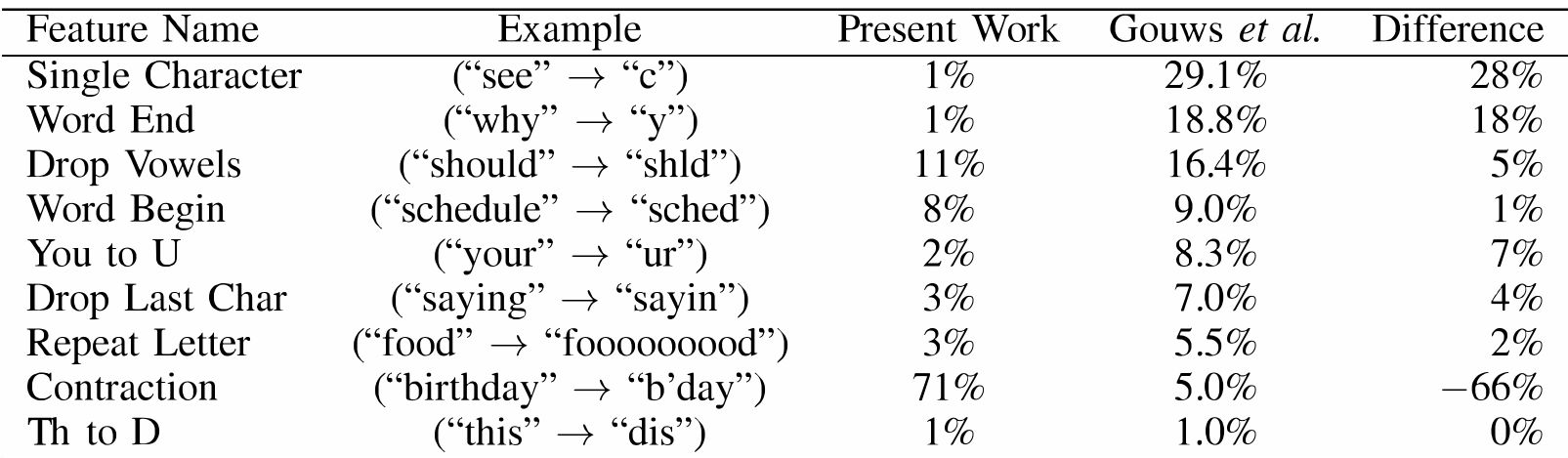
The researchers observed a startling divergence from previous benchmarks: Contractions dominated their dataset (71%), whereas prior general Twitter studies saw more Single Character substitutions (e.g., "see" → "c").
Discovering Rules: Association Mining
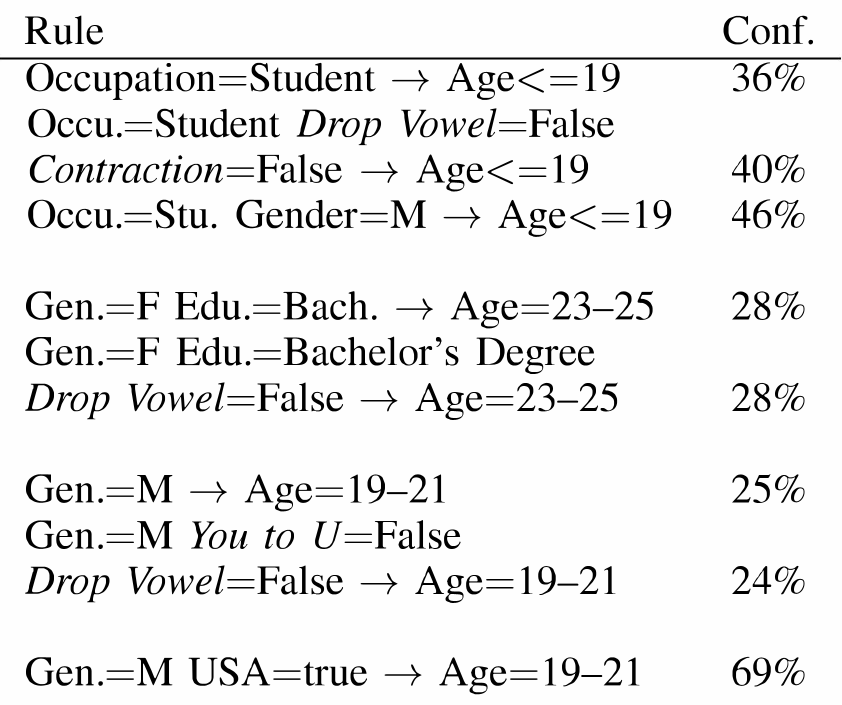
The authors utilized the Apriori algorithm to find Class Association Rules (CARs). The goal was to find patterns like IF [Feature A] AND [Feature B] THEN [Age Group].
One of the most effective discovered rules combined geographic and gender data:
- Rule:
Gender=Male AND Region=USA → Age 19-21(Confidence: 69%)
Interestingly, adding linguistic abbreviation features often lowered the confidence of rules based on demographic data. This suggests that while teenagers do use abbreviations, their educational level and geographic residency are more stable indicators of their identity than whether they drop the last character of a word (e.g., "sayin").
Critical Analysis & Insights
The "Education" Bias
The dataset revealed that 82% of participants had some college education—significantly higher than the general Twitter population. This explains the lower usage of "slangy" abbreviations compared to previous studies. It highlights a critical lesson for NLP researchers: your model is only as good as your demographic sample.
Limitations
The sample size (72 users) is relatively small, though the authors emphasize that this is a "test-bed" intended for future expansion. Furthermore, the binary (True/False) representation of abbreviations might be too coarse; a frequency-based (percentage) approach might yield more nuanced results in future iterations.
Conclusion: Toward a More Granular Sociolinguistics
The value of this work lies in its commitment to high-quality, user-vetted metadata. By showing that traditional abbreviation features hold less predictive power than demographic markers like "Student" status, the paper challenges researchers to look deeper than surface-level "Internet slang." For future age-inference models, the path forward involves integrating broader sociolinguistic contexts—education, region, and occupation—rather than just OOV token counts.