
Deciphering the Digital Social Fabric: Why Age and Gender Redefine OSN Relationships
User behavior in online social networks and its implications: a user study
This paper presents a cross-cultural user study on Online Social Networks (OSNs), examining how demographics like gender, age, and nationality influence social interaction. Utilizing survey data from 247 participants, it identifies patterns in "real" vs. "unreal" friend acquisition and highlights behavioral shifts in digital communication.
TL;DR
This study investigates the nuances of user behavior in Online Social Networks (OSNs), revealing that gender and age are primary drivers of how "friendship" is defined online. While younger users are more open to strangers, female users maintain a significantly higher threshold for digital intimacy. Surprisingly, the study finds that at a high level, social media behavior is becoming globally standardized, transcending even the deepest socioeconomic divides between nations like Norway and Pakistan.
The "Friend" Fallacy: Motivation for the Study
Standard Social Network Analysis (SNA) often operates on a binary assumption: either you are friends, or you are not. However, as documented by researchers like Danah Boyd, the metric for a "friend" is notoriously vague. The authors recognize that this lack of distinction—treating a close relative and a complete stranger as equivalent nodes—leads to "erroneous results" in data mining and recommendation systems. Their motivation was to look past the "Follow" button to understand the human factor: Who are we actually connecting with, and why?
Methodology: A Global Snapshot
To tackle this, the researchers surveyed 247 participants across 33 countries, with deep dives into two contrasting archetypes: Norway (high socioeconomic status, high internet penetration) and Pakistan (developing economy, emerging urban internet class).
Key Insights: Gender and Age as Filters
The study's methodology revealed distinct patterns in how we "gatekeep" our digital lives:
1. The Gender Gap in Digital Privacy
The data suggests a clear "conservativeness" gradient. Female participants were substantially more cautious, specifically regarding friend requests from strangers or even "friends of friends."
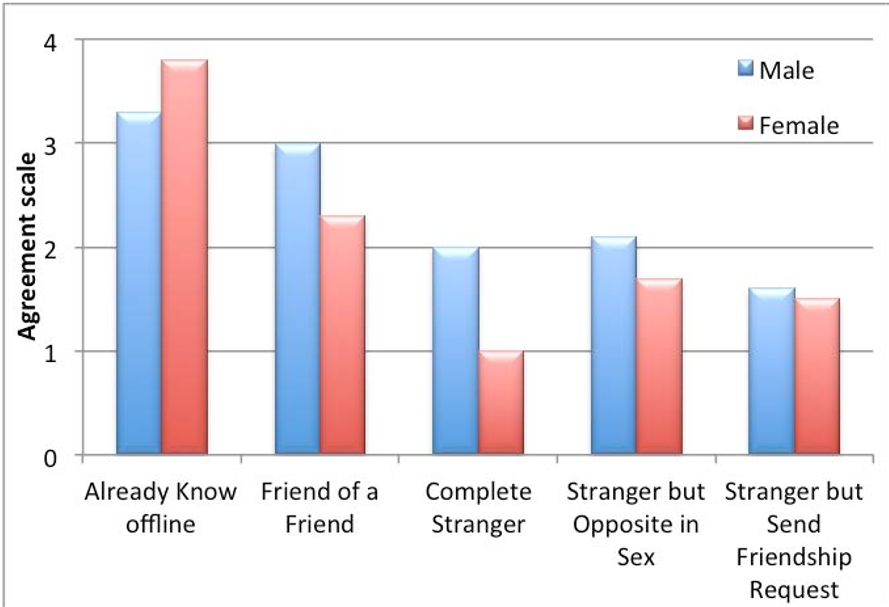 In the figure above, note the sharp drop in approval (y-axis) for females when dealing with strangers compared to their male counterparts.
2. The Myth of the 150-Friend Limit
Anthropologist Robin Dunbar famously suggested that humans can only maintain ~150 stable relationships. The study finds that the 20-29 age group consistently shatters this limit, though at the cost of relationship quality. These "unreal friends" are predominantly found in younger cohorts, whereas users over 30 tend to align their digital network with their actual physical social circle.
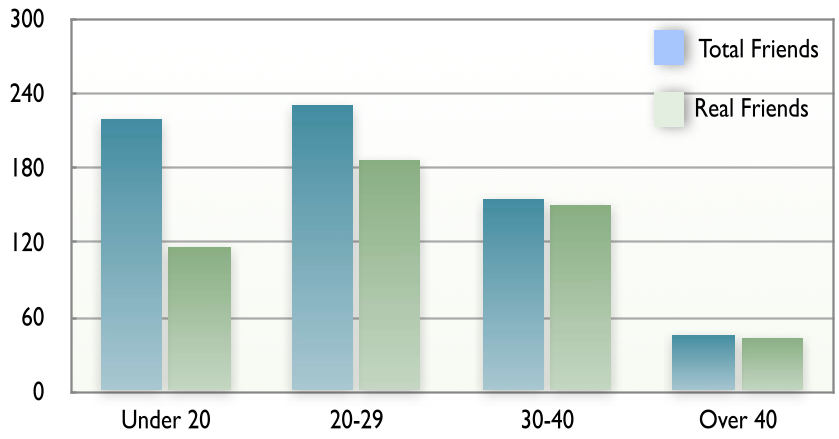 This chart highlights that while younger users have high 'total' counts, the 'real' friend count remains relatively stable across ages, proving the inflation of digital networks in youth.
Cultural Convergence: Norway vs. Pakistan
Perhaps the most striking finding is the homogeneity of behavior. despite Pakistan and Norway being worlds apart in political and socioeconomic terms, their OSN usage patterns—sharing photos, commenting, and browsing—were remarkably similar. The researchers attribute this to the "urban educated class" in developing nations adopting a globalized digital culture.
The only notable divergence: Private Communication..
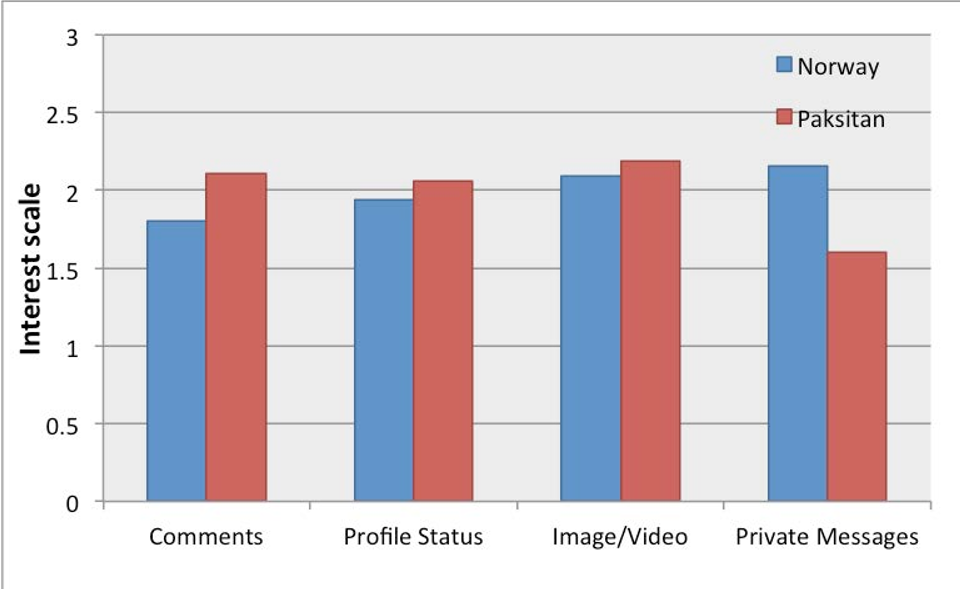 Norwegians showed a higher preference for private messaging (Inboxes) over public comments, suggesting a more mature or privacy-conscious approach to direct communication.
Critical Analysis & Conclusion
Takeaway
The paper effectively argues that OSNs are not just graphs and nodes; they are reflections of human sociology. The high volume of "unreal friends" among young people suggests that social networks are being used more for self-promotion and visibility than for genuine connection.
Limitations
As a "Short Paper," the sample size (247) limits the ability to generalize these findings to the entire global population. Furthermore, the 2012 timestamp of the study means it predates the massive shift toward algorithmic "For You" feeds (like TikTok), which may further distance "social networking" from "socializing with friends."
Future Outlook
The authors suggest moving toward semantic and ontology-based classification. By understanding the type of relationship (family vs. stranger), future systems can filter out the "noise" of hundreds of meaningless news feed updates, returning the "Social" to Social Networking.