
Collaborative Intelligence: Mining Input Method Logs for Semantic Discovery
User Behaviors in Related Word Retrieval and New Word Detection: A Collaborative Perspective
This paper introduces a collaborative framework for related word retrieval and new word detection by mining user behavior data from Chinese Pinyin input methods. It proposes a semantic relatedness measure based on User-Word bipartite graphs and enhances retrieval performance using a search-engine-based re-ranking mechanism.
Executive Summary
TL;DR: This research transforms the humble Chinese Pinyin Input Method into a powerful engine for Natural Language Processing. By treating users and the words they type as a bipartite graph, the authors apply Collaborative Filtering (CF) to retrieve related words and detect brand-new terminologies with high precision.
Background: Positioned at the intersection of Information Retrieval and Social Computing, this work moves beyond static text analysis. It treats the "typing behavior" of millions as a collective vote on word associations, achieving SOTA-level results in identifying domain-specific terms that are often missing from traditional dictionaries.
The Core Intuition: Typing is Collaborating
Traditional NLP often treats the web as a flat document collection. However, the authors observe that if a user types "Machine Learning," they are significantly more likely to also type "SVM" or "Feature Vector" in their personal session history.
By modeling this as a User-Word Bipartite Graph, the research bridges the gap between Recommendation Systems (like Amazon's "customers who bought X also bought Y") and Semantic Analysis ("users who typed word A also typed word B").
Methodology: From Graphs to Context
The method operates in two distinct phases:
1. The Statistical Foundation (Bipartite Graph)
The system maps users and words onto a graph. If a user uses word , an edge is formed. The authors tested several co-occurrence metrics, finding that a balanced Conditional Probability (where ) effectively mirrors the Dice Coefficient, providing a robust baseline for similarity.
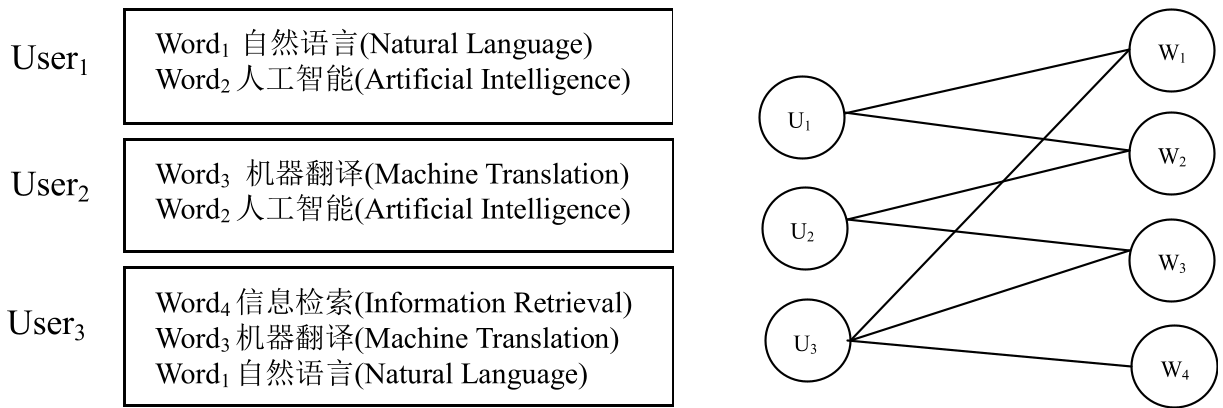 Figure 1: The User-Word bipartite graph mapping typing behavior to semantic links.
2. The Contextual Refinement (Web Re-ranking)
Statistical co-occurrence can be noisy. To filter out coincidental associations, the authors introduce an unsupervised re-ranking step. They query the Sogou search engine for candidate words, extract the top 20 snippets as "context vectors," and use Cosine Similarity to ensure the words are semantically aligned in the real world.
Experimental Breakthroughs
The experiments focused on two primary tasks:
- Related Word Retrieval: Using seed words like "Ericsson," the system successfully retrieved competitors ("Alcatel," "Siemens") and relevant tech ("Base Station") with significantly higher accuracy after re-ranking.
- New Word Detection: By identifying "expert users" (those who use many known tech terms), the system could flag words these experts used frequently that were not in existing dictionaries.
 Figure 2: Examples of related word retrieval across different semantic domains (Tech vs. Fruit).
Key Metrics:
- In New Word Detection: The system achieved 100% precision (P@30) in the Computer Science domain, finding missing words like "Serialization" and "Instantiate" that were absent from human-curated lexicons.
- Effect of Seed Information: The study proved that Multiple Seeds dramatically improve disambiguation (e.g., "Apple" + "Microsoft" ensures IT-related results, while "Apple" + "Strawberry" ensures fruit-related results).
Deep Insight & Conclusion
The true value of this work lies in its Language Independence. Because it relies on user behavior rather than syntactic parsing, it bypasses the "Chinese Word Segmentation" problem—one of the hardest hurdles in Asian NLP.
Limitations: The reliance on search engine snippets for re-ranking introduces a dependency on external Web IR, and the data is inherently noisy due to user typos or "spam" typing.
Future Outlook: As we move toward LLMs, this collaborative behavior data provides a "hidden" supervised signal that could be used to fine-tune models on emerging slang and technical jargon long before they appear in formal training sets.
Takeaway: This paper proves that the data generated by users during their daily digital lives is not just "digital exhaust"—it is a structured, collaborative map of human knowledge.