
Beyond the Specs: How User-Centered Design Transforms Product Marketing in Manufacturing
The Value of User Centered Design in Product Marketing: A Simulated Manufacturing Company Product Offering Market Strategy
The paper investigates User-Centered Design (UCD) in manufacturing marketing through a Simulated Industrial Manufacturing Company (SIMCO). It proposes an "affiliation-centric" marketing strategy that leverages school spirit to enhance customer information satisfaction and competitive advantage in an e-commerce context.
TL;DR
In the world of manufacturing, a great product isn't enough—it has to be marketed through the lens of the user's identity. This research demonstrates that for a student-run manufacturing company (SIMCO), shifting from a feature-heavy marketing site to one emphasizing school spirit and local craftsmanship increased user preference by over 80%.
Background: The "Last Mile" Problem in Manufacturing Education
Most manufacturing programs excel at teaching students how to move from a CAD model to a physical prototype. However, Indiana State University’s Advanced Manufacturing Management (AMM) program identified a critical gap: the marketing and sales phase.
Students often suffer from a "build it and they will come" mentality. When they transition to e-commerce, their sites are often sterile, technical, and disconnected from the customer's emotional triggers. This leads to poor cash flow and a lack of product exposure, despite the high quality of the items produced.
Motivation: The Power of Information Utility
The researchers hypothesized that the "competitive edge" for small-scale manufacturing lies in Psychographic Characteristics. Instead of competing on price or global reach, they focused on "School Spirit"—a powerful motivator for their target audience (students, alumni, and families).
The core insight was that Information Utility (how useful information is to a decision) is subjective. A student might not care about the technical grade of a material as much as the fact that their peer manufactured it in a local campus lab.
Methodology: A Tale of Two Websites
To test this, the authors conducted a comparative evaluation between two distinct marketing strategies:
- Website 1 (Standard): Focused on product-only information (Name, Cost, Material, Availability).
- Website 2 (School-Centric): Included all standard info PLUS details about ISU student involvement, the manufacturing environment, and the "story" behind the product.
Experimental Framework
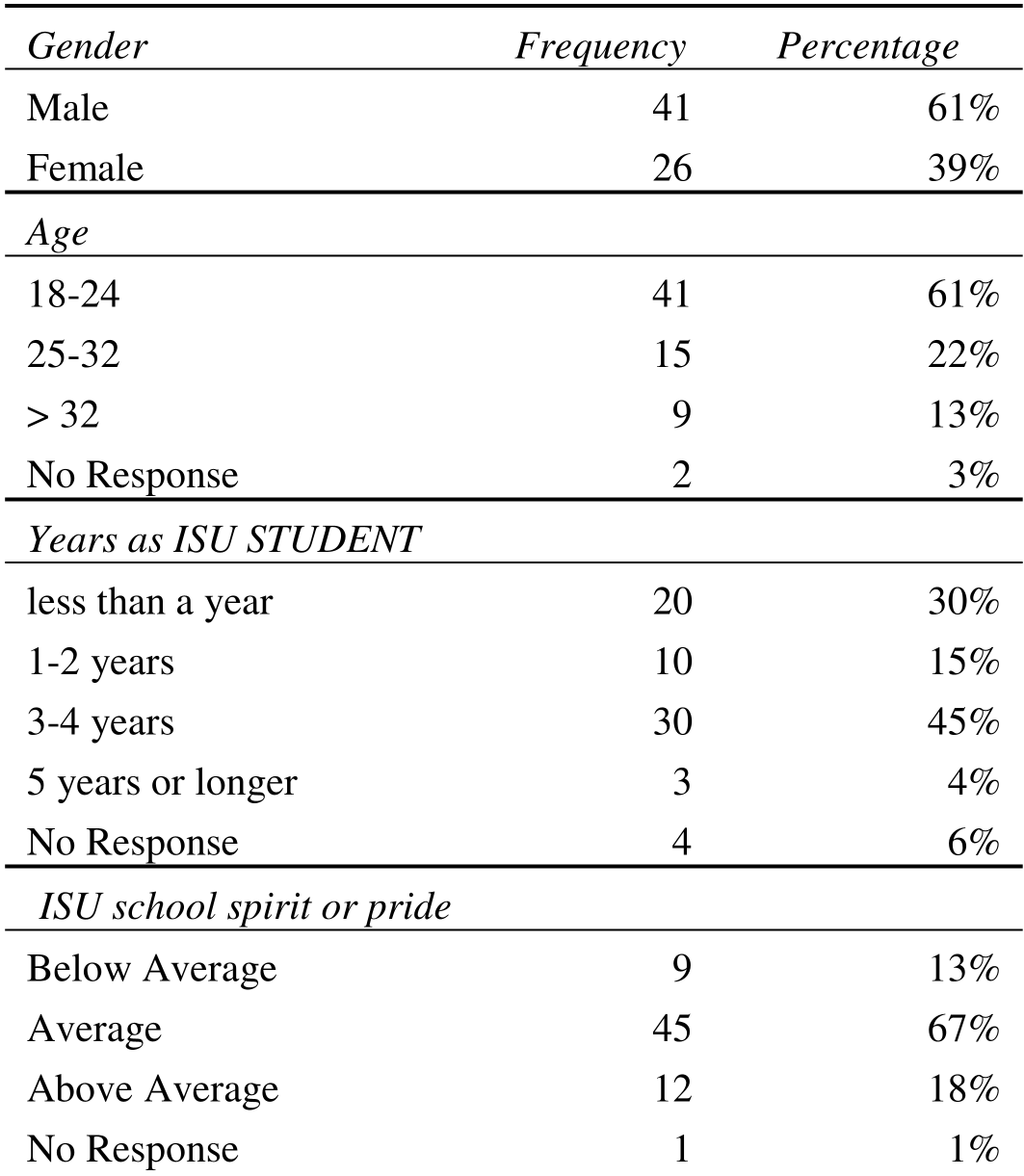
Participants (n=67) browsed both sites and were measured on a 5-point Likert scale (1 = Strongly Agree, 5 = Strongly Disagree).
Results: Why "Peer-Made" Beats "Product-Only"
The results were statistically significant across several key metrics:
- User Preference: 82% of participants preferred the school-centric website.
- Information Usefulness: Even though the product specs were identical on both sites, users rated the information on the school-centric site as more useful (Mean: 1.86 vs. 2.19).
- Information Satisfaction: Users reported higher satisfaction when the "story" of the manufacturing process was included (Mean: 1.95 vs. 2.36).

The "Additive Effect"
A fascinating takeaway from the data is the Halo Effect of psychographic information. When users felt an emotional connection (school pride), they perceived the technical product information as more valuable. The research shows a strong correlation (0.69) between the appeal of student-work details and overall information satisfaction.
Deep Insight: Identity-Driven E-commerce
This study proves that for niche manufacturing—whether in a university or a boutique firm—the "Value Chain" doesn't end at the shipping dock. It ends in the user's mind.
Limitations & Future Work
While the study provides a strong proof of concept, the authors acknowledge limitations:
- Homogeneous Population: The sample was restricted to ISU students. Future work should test if this "pride" effect translates to neutral third parties.
- Functional Depth: The test sites were restricted to basic browsing. Real-world e-commerce requires testing transaction flow and "trust" indicators.
Conclusion
For modern manufacturers, the competitive edge is no longer just about efficiency; it's about relevance. By integrating User-Centered Design into the marketing strategy—specifically by targeting the psychographic "tribe" of the customer—companies can turn a commodity into a symbol of identity.
Takeaway for the Industry: To increase your "Information Utility," stop talking about what you make and start talking about who made it and why it belongs in your customer's community.