
BM25FS: Bridging the Gap Between General Search and Social Intuition
User-Centered Social Information Retrieval Model Exploiting Annotations and Social Relationships
The paper introduces BM25FS, a Social Information Retrieval (SIR) model that personalizes search results by integrating a user's Informational Social Context (ISC). It leverages social tagging data (folksonomies) and social relationships to reweight document terms, outperforming classical BM25 in Mean Average Precision (MAP) on a Delicious-based dataset.
TL;DR
The paper introduces BM25FS, an evolution of the classic BM25 algorithm designed for the social era. By transforming a user's tags and their friends' annotations into "virtual document fields," the model successfully disambiguates queries and delivers personalized search results. Tested on real-world data from Delicious, it proves that "who you know" and "how you tag" are critical signals for modern Information Retrieval (IR).
The "Smartphone Android" Dilemma: Why General Search Fails
In classical IR, a query like "smartphone android" is treated as a static intent. However, as the authors point out, two users might mean very different things:
- User A (Hardware Enthusiast): Primarily interested in physical smartphone devices.
- User B (Developer): Primarily interested in the Android Operating System internals.
A standard system would rank a document about hardware and a document about software equally. The Informational Social Context (ISC)—the trail of tags and annotations a user leaves behind—is the missing key to understanding this latent intent.
Methodology: The Multi-Field Social Index
The core innovation of this work is the BM25FS model. Instead of just looking at the document's text, the authors treat the indexing process as a three-dimensional problem:
- Document Content: The raw text of the webpage.
- User Profile (): Terms the specific user has used in the past to tag other content.
- Neighborhood Profile (): Terms used by the user's social connections.
By utilizing the BM25F (the "F" stands for Fields) weighting function, the model calculates a combined term frequency (). If a query term appears in your personal tag cloud or your friends' tag clouds, its weight is boosted within the document being ranked.
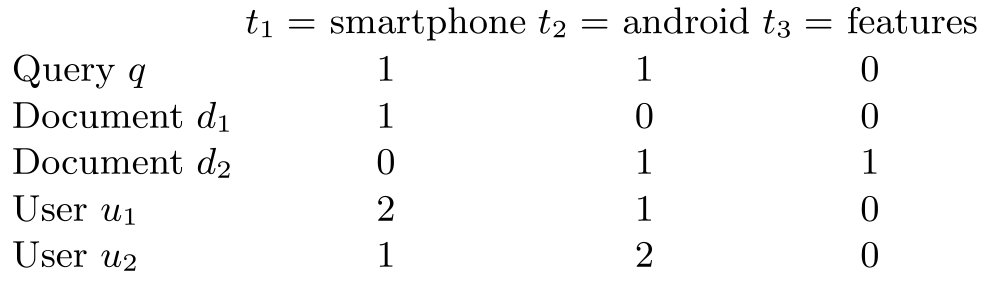 Table 1: Example showing how User 1 and User 2's interests differ despite the same query.
The Mathematical Intuition
The weighting formula integrates field-dependent parameters () that allow the system to tune how much "weight" to give to personal history versus social circles compared to the actual text of the document. This ensures that the system doesn't just return popular documents, but documents that are locally relevant to the user's social graph.
Experimental Evidence: SOTA Comparison
The authors built a specialized dataset, DelS, from the social bookmarking site Delicious, encompassing over 30,000 documents and 370 users.
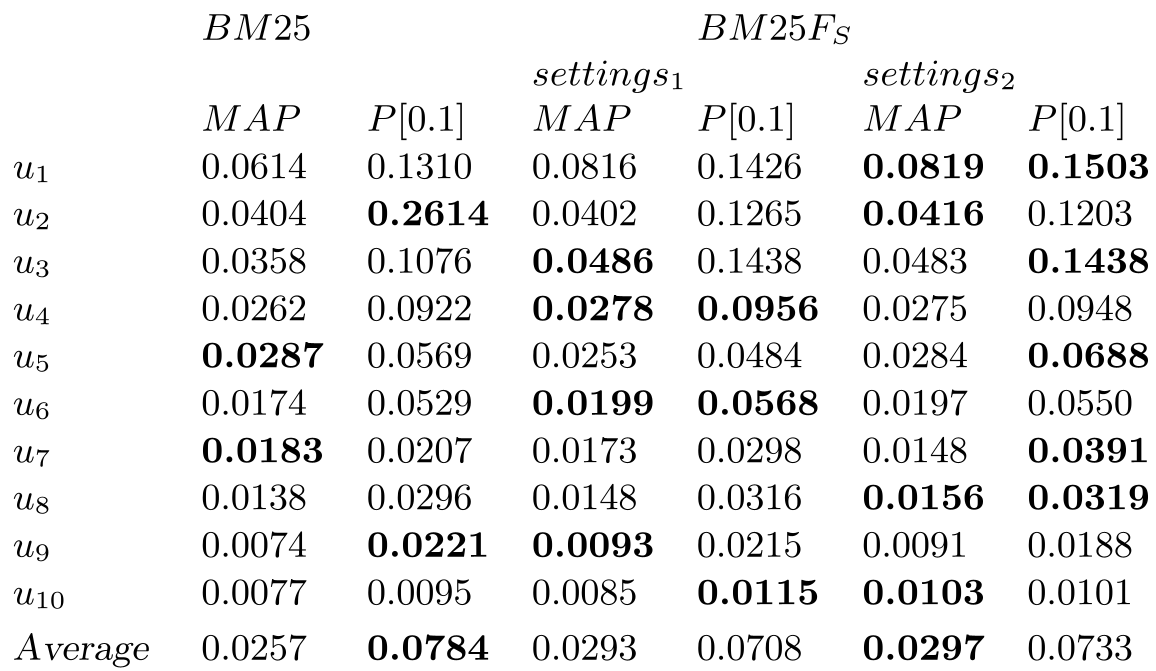 Table 4: Comparative analysis of BM25 vs. BM25FS across various users.
Key Findings:
- Classical IR limitation: When evaluated against user-centered truth, standard BM25 MAP scores drop significantly (from ~0.10 to ~0.03), proving it fails to capture individual needs.
- BM25FS Performance: The proposed model achieved an average MAP of 0.0297, a statistically significant improvement over the baseline.
- Social Boost: Including the "Neighborhood" profile (Settings 2) consistently provided better or more stable results than relying solely on the individual's own tags.
Critical Insight & Future Outlook
While the model shows clear gains in global metrics like MAP, the authors noted a slight trade-off in "Precision at 10% of recall." This suggests that while social context helps find more relevant documents correctly, the very top of the list is still heavily influenced by raw content relevance.
The "Future Work" section hints at exploring "friends of friends" (Neighborhood of Neighborhood) annotations. In the age of Large Language Models (LLMs), these social indexing techniques could provide the necessary architecture for RAG (Retrieval-Augmented Generation) systems to become truly personalized and "socially aware."
Conclusion
BM25FS successfully demonstrates that social metadata is not just a secondary feature but a fundamental component of the indexing process. By treating social context as a first-class citizen in the weighting function, we move closer to search engines that truly "know" their users.