
Designing for Safety: Using Distributed Cognition to Prevent Medical Errors
Checking User-Centred Design Principles in Distributed Cognition Models: A Case Study in the Healthcare Domain
This paper proposes a formal constructive procedure for building Distributed Cognition (DCog) models from ethnographic data to verify User-Centred Design (UCD) principles. Applied to a fatal healthcare incident involving a Fluorouracil overdose, the method identifies critical design flaws in information flow that previous investigations overlooked.
TL;DR
Researchers at Queen Mary University of London have developed a systematic way to turn "field notes" into rigorous technical models. By applying Distributed Cognition (DCog) to a real-world fatal chemotherapy overdose, they proved that we can identify "cognitive traps" in healthcare systems—like confusing labels or disconnected databases—using a repeatable, model-based approach before accidents happen.
The Problem: When Good Tech Causes Bad Outcomes
In 2010, the FDA reported a 50% surge in medical device incidents. The irony? We are adding more technology to healthcare to increase safety, yet these very systems often disrupt established "teamwork" workflows.
The current gold standard for understanding these systems is Ethnography (observing people at work). However, ethnography is often subjective and "messy." It tells us what happened, but it doesn't always provide a mathematical or logical framework to prove why the design failed or how to fix it predictably.
The Insight: "Cognition is Out There"
The authors lean on the theory of Distributed Cognition. Instead of looking only at what is inside a nurse’s head, they treat the entire clinic—nurses, pharmacists, paper labels, and computer screens—as a single "computational engine."
If information is "lost in translation" between a paper order and a digital screen, the system has a "thinking" error, even if the human is trying their best.
Methodology: From Narrative to Model
The paper introduces a structured 3-step pipeline to build a DCog model:
- Define Information Items: What matters? (e.g., Patient ID, Dosage, Drug Type).
- Define Observable Representations: Where is this info stored? (e.g., a sticky label, a calculator screen, a verbal shout).
- Define System Behaviour: How does information move and change?
The Case Study: The Fluorouracil Incident
They re-analyzed a case where a patient received a 4-day dose in just 4 hours. By mapping the information flow, the authors created a DiCoT (Distributed Cognition for Teamwork) model.
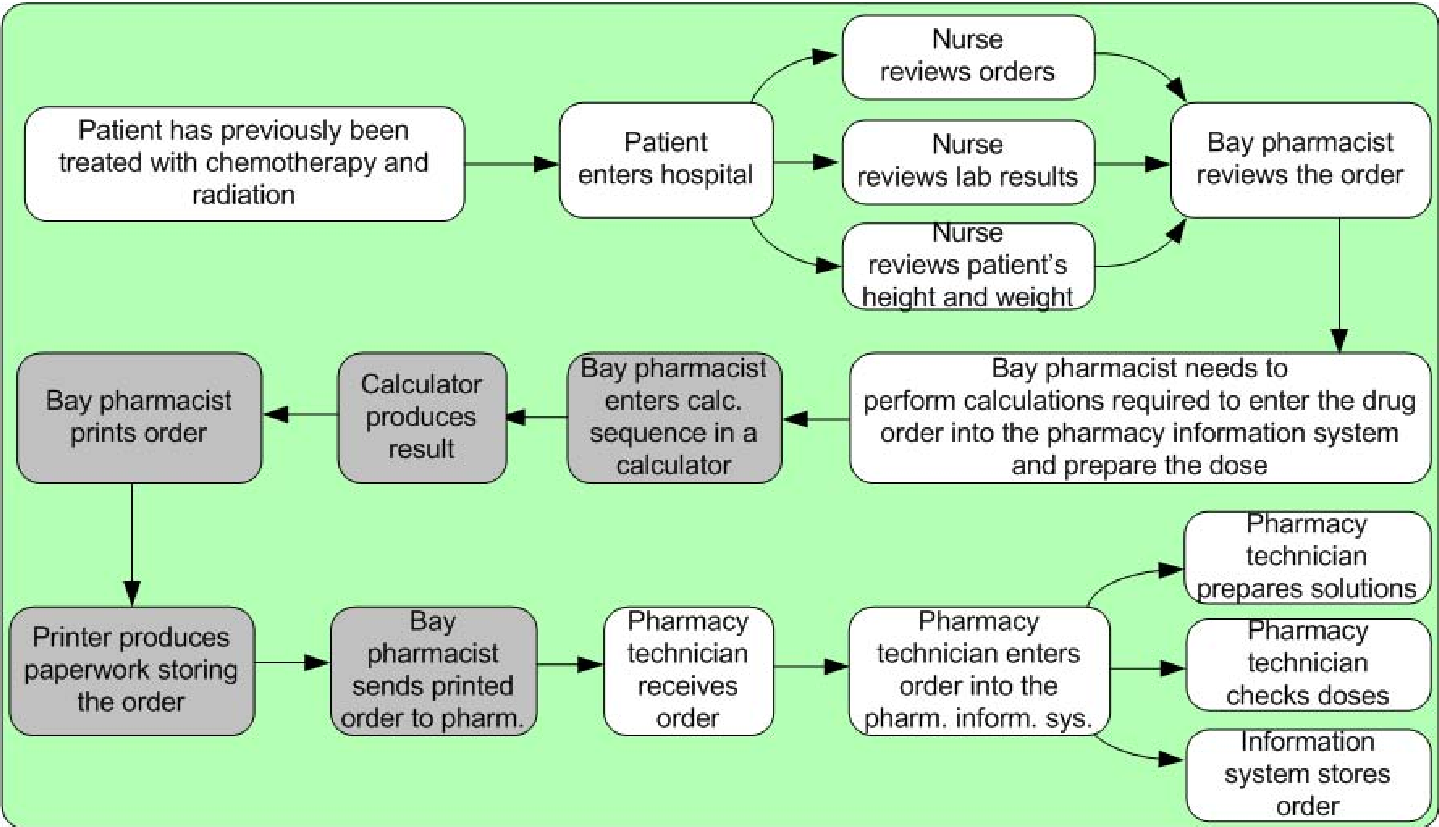 Figure 1: The information flow model showing dependencies between laboratory results, pharmacist reviews, and final administration.
Critical Analysis: Why the System Failed
The authors checked the model against Situation Awareness (SA) principles. Two major failures stood out:
1. Lack of Structured Information
The pharmacist had to use a manual calculator because the digital system didn't "talk" to the pharmacy system. The calculator only showed raw numbers without units (mg vs. mL). A single typo here is invisible to the system—it’s a "silent failure" waiting to happen.
2. Extraneous Information (Clutter)
The drug label, shown below, was a mess of "Attentional Tunnelling."
 Figure 2: The layout of the original printed order and label. Note the redundant abbreviations (5FU vs 5-Fluorouracil) and inconsistent rate formats.
The researchers found that the medication name was reported in different formats on the same page, and doses were listed in multiple units (mg/4days vs mg/24h). In a high-stress environment, this leads to cognitive overload, where the human mind "locks" onto one number and ignores the conflicting one.
Deep Insight: Beyond the Incident Report
The most impressive part of this work is that it found a risk the official investigation missed: The drug label didn't actually include the Patient's Identity. This means a nurse could easily attach a correct label to the wrong patient’s file, and there would be no "representational state" (no physical evidence) to alert them of the mismatch.
Conclusion & Future Outlook
This paper shifts the focus from "human error" to "design-induced error." By formalizing DCog, the authors provide a toolkit for hospital procurement officers and software designers to stress-test their workflows.
Limitations: The method still relies on high-quality contextual data. If the initial ethnography misses a step, the model will too. However, as an additive layer to safety engineering, it provides a "justifiable and repeatable" way to save lives through better information architecture.