
Beyond the Graph: Inferring Social Ties through User-Centric Latent Space Modeling
A User-Centric Feature Identification and Modeling Approach to Infer Social Ties in OSNs
The paper introduces a user-centric modeling approach to infer the strength of social ties in Online Social Networks (OSNs) using a Latent Space Model (LSM). By analyzing 11 Facebook-specific features across a two-level ego network, the authors visualize relationships in a 3D social space and devise a link probability function to predict user interactions.
TL;DR
Global analysis of massive social networks is computationally prohibitive and often ignores the nuances of individual relationships. This paper proposes a user-centric approach that builds a 3D social map around a "seed" user. By analyzing Facebook interaction data and spatial similarities through a Latent Space Model (LSM), the authors can predict the probability of social ties with significantly higher precision than random sampling, effectively identifying a user's "Sphere of Influence."
The Scalability Wall in OSN Analysis
Most Online Social Network (OSN) research treats the network as a monolithic entity. However, as Facebook and X (formerly Twitter) grow, visualizing or processing the entire graph becomes impossible. The "time-lag" between data collection and analysis often renders global snapshots obsolete.
The authors argue that for tasks like personalized recommendations or behavioral analysis, we don't need the whole graph—we need a socio-centric view. The problem is that physical links (friendships) only tell half the story; the true strength of a tie lies in hidden interactions and shared identity.
Methodology: The 11 Pillars of Social Strength
The researchers identified 11 features to quantify tie strength, categorized into three distinct dimensions:
- Interaction-Based: Frequency of comments, likes, posts, and word count exchanged.
- Interest-Based: Shared participation in events, common page likes, and overlapping URLs.
- Spatial-Based: Similarity in geography (current/home), religious/political beliefs, age, and language.
Rather than just counting these features, the paper maps users into a 3D Latent Space.
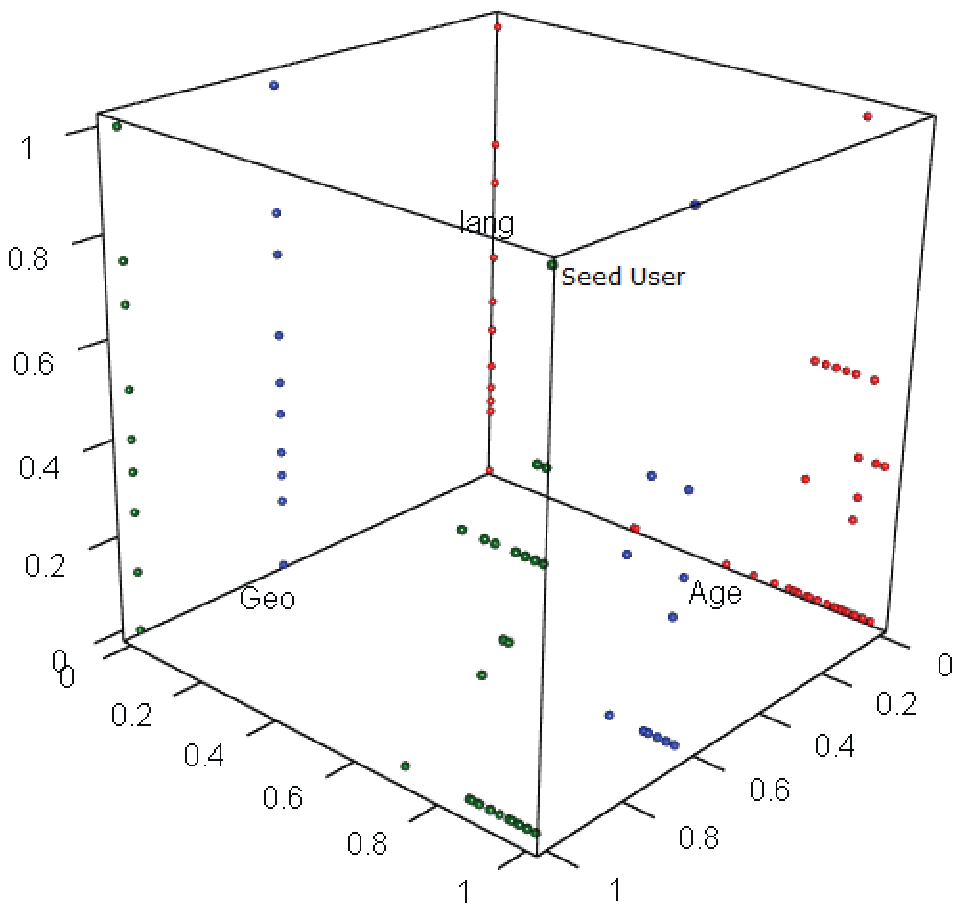 Figure 1: Users plotted in a 3D social space relative to the seed user (1,1,1).
The Link Probability Function
The core innovation is the modification of the link probability equation. Traditional models use Euclidean distance (), but this paper introduces (Interaction value) and (Feature similarity) to the kernel. This ensures that even if two users are "spatially" close (e.g., same age and city), their link probability only spikes if they also share active interactions.
Experimental Insights
The study analyzed a seed user and their network up to two levels (friend-of-a-friend), totaling 1,210 profiles. By applying the Latent Space Model, they categorized potential links into probability buckets.
- The Power of P*: By setting a threshold , the model identified a network of 14,093 "probable" edges.
- The Density of Ties: The interval contained the bulk of the network density, with a clustering coefficient of 0.942, suggesting that social ties are highly "clumpy" and predictable once the seed user's persona is defined.
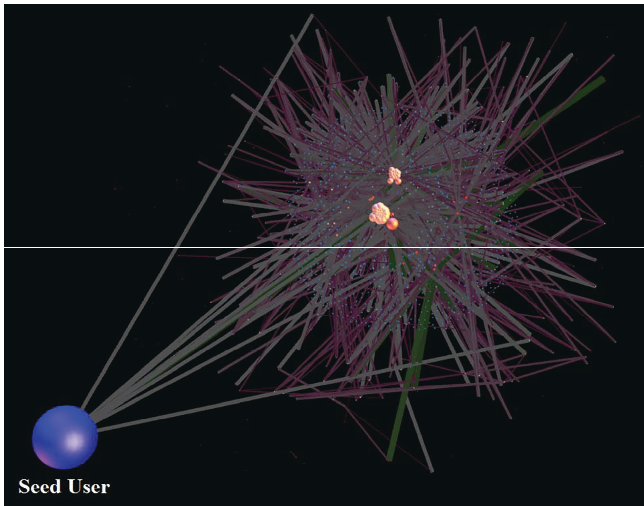 Figure 2: Multi-level view of the inferred high-probability social network (P).*
Critical Analysis & Conclusion
This work stands out because it moves away from the "static graph" view of the world. It treats a social network as a dynamic field of influence centered around individuals.
Key Takeaway: The "persona" of the seed user shapes the network interpretation. If the seed user is a niche hobbyist, the inferred ties will gravitate toward hobby-based interactions; if they are a professional, the ties follow industry lines.
Limitations: The study relied on a customized crawler with limited access to private data. In a modern context, privacy-preserving techniques (like Federated Learning) would be required to implement this at scale without compromising user data. However, the mathematical framework for using Latent Space to bridge the gap between "physical friendship" and "actual interaction" remains highly relevant for today's recommendation engines.