
USpam: Beyond Binary Filtering - Why Your Spam Filter Needs a Personality
USpam -- A User Centric Ontology Driven Spam Detection System
USpam is a user-centric, two-level hierarchical spam detection system that integrates ontologies with machine learning (J48 and Naive Bayes). Unlike traditional binary filters, it introduces a ternary classification—Ham, Good Spam, and Bad Spam—to align filtering results with individual user interests.
TL;DR
Traditional spam filters are too rigid, often burying important emails. USpam fixes this by using Ontologies to understand who you are. By categorizing mail into Ham, Good Spam (relevant ads), and Bad Spam, it reduces false alarms by up to 30% without sacrificing speed or accuracy.
Background: The "Spam" Paradox
In the current e-business paradigm, spam is an annoyance, but it is also a legitimate advertising tool. The problem is that most filters treat "Spam" as an objective truth. If a sender is unknown, the mail is trashed. This leads to a high False Alarm Rate (FAR), forcing users to manually check their spam folders anyway—defeating the purpose of the filter.
USpam operates on a critical insight: Spam is a relative concept. A "Call for Papers" is spam to a chef, but "Good Spam" to a researcher.
Methodology: The User-Centric Engine
USpam moves away from simple keyword matching toward a two-level hierarchical classification.
1. The Architecture
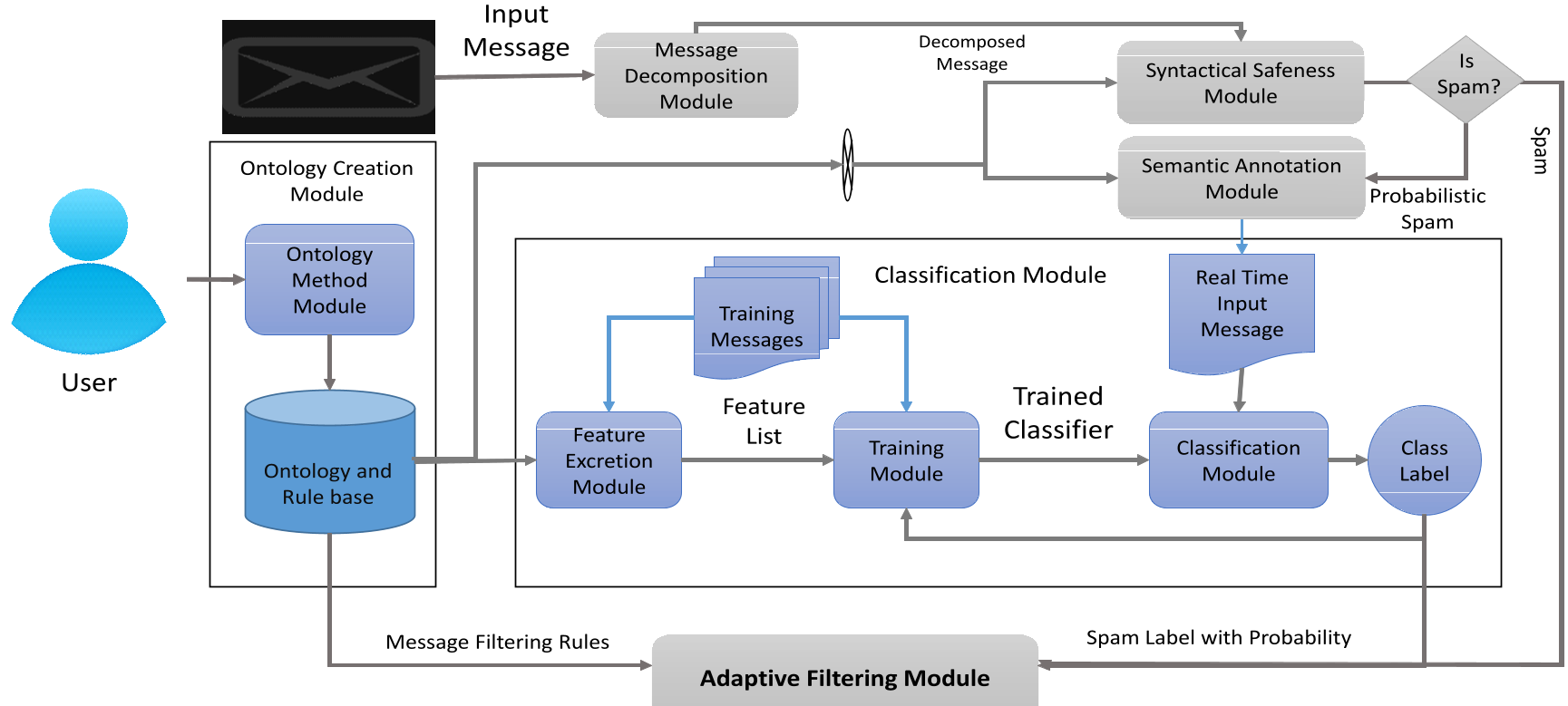
The system is composed of five modules that transform a raw email into a semantically understood entity.
- Message Decomposition (MDM): Parses headers and assigns weights based on user preference (e.g., prioritizing specific senders).
- Semantic Annotation (SAM): Uses TF-IDF and Cosine Similarity to calculate the "Degree of Abusiveness."
- Ontology Construction (OCM): The brain of the system, defining
UserType(Strict, Average, Moderate) andUserInterests.
2. The Math of Relevance
To decide if an email is "Good Spam," USpam utilizes the Ochehi coefficient, an extension of cosine distance, to measure the semantic overlap between the message contents () and user interests ():
This ensures that if you are a Data Scientist, an unsolicited ad for a "Data Mining Conference" is delivered to your inbox, while an ad for "Fluid Mechanics" is redirected to spam.
Experiments and Results
The researchers tested USpam against standard machine learning classifiers (SVM, Random Forest, etc.) and the ENRON dataset.
Performance Gains
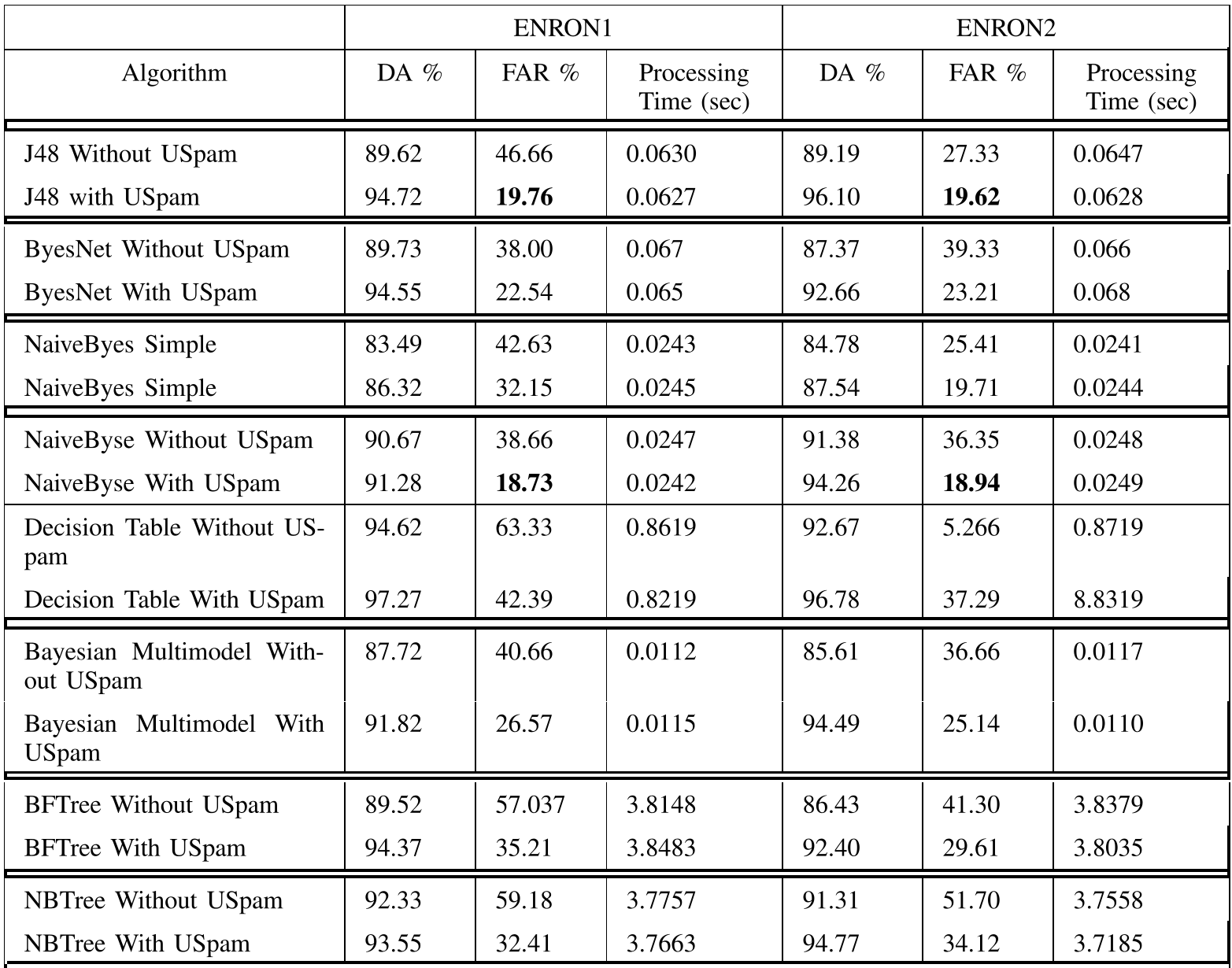
The integration of the USpam module significantly boosted the performance of standard classifiers like J48 and Naive Bayes. In head-to-head comparisons with prior SOTA (Shams et al.), USpam reduced FAR from ~41% down to ~19%.
Real-World Validation
A study with 20 real-world users confirmed these findings. Regardless of whether a user was "Strict" or "Moderate," the system maintained a consistent detection accuracy (DA) between 90% and 100%.
Critical Insight: Why This Matters
The most impressive part of USpam isn't just the accuracy—it's the latency. With a processing time of under 64ms, it proves that semantic, ontology-driven analysis doesn't have to be computationally expensive.
Limitations & Future Work
While USpam excels at text analysis, the current version notes that Malware detection (attachments/malicious links) is outside its scope. The next step for this research is an evolutionary framework—allowing the ontology to automatically update as a user's interests change over time (e.g., if a researcher moves from Data Mining to Quantum Computing).
Conclusion
USpam represents a shift from "filtering" to "understanding." By empowering users to define their own threshold of what constitutes "Good" vs. "Bad" spam, we can finally stop checking our spam folders for missing gold.