
PolicyMgr: Solving the Social Media Privacy Paradox with Machine Learning and Fusion
User Centric Policy Management in Online Social Networks
PolicyMgr is a supervised learning framework designed to automate access control in Online Social Networks (OSNs). It leverages user profile attributes and social graph metrics to build classifiers that categorize friends as 'trusted' or 'non-trusted,' achieving significant improvements in policy management efficiency.
TL;DR
The average social media user has over 130 friends, making manual privacy settings a logistical nightmare. PolicyMgr is a framework that uses supervised machine learning to "learn" your privacy preferences. By labeling just a few representative friends, the system auto-generates access rules for the rest, enhanced by a "fusion" mechanism that consults your friends' security settings for better accuracy.
The Problem: The High Cost of Manual Privacy
In Online Social Networks (OSNs), users are drowning in content and connections. Manually assigning "who can see what" for every photo or status update across hundreds of friends leads to Privacy Fatigue.
Most users either:
- Give up and leave everything public (The "Open" default).
- Partial configuration, leaving critical data exposed.
The core difficulty is that "trust" is subjective. My definition of a "Close Friend" might differ from how the social network's algorithm defines it. We need a system that understands individual preferences without requiring hundreds of manual clicks.
Methodology: From Clustering to Collaborative Wisdom
The PolicyMgr framework operates in a sophisticated five-step pipeline that transitions from individual intuition to algorithmic enforcement.
1. Feature Engineering: Beyond Basic Profiles
The system doesn't just look at age or location. It calculates Social Graph Metrics, such as:
- Betweenness Centrality: How much of a "bridge" a friend is between different groups.
- Closeness Centrality: How "near" they are to everyone else in the network.
- Interaction Data: In the Last.FM case, "Shouts" (posts) were used as a proxy for trust.
2. Intelligent Training Set Selection
To avoid asking the user to label everyone, PolicyMgr uses K-means clustering to group friends with similar attributes. It then asks the user to label only a small percentage () from each cluster. This ensures the training data is representative of the user's entire social circle.
3. Architecture and Fusion
The authors tested nine different classifiers, but the real "secret sauce" is Classifier Fusion. If your own classifier is unsure, PolicyMgr "asks" neighboring friends. If their classifiers (which have been trained on their own perspectives) consistently label a certain type of profile as "trusted," that advice is fused into your local decision.
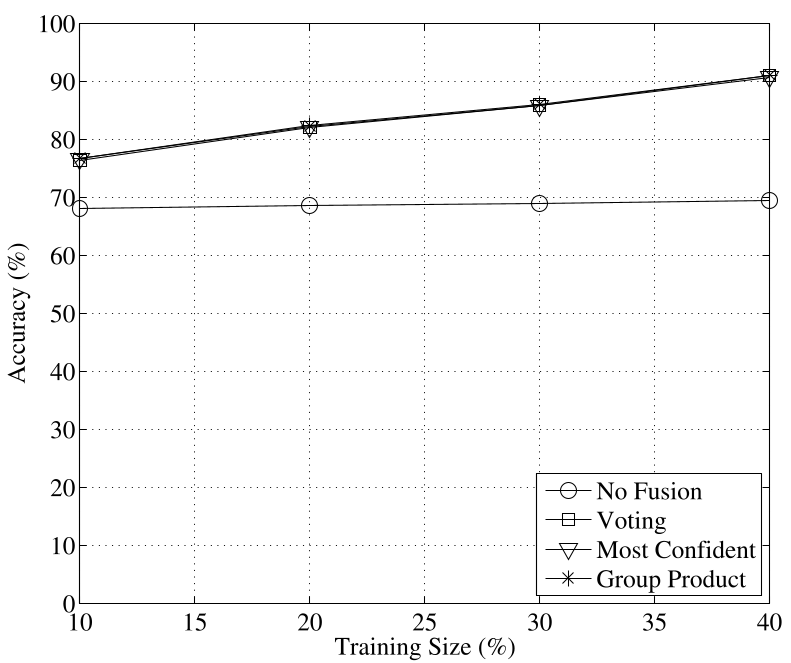 (Figure a) Comparison of different classifier types showing the impact of Fusion on Accuracy.
Experimental Results
The researchers crawled 1.6 million profiles from Last.FM to validate the framework.
- Accuracy Boost: A single AD Tree classifier reached ~70% accuracy. However, when using Group Voting fusion, accuracy jumped to 83%.
- Minimal Effort: The study found that users only need to label 10% to 20% of their friends to reach a performance plateau, meaning the "labor cost" of privacy is drastically reduced.
- The Threshold: Interestingly, data showed that inviting too many friends to provide advice (increasing ) actually decreases accuracy. This suggests that privacy "wisdom" is local—you should only trust advice from your immediate, similar social circle.
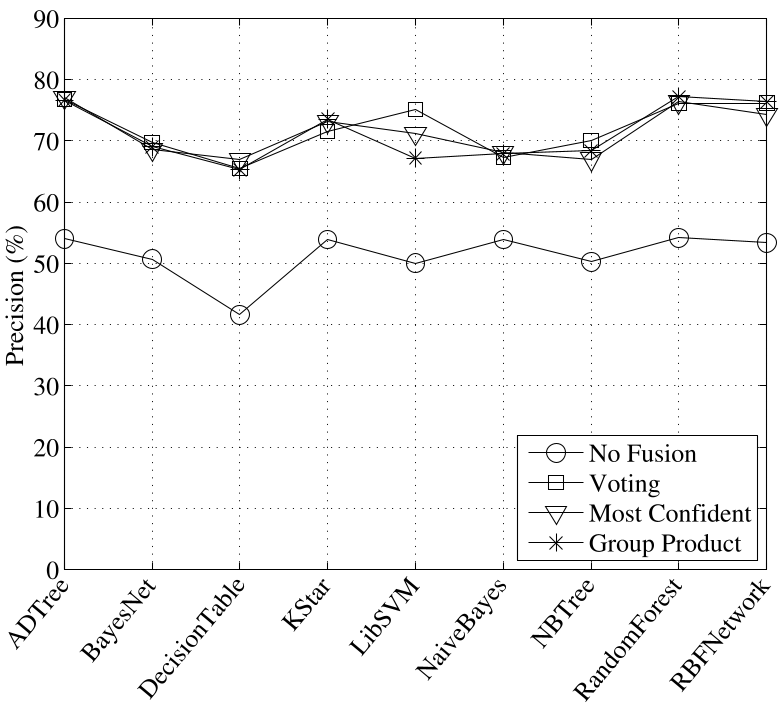 (Figure b) Accuracy vs. Precision across different fusion models like Group Voting and Confidence Product.
Critical Analysis & Takeaways
This paper highlights a critical shift in security: User-Centric AI. Instead of rigid, top-down rules, PolicyMgr treats privacy as a learnable behavior.
Limitations:
- Proxy Bias: Using "Shouts" as a ground truth for trust is a leap; the authors admit a real user study is needed.
- Cold Start: For a brand-new user with no friends and no interaction data, the classifier would struggle initially.
Future Outlook: This work paves the way for "Privacy Assistants" in the metaverse or decentralized social networks, where AI agents could negotiate access rights on our behalf based on our historical "trust manifold." At 83% accuracy, we are approaching a world where your social media can protect you better than you can protect yourself.