
Towards Socially-Aware Web Services: Blending User Wisdom with Service Relationships
Towards a User-Centric Social Approach to Web Services Composition, Execution, and Monitoring
This paper proposes a user-centric social approach for Web Services composition, execution, and monitoring by intertwining social networks of users with social networks of Web services. It introduces three core components—Social Composer, Social Executor, and Social Monitor—to leverage "social entourage" and service relationships (collaboration, competition, substitution) for enhanced service management.
TL;DR
The modern Web is no longer just a collection of static pages; it is a dynamic ecosystem of users and services. This paper introduces a framework that treats Web services as "social entities." By intertwining social networks of users (peer recommendations) with social networks of Web services (collaborators, competitors, and substitutes), the authors create a resilient environment for composing, executing, and monitoring business processes that learn from experience.
Background: The Limits of Traditional SOA
Historically, Service-Oriented Architecture (SOA) depended on registries and QoS (Quality of Service) metrics like response time. However, these metrics are often incomplete. They don't tell you if a service is "friendly" to other services or if a specific user group found a service unreliable in practice.
The authors identify two gaps:
- User Side: Users are now "prosumers" who have valuable experiences but lack a structured way to influence service selection.
- Service Side: Services are not isolated; they naturally compete for requests, collaborate in workflows, or substitute for each other during failures.
Methodology: The Social Triumvirate
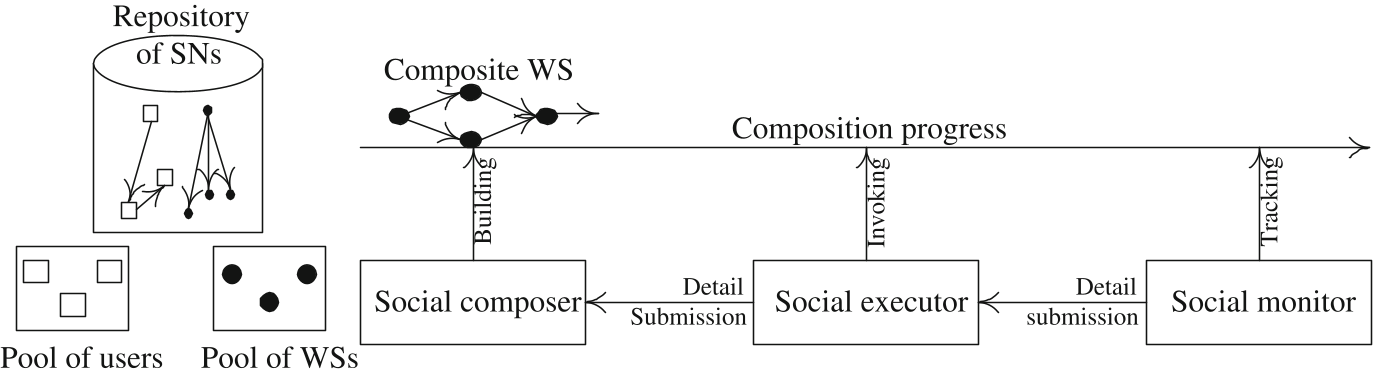
The paper proposes a three-layered architecture to manage this "social" lifecycle:
1. The Social Composer
The Composer doesn't just look for functional matches. It asks:
- User Context: What did your peers use after this step?
- Service Context: Does this service have a history of successful collaboration with the previous one?
2. The Social Executor
Execution is where the "social weight" is tested. The Executor monitors how the selected services perform. If a suggested service succeeds, its social link strengthens; if it fails or performs poorly, the network is updated via dynamic formulas.
3. The Social Monitor
Monitoring provides continuity. When a service fails at runtime, the Social Monitor immediately consults the Substitution Social Network of the failed service to find an equivalent replacement, ensuring the business process stays alive.
Mathematical Intuition: Quantifying Social Links
The core of this approach lies in its dynamic formulas. For example, the Revised Competitiveness Level () doesn't just look at similarity; it considers:
- The initial functional similarity.
- The "Acceptance Ratio": How often does service B step in when service A refuses a request?
- The actual runtime performance.
This ensures that the social network is a living graph, evolving with every execution.
Experimental Results
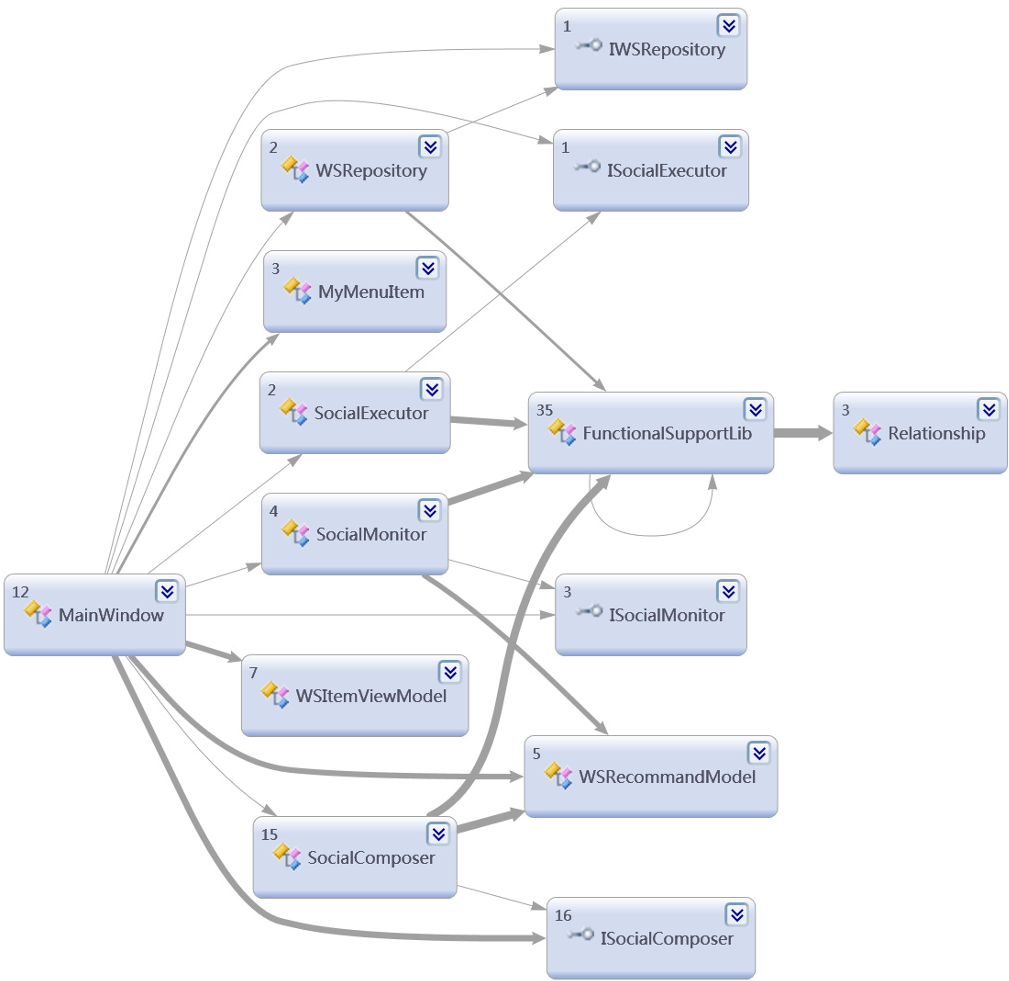
A prototype built on .NET demonstrates the feasibility of this "Socialized" Web. The researchers tested the Competition Social Network in scenarios where services refused to participate.
The results were promising:
- High Precision: The system achieved a precision of 0.8 when recommending the top 10 candidates. This means the social links were highly accurate in identifying relevant and reliable alternatives.
- Resilience: The Social Monitor was able to swap failing services seamlessly by utilizing the pre-calculated substitution links, reducing the time spent on traditional re-discovery.
Critical Analysis & Conclusion
The true value of this work is the shift from Service Discovery to Service Recommendation. By modeling services as nodes in a social graph, the system anticipates failures and identifies the best "team players" for a composition.
Takeaways:
- This paper lays the groundwork for "Cognitive SOA," where the system learns social patterns from user behavior and service interactions.
- Limitations: The model assumes users provide unbiased feedback and that calculating these weights doesn't introduce excessive overhead—a factor the authors plan to study further.
In the future, we can expect these "Social Web Services" to integrate with AI-driven adaptors, allowing for even more fluid and self-healing business applications.