
aLF: Bridging Distance Education Gaps with Multi-Classifier User Modeling
User Data Management and Usage Model Acquisition in an Adaptive Educational Collaborative Environment
The paper introduces aLF (active learning framework), a web-based educational environment designed for distance learning. It proposes an integrated user modeling subsystem that utilizes a multi-classifier ensemble approach to predict student activity levels and performance based on rich interaction data stored in relational databases.
TL;DR
This research addresses the "isolation problem" in distance learning by transforming static educational websites into adaptive environments. By introducing aLF (active learning framework), the authors demonstrate how structured database-driven interaction logs—processed through a sophisticated ensemble of machine learning classifiers—can accurately predict student engagement and provide proactive pedagogical interventions.
Problem & Motivation: The Static Wall of Distance Learning
In distance education, the lack of physical proximity often leads to student isolation. Traditional educational websites typically serve the same HTML content and navigation paths to everyone, regardless of their prior knowledge or current struggles.
The authors identify a critical gap: Prior adaptive systems focused primarily on static user attributes (like a one-time survey). They argue that the real "gold mine" for personalization lies in usage data—the minute-by-minute interactions a student has with forums, chats, and shared files. However, this data is noisy and complex, making it difficult for any single standard algorithm (like a Decision Tree) to provide accurate predictions across all scenarios.
Methodology: Beyond Web Logs to Relational User Models
The core of aLF’s innovation lies in its data architecture and its "referee-based" learning ensemble.
1. Structured Data Collection
Unlike systems that rely on messy "web logs" (which only track URLs), aLF is built on the ArsDigita Community System. This allows every interaction—forum replies, chat entries, and file uploads—to be stored as structured entities in a relational database. This makes it possible to track advanced features like "number of threads started but not replied to," which is a high-signal indicator of student frustration.
2. The Multi-Classifier Architecture
Predicting "Activity Level" or "Failure Risk" is non-trivial. The researchers propose an ensemble approach:
- Base Learners: They use C4.5 Decision Trees, Rule-based learners, and Naive Bayes.
- The Referee Mechanism: For each classifier, a "referee" is trained to predict whether its specific classifier is likely to be correct for a given instance.
- Final Decision: The system combines the predictions of the "trusted" classifiers via majority voting.
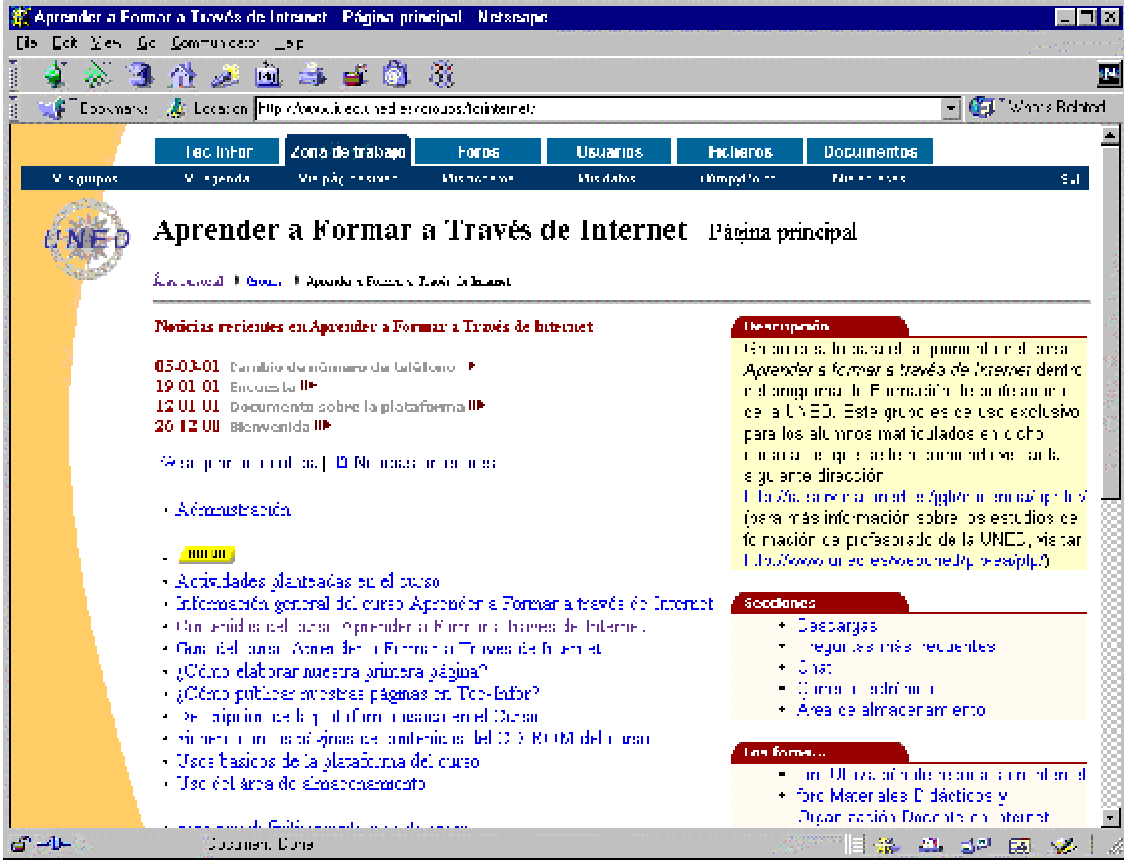 Figure 1: The community-based structure of aLF, grouping users into manageable workgroups.
Experiments & Results: The Power of the Ensemble
The researchers tested their approach on a dataset of 125 instances with 21 different interaction attributes. The results highlights a classic machine learning phenomenon: The Diversity Bonus.
| Algorithm | Accuracy (Individual) |
|---|---|
| C4.5 | 13.46% |
| Naive Bayes | 42.37% |
| Ensemble (Proposed) | ~87.8% (12.11% error) |
As shown in the data tables below, the individual performance of a single Naive Bayes or C4.5 model was relatively poor. However, the ensemble approach dramatically slashed the error rate.
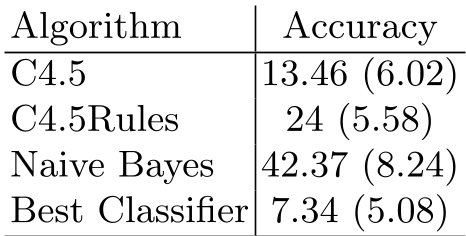 Table 2: Individual accuracy vs. the theoretical "Best Classifier" upper bound.
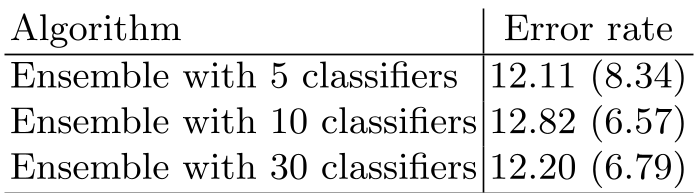 Table 3: The drastically reduced error rate when using an ensemble of 5 to 30 classifiers.
Critical Insight & Conclusion
The specific value of this work is the realization that pedagogical context matters. By identifying students who are "low activity" early in a course, instructors can intervene before the student fails.
Key Takeaways:
- Database over Logs: Storing interactions in relational tables allows for much deeper feature engineering than simple URL tracking.
- Ensembles for Heterogeneity: In human-centric data (like learning behavior), no single algorithm covers all "competence regions." Ensembles with referees provide a safety net.
- Adaptive Collaboration: The future of EdTech isn't just "show the right page," but "connect the right people" (e.g., suggesting a struggling student chat with a high-performing peer).
Limitations: The current study uses a relatively small sample size (125 instances). Scaling this to the 180,000 students at UNED would require significant computational optimization of the ensemble training process.