
Fine-Grained Sovereignty: Why Social Networks Need Expressive Access Control
On the need for user-defined fine-grained access control policies for social networking applications
This paper proposes the integration of user-defined, fine-grained access control policies for social networking applications. Drawing parallels from e-Science and e-Health (the e-* arenas), the author advocates for a technical shift toward expressive authorization languages like XACML to mitigate privacy risks such as stalking and data re-identification.
TL;DR
Social networking sites are the "Web 2.0" success story, yet their privacy controls remain rudimentary. Based on high-stakes data sharing in e-Science and e-Health, this paper argues that users should define their own fine-grained access policies using formal languages. By moving beyond "Friends/Public" toggles to attribute-based rules, we can better protect personal data without stifling social interaction.
Background: Published in 2008 (Securecomm), this work sits at the intersection of Social Computing and Formal Methods, attempting to fix the "Privacy Paradox" before it became a mainstream crisis.
Problem & Motivation: The Blunt Instrument of Modern Privacy
The author identifies a critical mismatch between user intent and system capability. Users want to share, but they lack the tools to share wisely.
- Lack of Expressivity: Existing platforms like LinkedIn or Facebook (at the time) distribute settings across multiple pages, making it impossible for a user to be certain of their security posture.
- Relationship Complexity: Social relations are not binary. We may want to reveal info to a stranger (anonymously) but hide it from a close acquaintance, or vice versa—a nuance current "circles" cannot capture.
- The Privacy Paradox: Users express deep concern for privacy yet disclose massive amounts of data. The author argues this is partly a failure of the UI/UX and the underlying technical architecture to provide meaningful, easy-to-use protections.
Methodology: Lessons from e-Health
The core insight is that social networks are effectively "Data Grids" for individuals. Therefore, the security architecture should mirror that of an e-Health Grid.
The paper advocates for three principles derived from the sif (Service-oriented Interoperability Framework):
- Ownership: The user (data owner) is the sole authority for policy definition.
- Flexibility: Systems must support "Attribute-Based" control (age, gender, network affiliation).
- Auditability: Users must be able to see who accessed what and when.
Formalizing the Policy
To avoid the ambiguity of natural language, the paper uses Z notation (a mathematical formalization) to describe access rules. This allows for real-time verification to ensure a user's specific policy doesn't violate a broader framework (like a parent's safety constraints for a child).
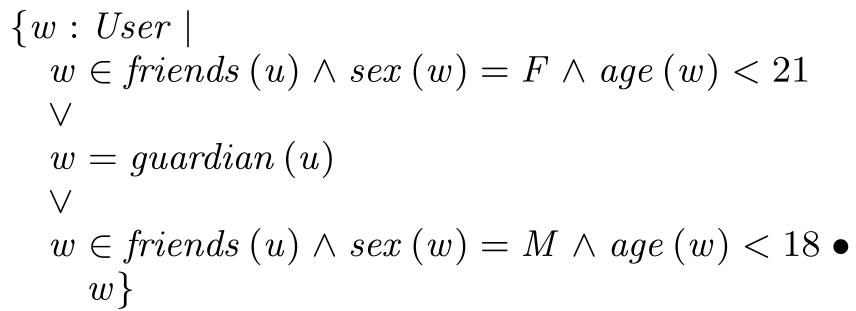 Above: A Z-style set comprehension defining a policy where only certain friends of specific ages or genders can view a profile.
Experiments & Results: The "Parental Boundary" Case
The author demonstrates the power of fine-grained control through a "Parental Boundary" scenario. In this model, a parent sets a high-level constraint (e.g., "Only friends under 21 can view files"), and the child creates their own policy within those bounds.
Comparisons with SOTA (2008)
| Feature | Facebook (2008) | LinkedIn (2008) | Proposed Method |
|---|---|---|---|
| Granularity | Limited (Networks/Friends) | Very Restrictive | Attribute-Based (Full) |
| Logic | Simple White/Black list | Fixed Categories | Complex Set Comprehension |
| Audit | None | Limited/Opt-out | Mandatory/Tailored |
 In practice, this would allow a user to say: "Only my female friends who are also in the Engineering network can see my work-related photos."
Critical Analysis & Conclusion
Takeaways
The paper successfully bridges the gap between academic formal methods and social media pragmatism. It posits that trust is not a technical constant but a social variable that requires expressive technical tools to manage.
Limitations
- Complexity vs. Usability: As the author admits, "with expressibility comes complexity." Expecting a teenager to write Z notation or XACML is unrealistic. The challenge remains in building a UI that translates human intent into these formal sets.
- The Corporate Conflict: The paper acknowledges but does not solve the fact that social media companies profit from data disclosure. A perfectly secure, fine-grained system might limit the data available for ad-targeting.
Future Outlook
As we move toward decentralized social media (Web3) and Self-Sovereign Identity (SSI), the principles of user-defined fine-grained access control are more relevant than ever. This 2008 paper laid the groundwork for what we now understand as "Privacy by Design."