
CUG-Based Recommendation: Bridging Social Graphs and Content Preferences
The User-Group Based Recommendation for the Diverse Multimedia Contents in the Social Network Environments
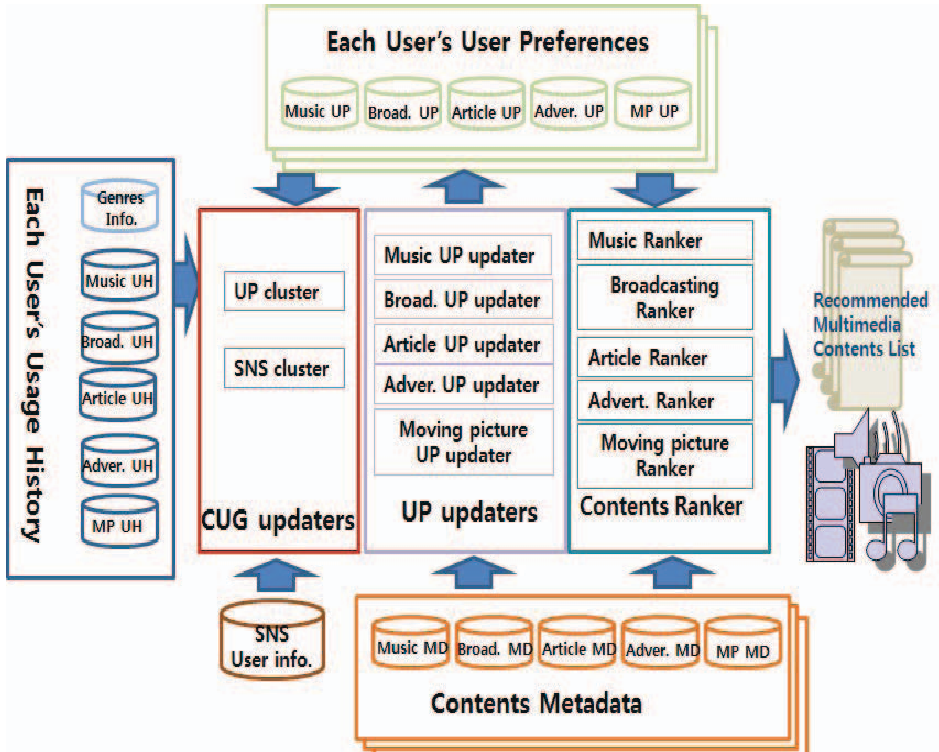
This paper introduces a Personalized Multimedia Content Recommendation System designed for Web 2.0 and Social Network Service (SNS) environments. It leverages a Collaborative User Group (CUG) framework, utilizing both Preference Clusters (similarity-based) and Social Clusters (relationship-based) to provide multi-modal recommendations across articles, TV, video, and audio.
TL;DR
As the web transitions from static pages to dynamic social ecosystems, recommendation engines must evolve. This paper proposes a Collaborative User Group (CUG) framework that enhances personalized recommendations by clustering users based on two dimensions: their explicit social ties and their implicit taste similarities. By applying this to a diverse range of multimedia (from TV to UCC like YouTube), the authors achieved a 30% improvement in recommendation quality (MRR).
The Evolution of the "Social" Recommendation
In the early days of personalized TV, systems were isolated islands. They looked at your history to predict your future. However, this approach hits a wall known as Data Sparseness. If you haven't watched much, the system knows nothing.
The authors argue that in a Web 2.0 world, two things are true:
- We like what our friends like (Social Influence).
- We like what people with similar tastes like (Statistical Trends).
Methodology: The CUG Framework
The core innovation lies in the CUG Updater, which doesn't just look for "similar users," but distinguishes between two types of clusters:
1. Preference Clusters (PC)
The system creates a binary preference vector for every user across various genres (News, Music, Video, etc.). It then calculates the Dice Coefficient to measure how much two users overlap.
Users with higher-than-average similarity are grouped, allowing the system to "borrow" history from the group to fill in the gaps for the individual.
2. Social Network Clusters (SC)
This leverages the actual social graph (friends, groups). The intuition is simple: social relations often imply shared interests that preference vectors might not yet have captured.
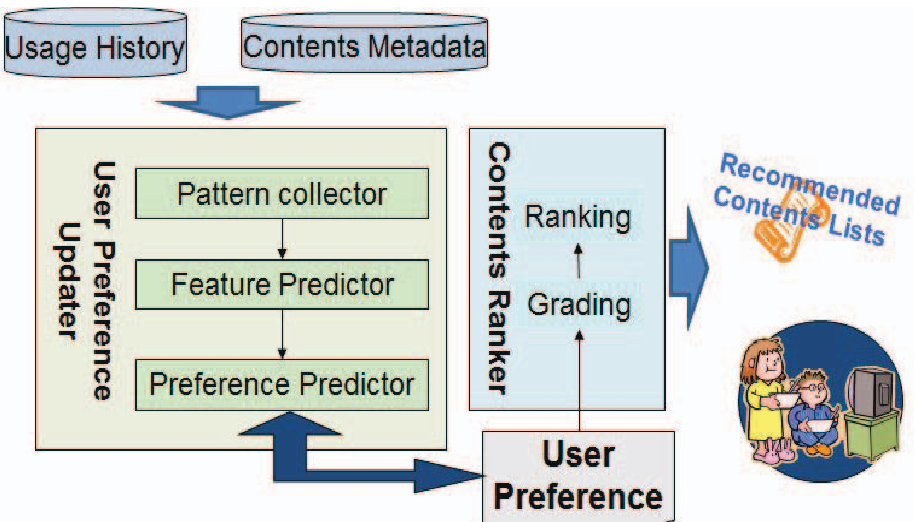
3. Action Sequence Mining (MI)
Instead of just looking at what was watched, the system looks at how it was watched. By calculating Mutual Information (MI), the system distinguishes between "Positive Patterns" (actions strongly linked to preferred content) and "Negative Patterns."
Experimental Validation
The authors tested the system using the TV-Anytime metadata standard. The primary metric was Mean Reciprocal Rank (MRR), which measures how "high up" the first relevant recommendation appears in the list.
- Baseline (No Clustering): 0.439 MRR
- With Preference Clusters: 0.572 MRR
This jump indicates that collaborative data significantly helps the engine find "correct" content faster.
Critical Insight & Future Work
The true value of this work is its hybrid nature. By combining formal social relations (SNS) with mathematical similarity (Dice Coefficient), the system becomes robust against the volatility of individual user behavior.
Limitations: The study utilized a relatively small group (10 users). While the theory is sound, the scalability to millions of social connections remains a challenge for future implementation. The authors aim to expand this to multi-platform environments where social relations are even more fragmented.
Conclusion
This paper sets a clear path for the next generation of Recommender Systems: stop looking at users as data points and start looking at them as nodes in a social network. The synergy between social context and usage history is the key to breaking the "filter bubble" and solving the data sparsity trap.