
The Physics of YouTube Groups: How Content Shapes Social Architecture
User Groups in Social Networks: An Experimental Study on YouTube
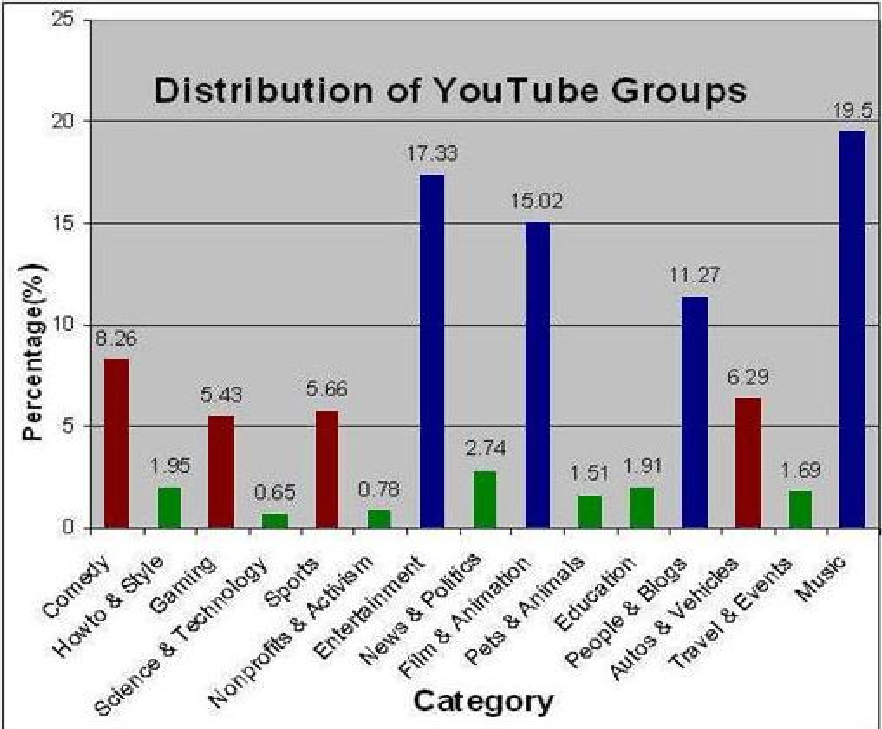
This paper presents a seminal longitudinal study of explicit user groups on YouTube, analyzing how content-oriented social networks function differently from purely social ones. By examining 18,000 groups across seven categories, the authors characterize the interplay between "friendship" (social-oriented) and "subscription" (content-oriented) ties, identifying a "smaller-world" phenomenon within these explicit communities.
TL;DR
This study deep-dives into the hidden structural mechanics of YouTube's explicit groups. It reveals that content-heavy platforms don't just mimic social networks; they create "smaller worlds" where content production—not social interaction—is the primary gravitational force. The findings show that a tiny elite (under 10%) generates the vast majority of value, while the network itself grows denser and "smaller" over time.
Context: Content as the Social Glue
In the mid-2000s, social networking was often categorized into "purely social" (Orkut, Friendster) vs. "content-oriented" (YouTube, Flickr). This paper asks a fundamental question: When users group together around videos, does the network look different?
The authors argue that "semantic differentiation" (the category of the group) acts as a structural differentiator. For example, a "Wrestling" group might be more reciprocal and social, whereas a "Programming" group is driven by expertise exchange.
Methodology: Mapping the YouTube Galaxy
To prove this, the researchers executed a massive five-phase crawl, capturing 193,000 users and 53 million friendship links. They analyzed the data through two primary lenses:
- Friendship Links: Symmetric, personal, and socialization-oriented.
- Subscription Links: Asymmetric, content-oriented, and intent-driven.
Core Discovery: The "Smaller World" Phenomenon
While the "Small World" effect (six degrees of separation) is well-known, YouTube groups are "Smaller Worlds."
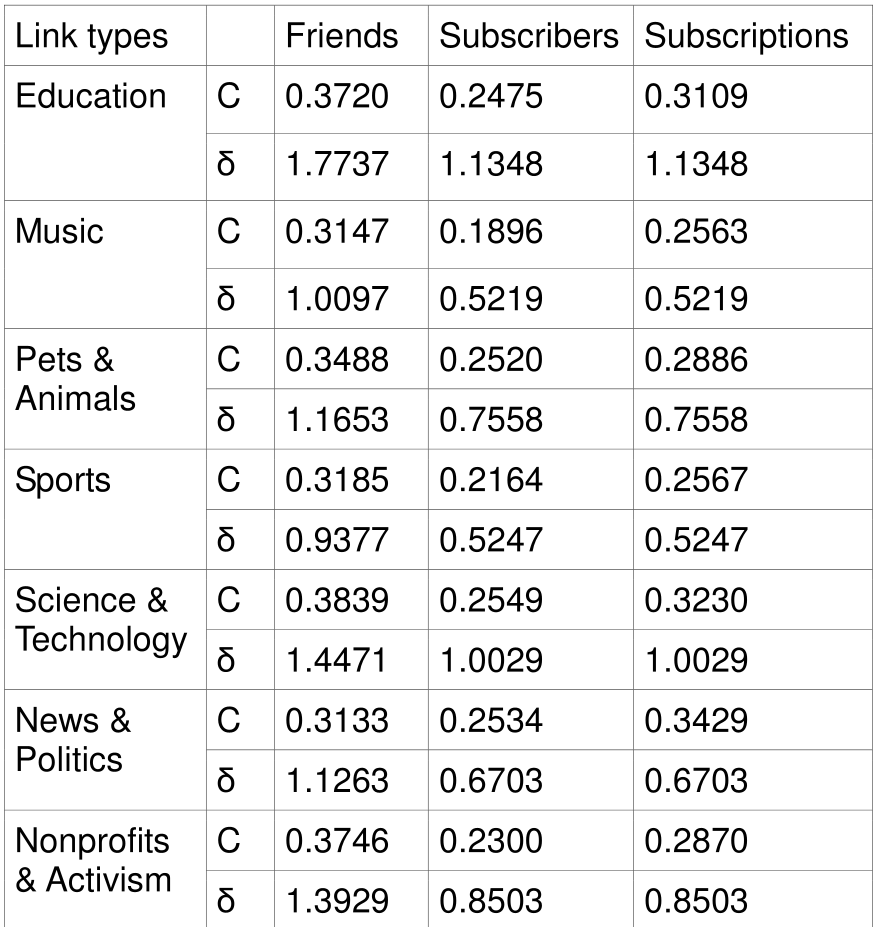
- High Clustering: The clustering coefficient () in groups is 2-3 times higher than in the general YouTube network.
- Tight Locality: When people join a group, they aren't just joining a list; they are entering a dense thicket of interconnectedness.
- Artificial Comparison: The authors compared real groups to "artificial" ones (random users with high friend counts). Real groups were significantly more clustered, proving that the group intent creates the structure, not just the existence of "popular" users.
The Pareto Principle of Production
Who actually runs the show? The study identified a stark imbalance in contribution:
- Owners & Centers: Only 7-10% of the population (owners and users at the mathematical center of the network) contribute 60% of all videos.
- Moderators' Irrelevance: Surprisingly, moderators contribute less than 1% of videos. Their role is purely administrative, whereas "central" users are the lifeblood of the group.
- The Singleton Majority: Despite the dense core, over 50% of users in every category are "singletons"—they join but never form a single friendship or subscription link within the group. They are pure consumers.
Evolution: Densification and the "Rich get Richer"
By tracking groups over 7 months, the authors observed a fascinating evolution:
- Shrinking Diameters: As groups grow, the average distance between members actually decreases. This is "densification."
- The Subscription Fringe: New members don't appear out of nowhere. 65% of new members are within 3 hops of existing members, mainly following "subscription" trails. Popular content producers act as magnets, roping in their existing "fringe" of subscribers into the explicit group.
Critical Insight: Why This Matters Today
This paper provides the early blueprint for what we now call the "Creator Economy." It demonstrates that in content-oriented networks:
- Social connections are epiphenomenal: You don't follow a person to be their friend; you follow them for the video, and the friendship follows the content.
- Asymmetry is Feature, Not Bug: The gap between content producers and consumers is structurally baked into the network.
Conclusion
YouTube groups are not just collections of users; they are high-density hubs driven by a few "alpha" contributors. As these hubs evolve, they don't just get bigger—they get tighter. For modern developers and social scientists, this highlights that community growth is best stimulated not by "social features," but by empowering the 7% at the center who provide 60% of the value.