
Beyond the Username: Identifying Users Through the Geographic "Fingerprints" of Their Friends
Short Paper: User Identification across Online Social Networks Based on Similarities among Distributions of Friends’ Locations
This paper introduces a novel cross-platform user identification method that leverages the spatial distribution of a user's friend network. By converting friends' location data into hierarchical geographic units (Country, State, City) and calculating distance-weighted occurrence frequencies, the method achieves 91.2% identification accuracy across Twitter and Foursquare.
TL;DR
Researchers have developed a method to identify the same individual across different social media platforms (like Twitter and Foursquare) by looking at where their friends live. By analyzing the spatial distribution of a user’s social circle and weighting rare, long-distance connections, the system achieves an impressive 91.2% accuracy, significantly outperforming traditional name-matching techniques.
Background: The Identity Linkage Problem
In the fragmented landscape of modern social media, we are digital ghosts. You might be a professional "John Doe" on LinkedIn, a pseudonymous "TechGuru99" on Twitter, and a private "JD" on Instagram. For researchers, advertisers, or investigators, linking these disparate accounts is a "User Identification" task.
The traditional go-to method is Display Name Similarity. However, this faces two fatal flaws:
- Inconsistency: Users often change names across platforms.
- Ambiguity: Thousands of people share the name "John Smith."
The Insight: You Are Where Your Friends Are
The authors of this paper shift the focus from the user to the user's context. They rely on a social phenomenon: social communities (schools, workplaces) often cluster geographically. Even if you hide your profile, the "distribution of your friends' locations" remains a remarkably stable and unique fingerprint across platforms.
Methodology: Mapping the Social Geography
The proposed framework operates in three sophisticated steps:
1. Geographic Normalization
Since OSN location fields are often messy (e.g., "The Big Apple" vs. "New York City"), the authors use OpenStreetMap to convert raw text into formal administrative units: Country, State, and City.
2. Weighted Occurrence Frequency (The "Rare Pair" Logic)
This is the core innovation. The authors hypothesize that while many friends might live in the same city, having a friend in Tokyo and a friend in California is a relatively rare combination. They calculate a weight () based on the distance between friend locations.
- Logic: If two accounts both have friends in two very distant locations, the likelihood that those accounts belong to the same person increases exponentially.
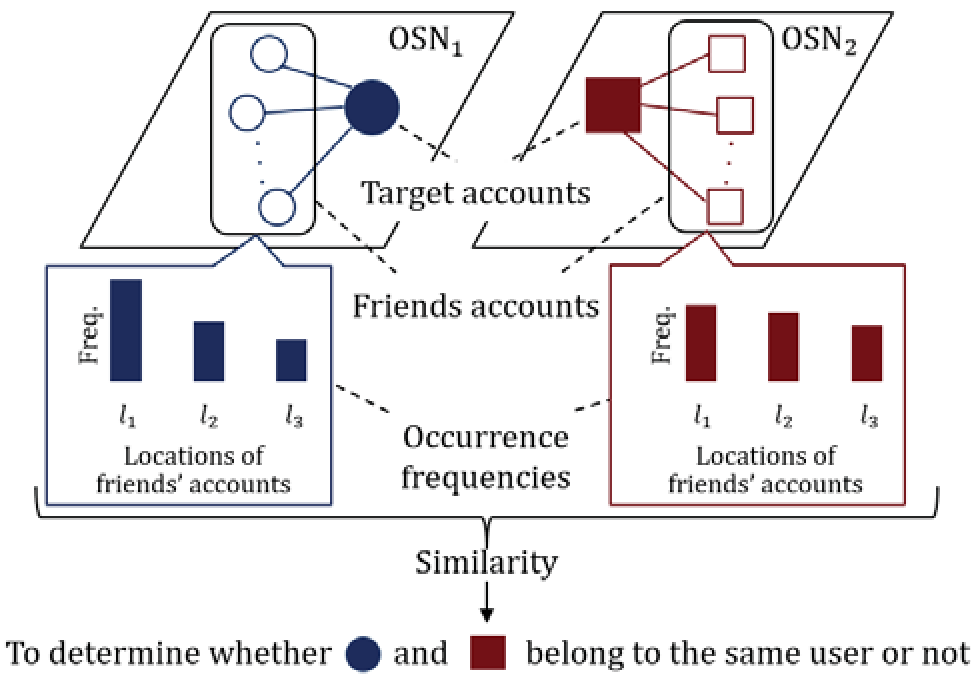 Fig 1: The workflow of extracting friend locations and calculating similarity scores.
3. Score Fusion
The system doesn't just look at one level. It calculates similarity scores at the Country, State, and City levels.
- Country level offers high Recall (finding potential matches).
- City level offers high Precision (verifying matches).
- By fusing these scores using a weighted average, the model achieves optimal performance.
Experimental Results: Setting a New SOTA
The researchers tested their method on a dataset of 623 users with both Twitter and Foursquare accounts. The baseline (Li’s name-matching method) hit a ceiling at 83.1% accuracy.
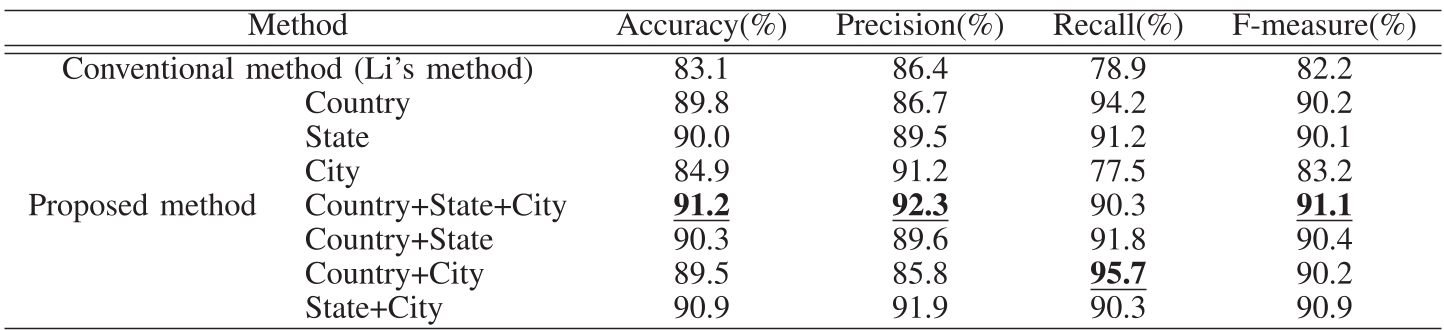 Table 1: The Proposed Method (Country+State+City) reaches 91.1% F-measure, a significant jump over name-based baselines.
Key Findings:
- Precision vs. Recall: Relying only on countries leads to too many "False Positives" (many strangers share the same country-level friend distribution). Relying only on cities is too strict.
- The Power of Fusion: The "Country+State+City" model provides the most robust separation between genuine matches and impostors.
Critical Insight & Evaluation
This work represents a shift toward Relational Features in identity linkage. It proves that even if a user is hyper-vigilant about their own privacy settings, the public data of their friends can betray their identity.
Limitations & Future Work:
- Cold Start: The method requires the user to have at least two friends with valid location data.
- Data Sparsity: As social networks become more globalized, the "geographic fingerprint" might become more diluted, requiring more advanced graph-based features beyond simple administrative units.
- Future Extension: Applying this to multi-modal data (e.g., matching the style of posted photos) could drive accuracy even closer to 100%.
Conclusion
By treating a friend list as a geographic distribution rather than just a list of names, the authors have provided a powerful tool for cross-platform analytics. It serves as both a breakthrough for personalized services and a sobering reminder of how difficult it is to remain truly anonymous in an interconnected world.