
Beyond Text: Identifying Social Media Users via Graph Transformer Networks
User Identification in Online Social Networks using Graph Transformer Networks
2021-12-13
Summary
Problem
Method
Results
Takeaways
Abstract
The paper introduces a graph-based biometric identification system for Twitter users, utilizing a novel Graph Transformer Network (GTN) architecture. By combining semantic textual analysis via a Siamese Attention-based Bi-directional LSTM (SAB-LSTM) with social interaction graphs (retweets, mentions, replies), the system achieves state-of-the-art results in closed-set node identification across three public datasets.
## Executive Summary
**TL;DR**: This paper presents a breakthrough in social media forensics by identifying Twitter users through a combination of *what they say* and *who they interact with*. By bridging Natural Language Processing (NLP) and Graph Neural Networks (GNNs), the authors' proposed **Graph Transformer Network (GTN)** outperforms traditional stylometric and content-based methods.
**Background**: In the landscape of digital forensics, "Soft Biometrics"—behavioral patterns rather than physical traits—are becoming vital for security. This work moves from simple "count-based" text analysis to high-dimensional "relational" analysis, positioning itself as a new SOTA (State-of-the-Art) in closed-set user recognition.
## The Core Challenge: The Sparsity of Tweets
Identifying a user by a few tweets is like trying to identify a person by a single shouted sentence. Previous methods struggled because:
1. **Linguistic Noise**: Tweets are short, informal, and change over time (high intra-user variability).
2. **Relational Neglect**: Most systems treat users as isolated islands, ignoring the rich "social signal" of retweets, mentions, and replies.
3. **Feature Engineering**: Older models relied on handcrafted features (like punctuation frequency) that don't scale well across different populations.
## Methodology: The Fusion of Semantics and Topology
The authors solve this through a sophisticated three-stage pipeline that treats the social network as a **weighted graph**.
### 1. The Semantic Engine: SAB-LSTM
To capture the "flavor" of a user's writing, the authors developed a **Siamese Attention-based Bi-directional LSTM (SAB-LSTM)**.
- **Distributed Semantic Representation**: It combines word-level statistics (GloVe) with deep contextual embeddings (Universal Sentence Encoder).
- **Why it works**: The Siamese architecture is trained to minimize the distance between tweet streams from the same author while maximizing it for different authors.
### 2. The Weighted Social Graph
Instead of a simple binary edge (connected/not connected), the authors calculate **edge weights** using the authorship similarity output from the SAB-LSTM. This creates a "User Affinity Matrix" where intimacy is mathematically defined.
### 3. The Powerhouse: Graph Transformer Network (GTN)
The GTN is the "brain" of the system. It processes the graph by attending to the most informative neighbors.
- **Positional Encoding**: Uses the Weisfeiler-Lehman (WL) algorithm to give the model a sense of "where" a node sits in the global structure.
- **Architecture**:
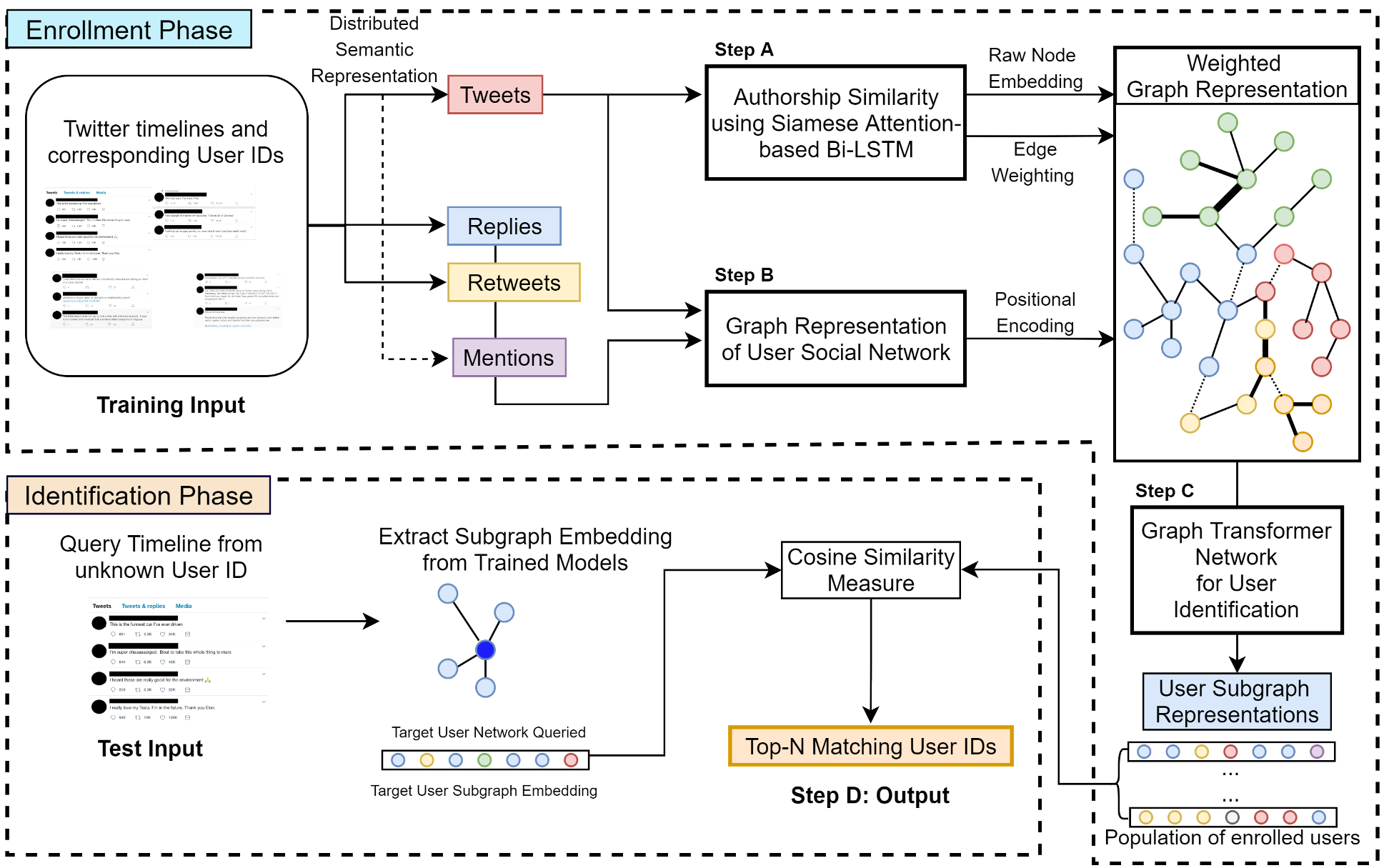
*Fig 1: The dual-path pipeline from raw tweets to graph-based identification.*
## Experimental Insights: Better Together
The authors tested their system against several benchmarks (MLP, CNN, GRU, etc.) and established SOTA systems like AA-SMF.
### Key Findings:
- **Input Representation Matters**: The combination of **GloVe + USE** provided the most stable feature set, enabling the SAB-LSTM to reach 57.2% accuracy on its own.
- **The "Graph Bonus"**: When the GTN was added, accuracy shot up. On the GW Libraries dataset (1000 users), the Rank-20 accuracy reached **81.6%**, proving that social interactions are a highly identifying biometric trait.
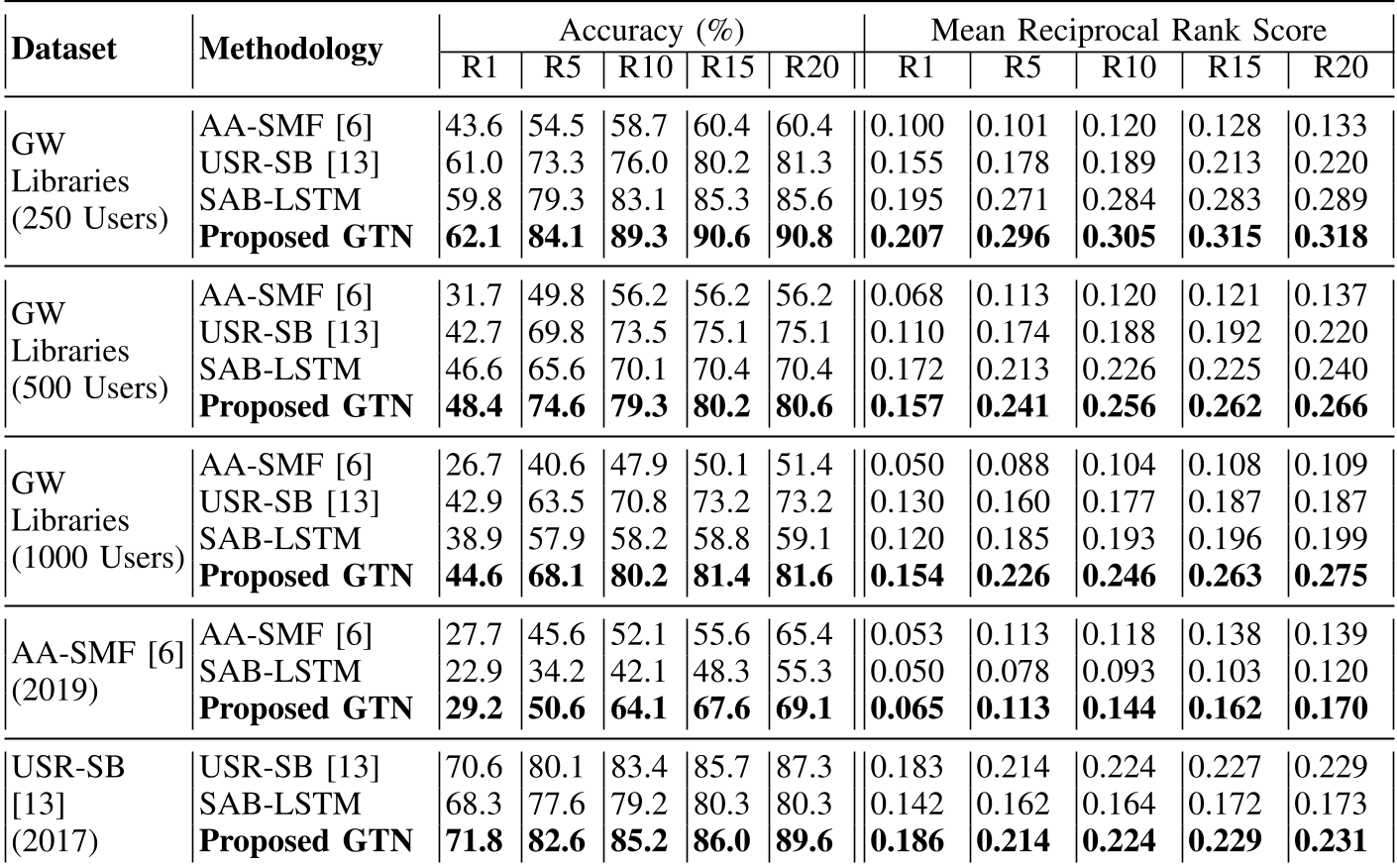
*Table 1: GTN consistently outperforms previous benchmarks across multiple datasets.*
## Critical Analysis & Future Outlook
**Insight**: The most significant take-away is the **Manhattan distance** performance. In the Siamese network, the authors found Manhattan distance worked better than Euclidean or Cosine, likely because high-dimensional latent spaces in text analysis favor the $L_1$ norm's ability to handle sparse differences.
**Limitations**:
- **Privacy Risks**: The paper explicitly mentions that such high identification accuracy is a "threat to privacy," highlighting the need for "de-identification" research.
- **Computational Cost**: Training Graph Transformers on massive, real-world social graphs (millions of nodes) remains a challenge not fully addressed here.
**Future Work**: The next frontier is **multimodal biometrics**—integrating images, videos, and shared URLs into the graph to create a truly "un-spoofable" digital identity.
## Conclusion
By moving from "Authorship Attribution" to "Social Behavioral Biometrics," this work provides a framework for the next generation of cybersecurity tools. It proves that in the digital age, your identity is not just what you say—it’s how you are woven into the social fabric.