
GAUI: Decoding Identity Across Social Networks via Global View Features
User Identification across Social Networks Based on Global View Features
The paper introduces GAUI, an iterative algorithm for User Identification across social networks that combines user attributes with a novel "Global View Feature." It achieves state-of-the-art results on datasets like Twitter-Flickr and LiveJournal-Last.fm by leveraging the relative positioning of users within the broader network structure.
TL;DR
Matching a single user across different platforms (e.g., finding the same person on Twitter and Flickr) is a classic "User Identification" challenge. While most methods look at who your immediate friends are, GAUI looks at where you stand in the entire network "map." By using an iterative process and a novel Global View Feature, this method achieves high precision even when pre-existing link data is sparse.
Problem & Motivation: The Limits of Local Sight
Traditional user identification focuses on Local Structure Features. If user A on Twitter and user B on Flickr share many "linked" friends, they are likely the same person. However, this has two major flaws:
- Neighbor Blindness: It ignores users who are not immediate neighbors but are still close in the network hierarchy.
- Cold-Start Sensitivity: If you don't already have a massive number of known links (anchor links), local methods fail to find new ones because the "overlap" is too small to be statistically significant.
The authors' insight is simple: Your identity isn't just defined by your immediate circle, but by your relative position to major landmarks (known anchor links) across the entire social landscape.
Methodology: Mapping the Global View
1. Global View Feature (GVF)
Instead of just counting friends, GAUI creates a coordinate for every user based on their distance to known "Anchor Links."
The core formula for relationship considers not just the shortest path between a landmark and user , but also the distances of all 's neighbors. This "smooths" the distance and provides a more unique signature for each user's location.
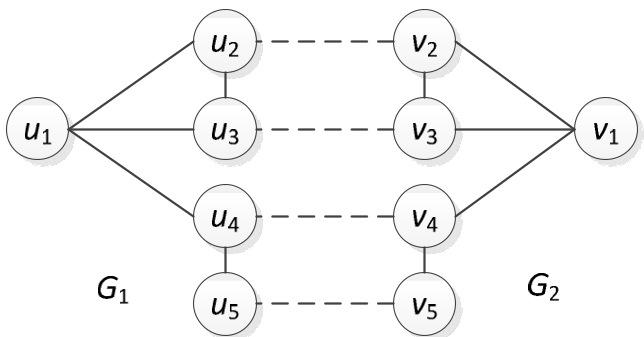 Figure 1: The concept of aligned social networks and anchor links.
2. The GAUI Algorithm
The algorithm operates in two iterative stages:
- Similarity Computation: Calculates a hybrid similarity score combining text attributes (username, email) and the Global Structure Similarity (GSS) derived from GVFs.
- Mapping & Filtering: Uses a Stable Matching strategy. To avoid errors, it only accepts matches that exceed a similarity threshold () and ensures there is no "ambiguity" (where two candidate matches have nearly identical scores).
3. Community-Based Efficiency
Calculating distances to every anchor link is expensive. GAUI uses a Core Anchor Link Filter. It partitions the network into communities and selects "Central" nodes within those communities to act as the primary landmarks, reducing dimensionality without losing structural resolution.
Experiments & Results: SOTA Performance
The authors tested GAUI on Twitter-Flickr and LiveJournal-Last.fm datasets.
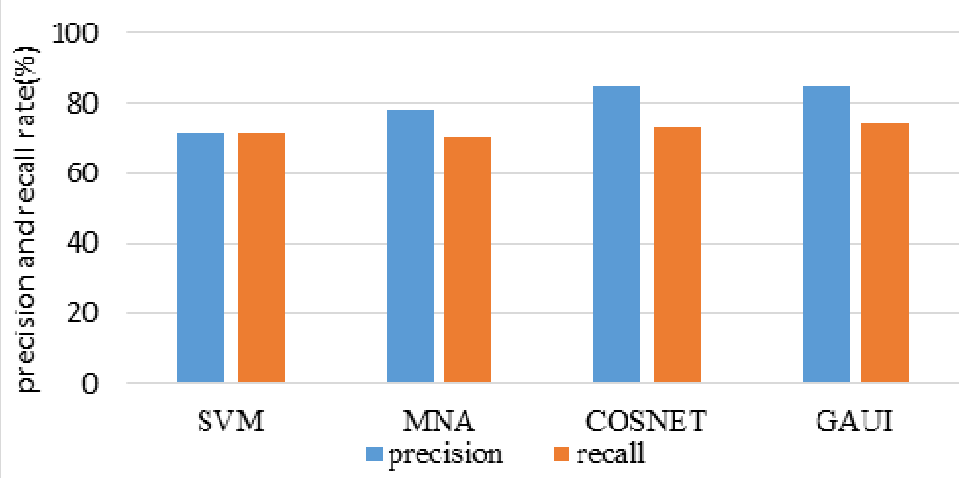 Figure 5: Performance on Twitter-Flickr dataset showing GAUI's superiority over SVM and MNA.
Key Findings:
- Precision vs. Recall: GAUI consistently outperformed supervised learning (SVM) and local-structure methods (MNA).
- Stability: Unlike energy-based models (COSNET) which are computationally heavy, GAUI’s iterative approach allows for a controlled, high-precision expansion of the anchor link set.
- Optimal Hyperparameters: The research found that a balanced weighting between attributes and structure () yielded the best results, proving that "who you are" and "where you are" are equally important.
Critical Analysis & Conclusion
Takeaway: GAUI successfully shifts the paradigm from "friend-matching" to "position-matching." By treating known links as navigation satellites, it maps the "GPS coordinates" of users across social graphs.
Limitations: The method relies on shortest-path calculations. In hyper-dense networks (like Facebook), the "Small World" phenomenon might make shortest distances less discriminative as most users are only 3-4 hops away from any landmark.
Future Outlook: The next step for this lineage of research involves integrating temporal dynamics—how your location in the network changes over time—and exploring how Graph Neural Networks (GNNs) could automate the extraction of these "Global View" features without manual distance formulas.