
UserNet: Decoding Digital Fingerprints Across Social Media via Multi-modal Content and Time-Awareness
14374_User Identity Linkage Across Social Media via Attentive Time-Aware User Modeling.
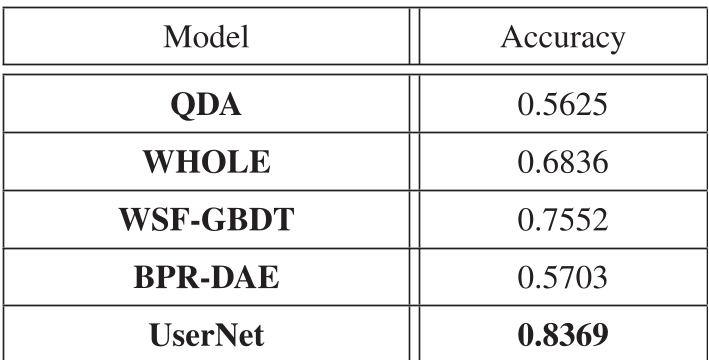
This paper introduces UserNet, an attentive time-aware framework for linking user identities across social media platforms like Twitter and Instagram using heterogeneous User-Generated Content (UGC). It leverages BiLSTM for text and ResNet for images, uniquely integrating temporal post correlation and modality-specific attention to achieve a state-of-the-art accuracy of 83.69% on the newly created TWIN dataset.
TL;DR
In an era where users scatter their digital presence across multiple social networks, linking these disparate accounts to a single identity is a "Holy Grail" for personalized services and security. UserNet is a deep-learning-based framework that achieves this by analyzing what users post (multi-modal UGC) and when they post it (temporal correlation). By combining BiLSTM-based text analysis, ResNet visual features, and a novel attention-time mechanism, it achieves a high accuracy of 83.69% on a massive real-world dataset.
The Identity Paradox: Why Current Methods Fail
Linking a Twitter handle to an Instagram account is notoriously difficult. Historically, researchers relied on:
- User Profiles: Usernames and bios can be faked or vary significantly (e.g., @TechGuru on Twitter vs. @JohnDoe_Life on Instagram).
- Network Structures: Reconstructing a user's entire friend graph is often impossible due to API restrictions and privacy silos.
- Shallow Content Analysis: Previous content-based methods focused only on text (ignoring images) and treated a user’s history as a static "bag of words," ignoring the vital temporal rhythm of human behavior.
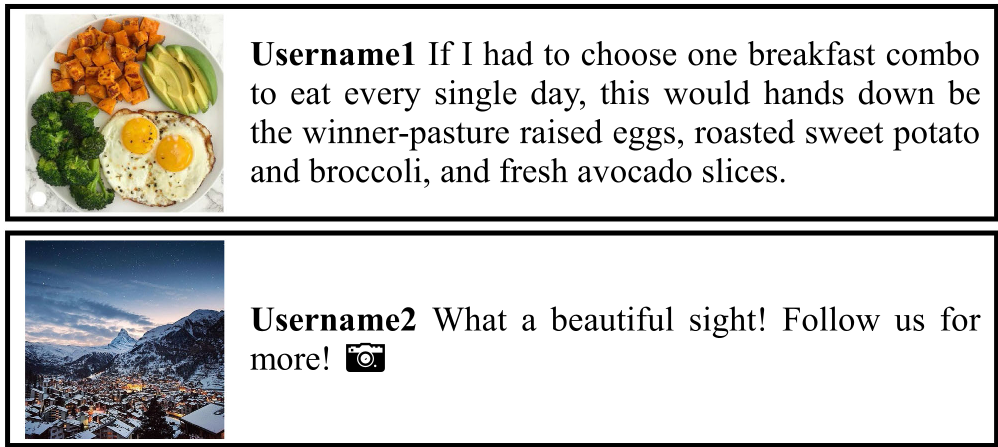
The authors of UserNet realized that while our content changes, our cross-platform synchronization remains a strong signal. If you post a photo of your latte on Instagram and tweet "Morning coffee in Paris!" at the same time, that temporal alignment is a digital fingerprint.
Methodology: The UserNet Architecture
UserNet is built on the philosophy that identity is revealed through the consistency of content and the proximity of actions.
1. Multi-modal Representation
The model processes heterogeneous User-Generated Content (UGC) using specialized "encoders":
- Text (BiLSTM + GloVe): Captures the semantic nuance and writing style of tweets and captions.
- Images (ResNet): Extracts high-level visual features to represent the "visual aesthetic" or recurring objects in a user’s life.
2. Time-Aware Post Correlation
This is the "secret sauce." Instead of treating all posts as equal, UserNet applies a time decay factor. The intuition is simple: the closer two posts are in time across different platforms, the more likely they are to describe the same event, hence providing stronger evidence for identity linkage.
3. Attentive Similarity Modeling
Not all modalities are equally useful for every user. For some, their writing style (text) is more distinctive; for others, their photography (visual) is the key. UserNet uses an Attention Mechanism to adaptively fuse these modalities based on a global similarity distribution.
Experimental Results & Insights
To test UserNet, the authors released TWIN, a dataset of 5,765 users across Twitter and Instagram.
- Performance vs. Baselines: UserNet crushed standard baselines like WSF-GBDT (Writing Style Features) and BPR-DAE.
- The Power of Time: When the temporal factor was removed (UserNet-NoT), accuracy for the multi-modal model dropped from 83.69% to 72.17%, highlighting that time is as important as content.
- Text vs. Image: Interestingly, the study found that textual information remains the dominant signal for identity. However, combining it with visual data through attention still provided the best results.
Critical Analysis & Future Outlook
UserNet successfully bridges the gap between shallow profile matching and deep behavioral analysis. Its reliance on UGC makes it far more robust against users who try to obfuscate their identity through different usernames.
Limitations: The current model thrives on "active" users. For "lurkers" or users with sparse UGC, the model’s performance might degrade. The authors acknowledge this and suggest that future work should integrate UGC analysis with sparse network structures for a hybrid approach.
Conclusion: By proving that our cross-platform "synchronicity"—the alignment of our multi-modal lives in time—is a valid identifier, this paper sets a new standard for User Identity Linkage (UIL) research.
Takeaways for Researchers
- Don't ignore the clock: Timestamps are not just metadata; they are core behavioral features.
- Attention is adaptive: Forcing a 50/50 split between text and image similarity is suboptimal; let the data decide which modality "knows" the user better.