
Joint Multi-Modal Deep Learning: The New Frontier of User Identity Linking
User Identity Linking Across Social Networks by Jointly Modeling Heterogeneous Data with Deep Learning
The paper proposes a deep learning framework for User Identity Linking (UIL) by jointly modeling heterogeneous data across platforms. Specifically, it integrates profile features, network structures, and text content to connect social (Twitter) and academic (DBLP) profiles, achieving a state-of-the-art F1-score of 0.97.
Executive Summary
TL;DR: This paper introduces a sophisticated deep learning approach to User Identity Linking (UIL) that mimics human behavior by simultaneously analyzing profile details, social connections, and shared content. By moving beyond single-feature matching, the authors achieved an impressive 0.97 F1-score in linking Twitter handles to DBLP academic profiles.
Background: Positioned in the field of Social Network Analysis, this work serves as a robust validation of how multi-level neural fusion can solve the "identity fragmentation" problem in the social web.
Problem & Motivation: Why Is Linking So Hard?
Modern users are fragmented across the web—a scientist might share raw thoughts on Twitter but publish formal papers on DBLP. Prior works often focused on "silos":
- Profile-based: Relies on usernames (vulnerable to common names/impersonation).
- Content-based: Relies on text similarity (vulnerable to language shifts between platforms).
- Network-based: Relies on structural topology (vulnerable to incomplete graphs).
The authors' Insight is that no single signal is sufficient. Just as a human "surfer" would check a profile picture, then look at who the user follows, and finally read their posts to confirm an identity, a machine learning model should "jointly" process these heterogeneous cues.
Methodology: The Two-Level Fusion
The core of the approach lies in Representation Learning for three distinct modalities:
- Profile Representation: Uses character-level embeddings for usernames to catch variations and transfer learning for profile images.
- Network Representation: Learns independent embeddings for reciprocal followers (Twitter) and co-authors (DBLP), then learns a mapping between these low-dimensional spaces.
- Content Representation: Matches sentence-level representations (e.g., matching a "Just published a paper on AI" tweet with a DBLP publication title).
Architecture Overview
The system employs a two-tier matching strategy. First, individual MLPs calculate similarity scores for each modality. Then, a "Master MLP" takes these scores as input to make the final decision.

Experiments & Results
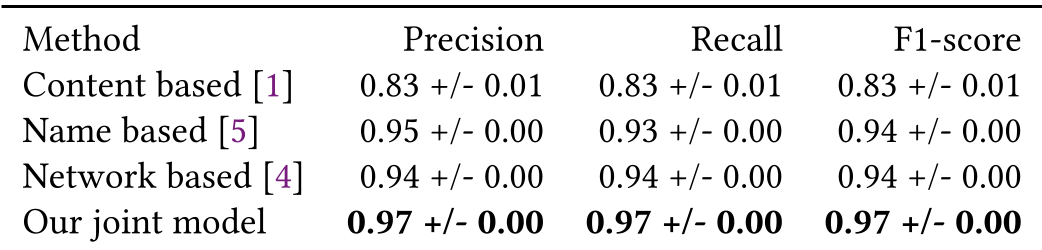
The researchers tested their model on a real-world dataset of computer scientists. The results demonstrate the "synergy effect": the combined model significantly outperforms the sum of its parts.
| Method | Precision | Recall | F1-score |
|---|---|---|---|
| Content based | 0.83 | 0.83 | 0.83 |
| Name based | 0.95 | 0.93 | 0.94 |
| Network based | 0.94 | 0.94 | 0.94 |
| Our Joint Model | 0.97 | 0.97 | 0.97 |
Ablation Insight: While name and network features are strong on their own, adding content and image features provides the "extra mile" needed to resolve ambiguous cases where names overlap.
Deep Insight & Conclusion
Takeaway
The primary contribution of this work is proving that joint modeling is not just an incremental improvement but a necessary evolution for UIL. By leveraging representation learning, we can bridge the gap between "soft" signals (images) and "hard" signals (graph structures).
Limitations & Future Work
- Computational Expense: Multi-modal fusion requires significant resources compared to simple string matching.
- Privacy Concerns: While this tool is powerful for research (e.g., verifying experts), it also raises questions about user anonymity across networks.
- Scaling: Future research could explore how these models scale to millions of users where 10-fold cross-validation becomes computationally prohibitive.
This paper provides a solid blueprint for building more intelligent, cross-platform knowledge graphs by accurately identifying the human "anchors" at the center of the data.