
Scalable Robot Skin: Bridging the Gap Between Proximity Safety and Natural Interaction
User-Interactive Robot Skin With Large-Area Scalability for Safer and Natural Human-Robot Collaboration in Future Telehealthcare
This paper introduces a modular, self-capacitive robot skin designed for safer and natural Human-Robot Collaboration (HRC) in telehealthcare. The solution features two operation modes—safety and interaction—achieving real-time obstacle avoidance and gesture-based manipulation using a scalable FPCB-based sensor array.
TL;DR
Researchers have developed a modular, flexible "robot skin" based on self-capacitive proximity sensing that allows collaborative robots (cobots) to "feel" humans before they touch them. By decoupling the system into Safety Mode (active collision avoidance) and Interaction Mode (complex gesture recognition), this technology transforms robot arms into intuitive interfaces, specifically targeting the high-stakes environment of Telehealthcare 4.0.
The Motivation: Moving Beyond "Collision Detection"
In the evolving landscape of Healthcare 4.0, robots are no longer confined to cages; they work alongside nurses and patients. Current safety standards often rely on torque sensors or physical tactile feedback. The fundamental flaw? Contact has already occurred. For a robot assisting an elderly patient, even a "safe" collision can be traumatic or dangerous.
Furthermore, most research-grade electronic skins struggle with scalability. Covering an entire robot arm typically results in a "wiring monster" that hinders the robot’s range of motion. This paper addresses both the temporal gap (detecting obstacles before contact) and the spatial gap (scalable, modular coverage).
Methodology: The Modular Diamond Pattern
The core of the system is a Self-Capacitive Sensing mechanism. Unlike mutual capacitance, self-capacitance measures the change in a single electrode's charge relative to the earth's ground, making it highly sensitive to human proximity.
1. The Diamond Lattice
The authors utilize a diamond-shaped electrode pattern on a 6x6 matrix. This geometry balances conductive surface area (for distance detection) with spatial resolution (for localizing exactly where a hand is).
2. Scalable Architecture
To solve the wiring bottleneck, the design utilizes:
- FPCB Construction: Flexible Printed Circuit Boards that conform to the robot’s curved limbs.
- I2C Modular Daisy-Chaining: Using MPR121 controllers with configurable addresses, multiple "skin patches" can share a single communication line.
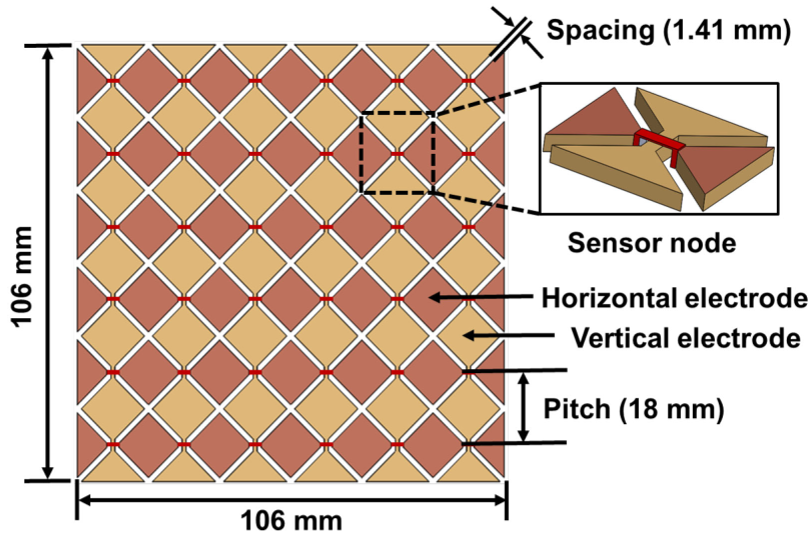 Figure: The modular design of the skin and the cascading communication architecture.
Dual Operation Modes: Safety & Interaction
The brilliance of this work lies in its dual-purpose software logic:
- Safety Mode (Active Avoidance): The skin generates repulsive vectors based on proximity data. When a hand approaches, the robot doesn't just stop; it dynamically re-calculates its trajectory to "swerve" around the obstacle in real-time.
- Interaction Mode (Gesture Command): The skin acts as a touch-free "trackpad." By tracking the sequence of activated nodes, the system can recognize complex gestures (like drawing the letter 'Z' in the air) to trigger higher-level tasks, such as "Pick and Place."
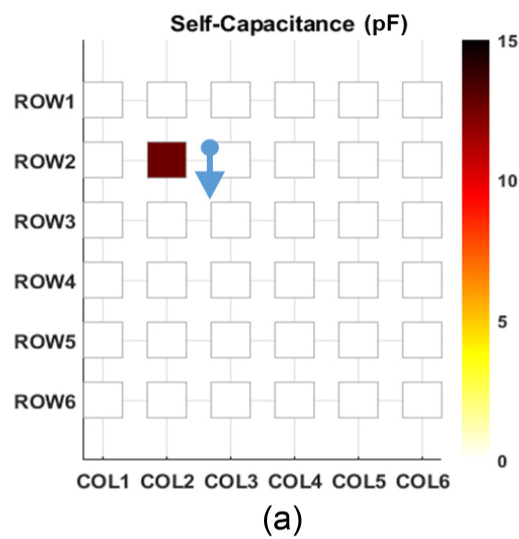 Figure: Recognition of sequential node interaction for gesture-based control.
Experimental Results & Validation
The team tested the skin on an ABB YuMi cobot. Key performance metrics included:
- Detection Range: Reliable detection up to 20mm.
- Stability: Low hysteresis (max 3.75%) and high SNR (up to 56 dB), ensuring that ambient electromagnetic noise doesn't trigger false "scares" for the robot.
- Real-world Utility: The robot successfully navigated a workspace while avoiding a human hand and interpreted "handwritten" commands to move objects with 100% gestural accuracy in controlled trials.
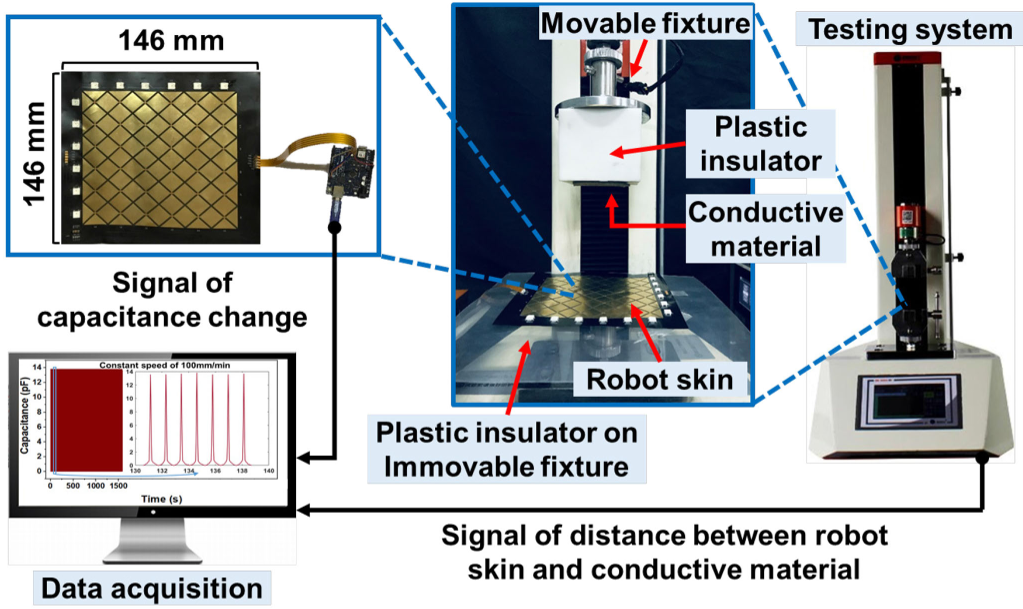 Figure: Testing sensing performance using various surrogate materials and approach speeds.
The Critical Insight: Why This Matters
The shift toward Telehealthcare requires robots that are not just "tools," but "partners." The primary contribution here isn't just a better sensor; it is a scalable integration framework. By reducing wiring complexity and providing visual feedback (via integrated LEDs), the authors have made a "plug-and-play" safety layer that could be retrofitted onto existing industrial arms.
Limitations & Future Work
While the 20mm detection range is sufficient for low-speed collaboration, it is too short for high-speed industrial motion. The authors acknowledge that for "True Safety," a range of 50-100mm is needed to account for the robot’s deceleration time (breaking distance). Future iterations will likely look into shielded cabling and EtherCAT to reduce the current 15ms latency.
Conclusion
This modular robot skin represents a significant step toward "natural" HRC. By giving robots a "sense of space" that mimics human skin's anticipatory nature, we move closer to a future where robots can provide care in homes and hospitals with the same intuitive safety we expect from a human assistant.