
Beyond the Graph: Elevating Tunisian Tourism with Social-Ontological Intelligence
Designing a User Interest Ontology-Driven Social Recommender System: Application for Tunisian Tourism
This paper introduces a User Interest Ontology-driven social recommender system tailored for the Tunisian tourism industry. It integrates Facebook social graph data with semantic modeling to deliver personalized travel recommendations by merging Collaborative Filtering with domain-specific ontologies.
TL;DR
This research presents a novel architecture for social recommender systems that moves beyond simple numerical rankings. By constructing a User Interest Ontology from Facebook data—analyzing everything from "likes" to semantic linguistic patterns—the system provides highly personalized tourism suggestions for Tunisia, effectively solving the "Cold-Start" problem through social friendship heuristics.
The "Cold-Start" and Semantic Gap
Traditional recommenders are often stuck in a catch-22: to give good recommendations, they need user data; but to get user data, users must engage with the system. This leads to the Cold-Start problem. Furthermore, most systems treat social relationships as simple binary connections (Friend/Not Friend), ignoring the rich semantic context of why we interact with certain people or topics.
The authors argue that by using Ontologies, we can represent the actual meaning behind these relationships and interests, transforming raw social data into an "Intelligent Analysis" layer.
Methodology: The Three-Layer Architecture
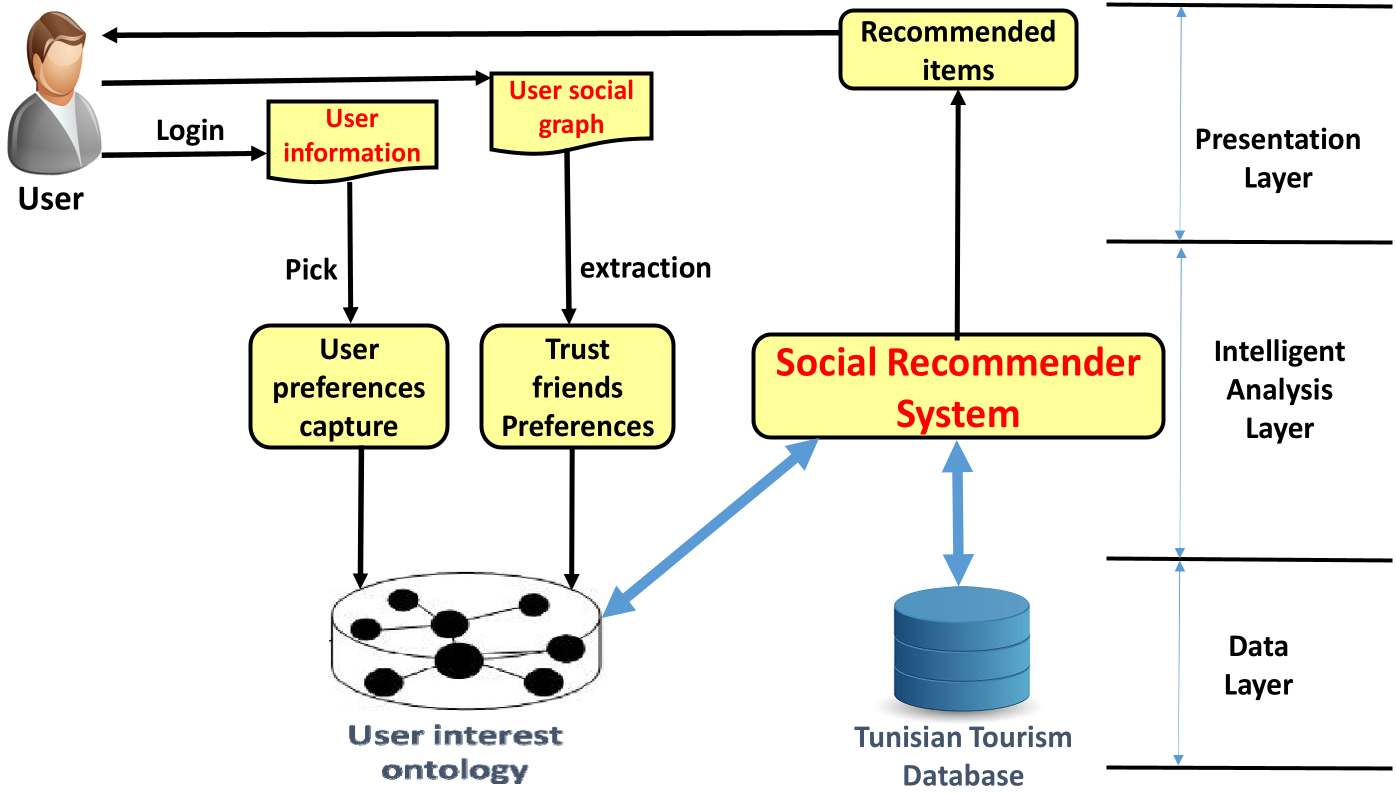
The system is organized into a robust modular framework designed to handle the messy reality of social media data.
1. The Intelligent Analysis Layer
This is the "brain" of the system. It uses the Facebook Open Graph API to capture:
- Explicit Data: Profile information (age, gender, education).
- Implicit Data: Behaviors like comments, shares, and "likes."
2. Semantic Extraction & WordNet Integration
To ensure the system understands that "lodging" and "hotel" are related, the authors employ WordNet and a specialized linguistic similarity function: This allows the system to calculate the distance between a user's expressed interest and the actual tourism database (hotels, restaurants, monuments).
Core Innovation: Trusted Friends & Dynamic Updates
One of the most insightful components is the Trusted Friends List. Instead of looking at all friends, the system filters for those with the highest interaction frequency within a specific timeframe. If a user is new (Cold-Start), the system "borrows" the ontological preferences of these trusted friends to generate initial suggestions.
The Feedback Loop:
- If a user rates a recommendation highly (>2), the User Interest Ontology is immediately updated, shifting the weights of specific concepts.
- If the user dislikes it, the system moves to the next item in the semantically ranked list.
Critical Insight & Conclusion
While many modern systems rely on black-box Deep Learning, this paper champions the Social Semantic Web approach. The use of an ontology provides explainability—we know why a certain hotel was recommended (e.g., because of a semantic link between the user's "history" interest and the "monument" tag in the database).
Future Outlook: While the current prototype focuses on textual data via TF-IDF and WordNet, integrating multi-modal analysis (analyzing user-posted photos of Tunisian landmarks) could be the next frontier for this Tunisian tourism assistant.
Keywords: Recommender Systems, Ontology, Social Networks, Semantic Similarity, Collaborative Filtering.