
ULA: Decoding Identity Across Anonymized Social Networks Using Structural Intelligence
User Linkage Across Anonymizd Social Networks
The paper introduces ULA (User Linkage Algorithm), a novel semi-supervised framework designed to identify the same users across different anonymized social networks. By utilizing a probabilistic generative model and Locality Sensitive Hashing (LSH), it achieves SOTA-level linkage accuracy using only network structural information and minimal ground-truth data.
TL;DR
In an era of strict privacy laws and "water army" camouflage, user profiles are often hidden or faked. ULA (User Linkage Algorithm) breaks through this barrier by linking identical users across different social platforms using only network structure. By combining Locality Sensitive Hashing (LSH) for scalability and an EM-based probabilistic model for accuracy, it provides a powerful semi-supervised solution for deanonymization.
The "Profile-less" Dilemma
Most user linkage methods are "identity-heavy," relying on names, locations, or emails. However, two major hurdles have emerged:
- Privacy Regulations: ISPs and platforms now strip sensitive metadata to comply with laws.
- Intentional Deception: Malicious actors (botnets) deliberately provide false info.
The ULASN (User Linkage across Anonymized Social Networks) problem asks: Can we identify the same human being across Twitter and Foursquare if we only see their "friendship" dots and lines?
Methodology: The ULA Framework
The researchers proposed a semi-supervised approach that thrives on "low-quality" and "interrelated" data. The process is divided into three critical phases:
1. Scalable Blocking with LSH
Comparing every user in Network A to every user in Network B is an nightmare. ULA uses Locality Sensitive Hashing (LSH) to partition users into "blocks" or "buckets" based on structural similarity (shingles of their neighbors).

2. Probabilistic Generative Model
Instead of a simple binary classifier, ULA treats user linkage as a generative process. It assumes social similarities follow specific continuous distributions (like Exponential or Gaussian).
- E-step: Estimates the probability that a pair is a "match" based on current parameters.
- M-step: Updates the distribution parameters to maximize the likelihood of the observed graph structure.
3. Iterative Decision Making
The model uses a Linking Score to rank candidates. In each iteration, the top- most confident matches are added to the ground-truth set, which in turn helps refine the model for the next round—a classic "bootstrapping" effect.
Experimental Insights
The authors validated ULA using Twitter and Foursquare datasets.
Resistance to Noise
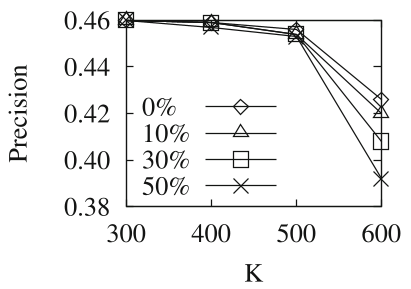
One of the most impressive findings was the algorithm's Interference Immunity. Even when 30% of a user's social connections were "erased" (to simulate missing data), ULA maintained high precision and recall.
Efficiency Gains
The use of LSH was a game-changer for scalability. As shown in the performance charts, the number of candidate pairs dropped by over 99.9%, allowing the system to process large graphs in under 2 hours, whereas standard methods lagged beyond 12 hours.
Critical Analysis & Takeaways
The core insight of ULA is that social topology is a unique fingerprint. Even without a name or photo, your "circle of influence" is distinct enough to identify you across platforms.
- The Strength: ULA is semi-supervised, meaning it only needs a tiny fraction of known "anchor links" to start the engine.
- The Limitation: The method currently assumes a static snapshot of the network. In the real world, social networks evolve; friends are added or dropped daily.
- Future Impact: This research highlights a significant privacy vulnerability. It suggests that merely "anonymizing" a dataset by removing names is insufficient protection if the underlying relational structure remains exposed.
For developers and researchers, ULA provides a template for handling high-dimensional, sparse linkage tasks where data quality is low but relational context is rich.