
UMPP: Bridging User Psychology and Data Privacy in Social Networks
User Motivation Based Privacy Preservation in Location Based Social Networks
This paper introduces the User Motivation Based Privacy Preservation (UMPP) model, a novel framework for Location-Based Social Networks (LBSNs) that adapts privacy policies to the underlying intent of a check-in. By distinguishing between "Social" and "Private" motivations, the model optimizes the trade-off between data utility and privacy, achieving a 20% reduction in information loss for social check-ins compared to the PrivCheck baseline.
TL;DR
The User Motivation Based Privacy Preservation (UMPP) model shifts the focus of data security from fixed algorithms to human intent. By categorizing check-ins as "Social" or "Private," it applies adaptive obfuscation that keeps social data useful (20% less information loss) while making private movements harder to track.
Background: The Privacy-Utility Tug-of-War
In the world of Location-Based Social Networks (LBSNs) like Facebook Places or Foursquare, every "check-in" carries a digital footprint. Currently, users are stuck between two extremes: sharing their exact coordinates (exposing them to inference attacks) or sharing nothing at all (losing the social benefits of the app).
The core insight of this paper is that not all check-ins are created equal. A post about a basketball game with friends has a different "motivation" than a routine morning check-in at an office. Treat them the same, and you either leak the office routine or ruin the social coordination of the game.
Why Context Matters
The authors argue that existing SOTA methods fail because they ignore the Why behind the Where. UMPP uses five context features to determine motivation:
- Weekday/Time: Distinguishing work hours from leisure.
- User/Location Frequency: Identifying habit-based vs. sporadic visits.
- Co-location: Detecting social gatherings where friends are present.
Methodology: The UMPP Model
The UMPP framework uses a three-pronged obfuscation approach applied based on the detected motivation.
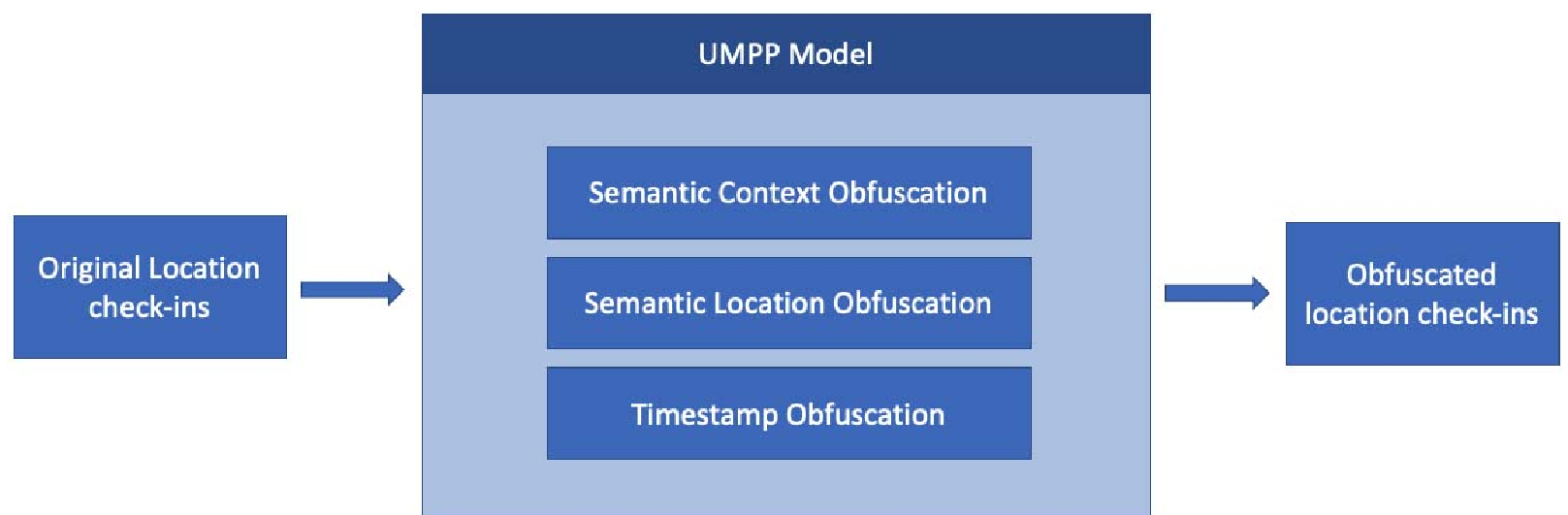
1. Timestamp Obfuscation
Instead of using the exact time, UMPP employs a Reverse kNN approach. It finds the nearest check-ins and randomly swaps the timestamp with one of them, breaking the ability of attackers to build precise temporal profiles.
2. Semantic Context & Location Obfuscation
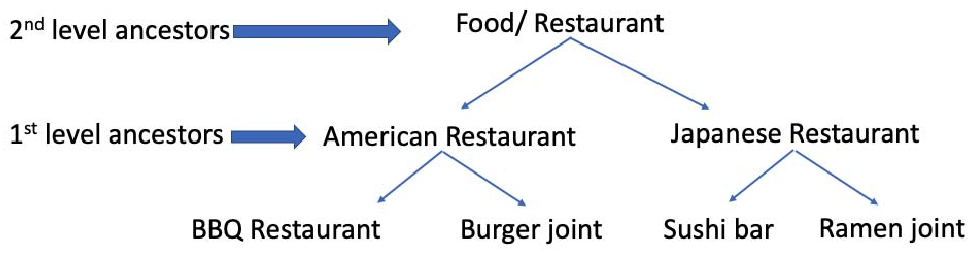
This is where the psychological alignment happens. The model uses hierarchical trees for both location types (Lexical) and geographic addresses (Semantic).
- Social Motivation: Generalizes a "Sushi Bar" to a "Japanese Restaurant" (1st level ancestor). It keeps the information relevant for friends.
- Private Motivation: Generalizes the "Sushi Bar" all the way to "Food/Restaurant" and the street address to the entire "State" (2nd level ancestor).
Experiments and SOTA Comparison
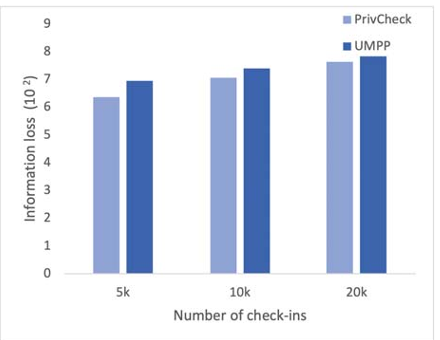
The authors compared UMPP against PrivCheck using real-world data from Gowalla and Brightkite.
Key Findings:
- Social Retention: For social check-ins, UMPP achieved a massive 20% reduction in information loss. While Re-identification Accuracy (RAC) was slightly higher than the baseline, the utility gained for the user was significantly better.
- Private Protection: For private check-ins, UMPP reduced the RAC by 6%, proving to be more effective at hiding sensitive patterns than non-motivation-aware models.
Critical Insight: Complexity for the Attacker
Beyond the numbers, UMPP introduces inconsistency. Traditional models apply a uniform noise layer that sophisticated attackers can eventually "reverse-engineer" if they understand the policy parameters. Because UMPP varies the policy per check-in based on intent, it creates a moving target that is significantly harder to de-anonymize.
Conclusion & Future Outlook
UMPP proves that privacy policies should be as dynamic as the users they protect. By respecting "Social Motivation," we preserve the soul of social networks—connection—while the "Private Motivation" layer builds a stronger wall around our domestic routines.
The next frontier for this research involves expanding context features to include sentiment analysis of check-in captions and adapting the model for real-time "streaming" data releases.