
BSNA: Decoding Digital Identity Through Username Mapping Learning
User Naming Conventions Mapping Learning for Social Network Alignment
The paper introduces BSNA (BP Neural Network mapping for Social Network Alignment), a supervised learning method that aligns user accounts across different social platforms using username naming conventions. By transforming the traditional classification task into a vector mapping problem, it achieves state-of-the-art precision across multiple real-world datasets like Twitter, Facebook, and Instagram.
TL;DR
In the fragmented landscape of modern social media, a single user often manages over eight accounts, yet these identities remain isolated silos. BSNA (BP Neural Network Mapping for Social Network Alignment) addresses this by treating username alignment not as a simple "matching" task, but as a vector mapping problem. By extracting deep behavioral features and utilizing a 4-layer BP neural network, BSNA achieves a 4% precision boost over traditional SOTA methods with significantly less training data.
The Core Challenge: Why is Identity Linkage Hard?
Traditional social network alignment (SNA) faces a "Privacy vs. Utility" paradox. Relying on profile attributes (location, birthday) is effective but often blocked by privacy settings. Conversely, network structure analysis is computationally expensive and highly sensitive to noise.
Usernames offer a middle ground: they are public, highly accessible, and carry a "behavioral fingerprint." However, simple string matching fails because users often vary their names (e.g., john_doe vs johndoe88). Existing classifiers like SVM or Logistic Regression struggle with these subtle variations unless provided with massive, laboriously labeled datasets.
Methodology: From Classification to Mapping
The fundamental shift in BSNA is the transition from a binary classifier (Is this the same person? Yes/No) to a Mapping Function.
1. High-Dimensional Feature Extraction
The researchers don't just look at the string; they analyze the psychology and physics of naming through a 358-dimensional vector:
- Human Limitations: Focuses on memory and uniqueness.
- Exogenous Factors: Analyzes the "typing rhythm" (e.g., the proportion of keys pressed by specific fingers or hands based on QWERTY layouts).
- Endogenous Factors: Uses information entropy, Jaccard distance, and Edit Distance to quantify randomness and abbreviation patterns.
2. The BP Mapping Framework
Instead of outputting a probability, the BP network maps the source feature vector into the space of the target network. The goal is to minimize the Cosine Distance between the mapped vector and the true target vector .
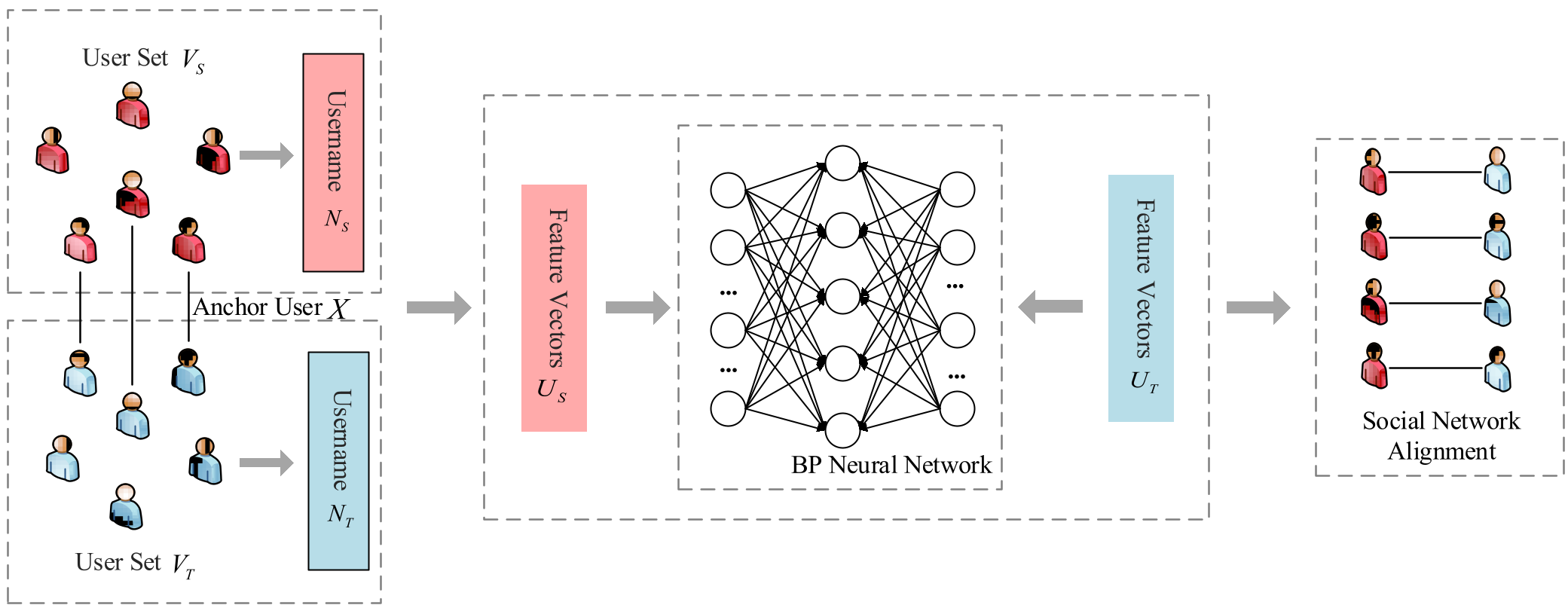 Fig 1: The three-stage pipeline: Extraction, Representation, and Mapping Learning.
Experimental Performance
The authors tested BSNA on four major cross-platform datasets (Twitter-Instagram, Facebook-Instagram, etc.).
Key Findings:
- Precision @ 1: BSNA reached 98.12% on Twitter-Instagram, consistently beating the UISN-UD and MOBIUS benchmarks.
- Data Efficiency: While other models require large training sets to "learn" the boundary, BSNA converges rapidly. Performance remains stable even when the training ratio drops significantly.
- Feature Sensitivity: Interestingly, "Intrinsic Factors" (naming logic) were found to be more critical than keyboard typing patterns (Exogenous Factors).
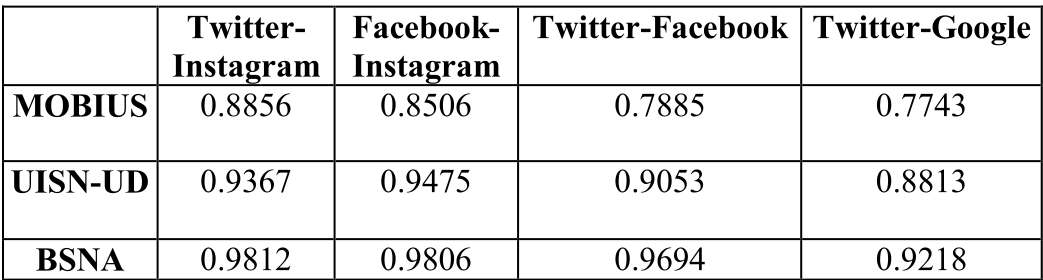 Table 1: Performance comparison across different social network pairs.
Critical Insight: The "Non-English" Hurdle
A notable observation in the study was the slight performance dip on the Twitter-Google dataset. The authors attributed this to multilingual noise. When usernames contain numbers or non-English characters, the traditional character-based features lose some discriminative power. Specifically, non-English characters had the most significant negative impact on accuracy.
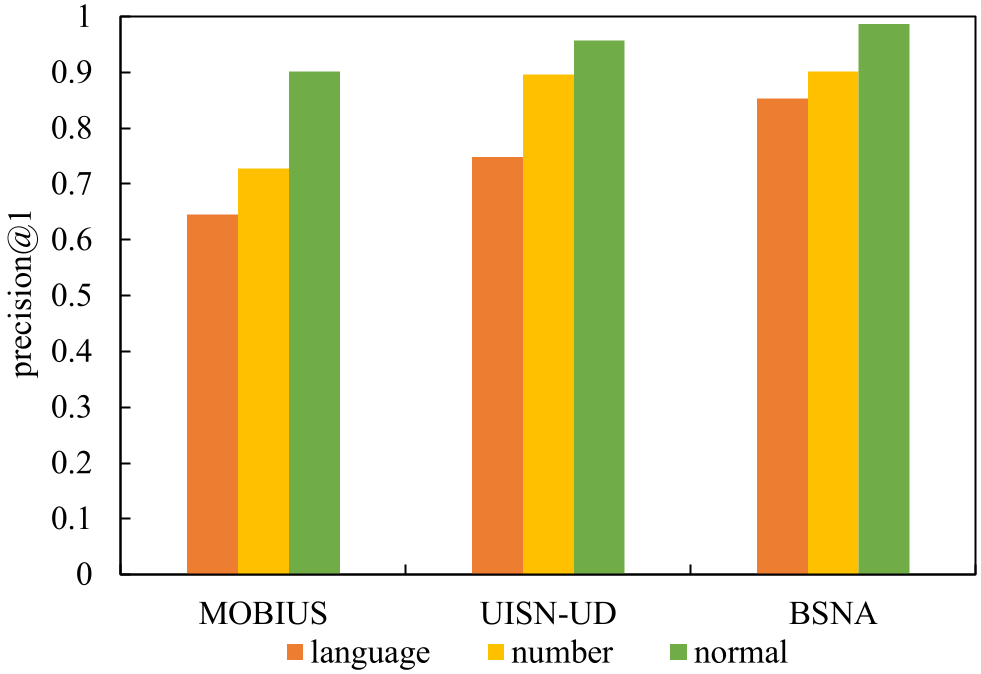 Fig 2: Impact of Language and Numbers on search accuracy.
Conclusion & Future Directions
BSNA proves that the "mapping" approach is a more robust inductive bias for social network alignment than standard classification. By capturing the latent naming conventions of users, we can bridge the gap between platforms with high precision.
Future Outlook: The next frontier for this research lies in Multilingual Robustness. Incorporating cross-lingual embeddings or character-level transformers could potentially bridge the gap for global users who mix scripts (e.g., Kanji and Latin characters) in their digital handles.
Takeaway for Practitioners: When dealing with entity resolution across sparse feature sets, consider mapping entities into a shared latent space rather than training a rigid binary classifier. Complexity lies in the relationship between spaces, not just the features themselves.