
Beyond the Avatar: Engineering Personality in Text-Only Chatbots
User Perception of Text-Based Chatbot Personality
This paper explores the simulation of chatbot personality through text-only interfaces using the Five Factor Model (FFM). By developing two distinct agents—one high in extraversion/agreeableness and one low in both—the authors demonstrate that specific personality traits can be reliably conveyed and perceived by users without visual or auditory cues.
TL;DR
Can a chatbot have a "soul" without a face or a voice? This study proves that through specific linguistic choices—like punctuation, verbosity, and social phrasing—users can accurately perceive complex personality traits (Extraversion and Agreeableness). While users preferred the "friendly" bot, they actually spent more time talking to the "formal" one, challenging our standard assumptions about user engagement.
Problem & Motivation: The Silent Interface
In an era of hyper-realistic avatars and voice-cloning, we often forget that the majority of digital interactions—customer service, news bots, and FAQ assistants—remain purely text-driven.
Existing literature in Human-Computer Interaction (HCI) has long leaned on visual and auditory "crutches" to define agent personality. The researchers here identified a significant gap: How does personality manifest when you strip away the gendered voices and the smiling avatars? They aimed to isolate language itself as the primary vehicle for personality, seeking to answer if "Introversion" or "Agreeableness" can survive the transition to a simple chat bubble.
Methodology: Coding Personality into Phrasing
The study leveraged the Five Factor Model (FFM), specifically targeting the axes of Extraversion (sociability, energy) and Agreeableness (trust, politeness).
The team developed two bots:
- Chatbot A (High E, High A): Interactive, informal, uses exclamation marks, and provides positive reinforcement (e.g., "Wow! Which module is your favorite?").
- Chatbot B (Low E, Low A): Direct, formal, self-focused, and passive (e.g., "Which module is your favorite? Mine is secure software engineering.").
The Linguistic Blueprint
The authors mapped psychological traits to specific textual "stylometric" features:
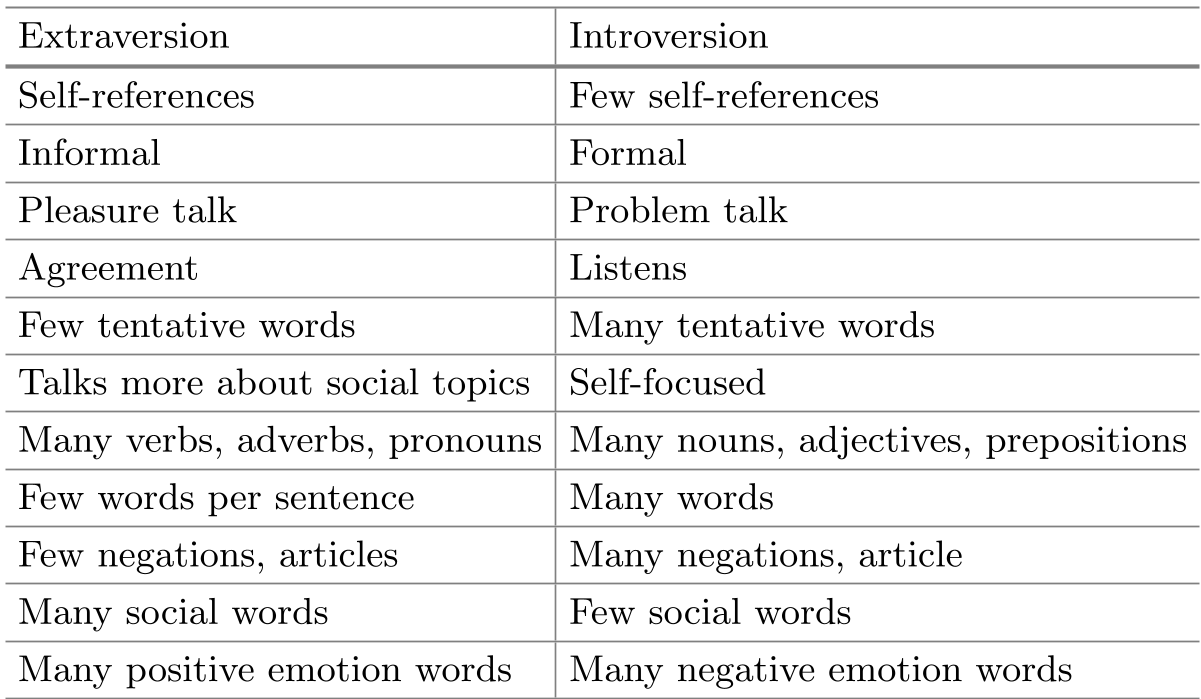
The design ensured that while the style changed, the substance (the knowledge base about university courses) remained identical.
Experiments & Results: The Engagement Paradox
The study used a within-subject design where 17 participants interacted with both bots. The results revealed a fascinating disconnect between what users say they like and how they actually behave.
1. Perception is Accuracy
Users successfully identified the intended personalities. Chatbot A was described as "bright" and "fun," while Chatbot B was called "robotic" and "formal." Crucially, users rated both bots similarly on "Knowledge," proving that the personality didn't distract from the perceived intelligence of the system.
2. The Engagement Flip
Despite 70.6% of users preferring the friendly Chatbot A, the quantitative data told a different story:
- Duration: Users spent significantly more time with the formal Chatbot B (Mean: 6.35 min vs. 3.18 min).
- Turns: Interaction with the formal bot resulted in more conversation turns (Mean: 20.29 vs. 15.59).
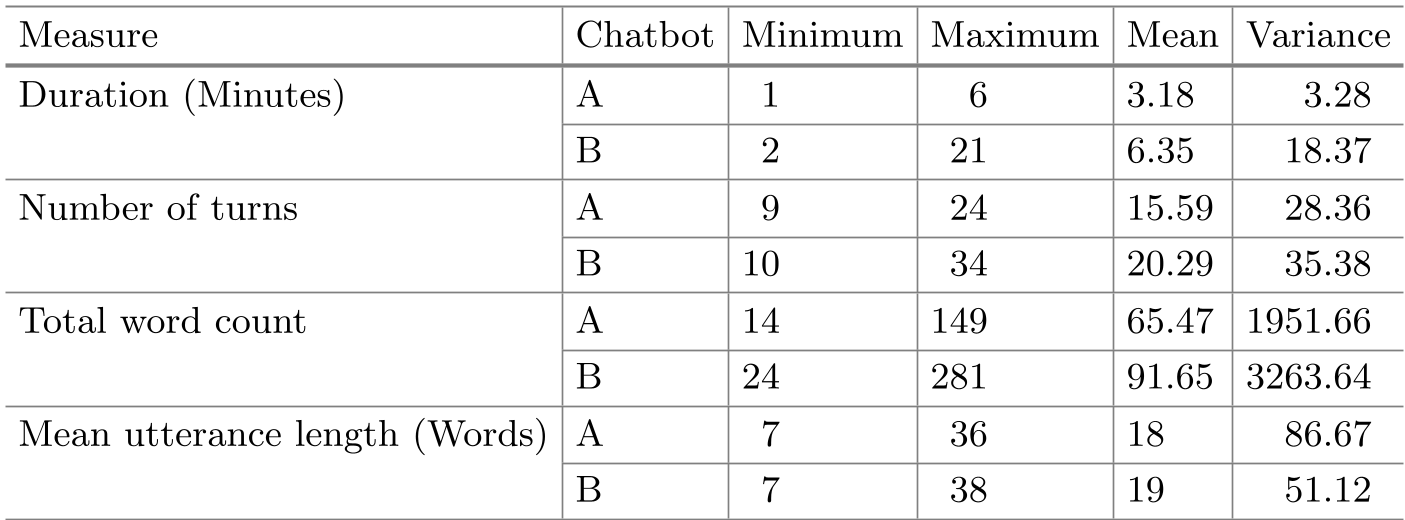
The Intuition: The researchers suggest that the "formality" of Chatbot B might have triggered a "mirroring" effect. Users felt they needed to provide more detailed, formal responses, whereas the "chitty" nature of Chatbot A encouraged short, colloquial, and rapid-fire replies.
Deep Insight: Design for the Mission, Not the "Like"
The core takeaway for AI developers is profound: Engagement metrics (like time on site or turn count) are not proxies for user satisfaction.
- Is the goal speed? Use a high-extraversion, friendly personality to encourage quick, breezy interactions.
- Is the goal depth? A more formal, perhaps even "colder" personality might inadvertently signal to the user that they should be more through and precise in their input.
Limitations & Future Work
The study’s sample size (n=17) is small, and by varying two traits simultaneously (Extraversion + Agreeableness), it’s hard to pinpoint which one did the heavy lifting. Future research should look at "Openness" and "Neuroticism" in text—could a "worried" chatbot actually be more persuasive in a health context?
Conclusion
This paper serves as a vital reminder that in the world of NLP, how we say something is just as important as what we say. Personality is not just "flavor text"; it is an architectural component of the user experience that fundamentally dictates the flow of human-machine collaboration.