
UFP-product-Rank: Engineering the "Viral" Effect through User-Aware Tagging
Earn More Social Attention: User Popularity Based Tag Recommendation System
The paper introduces UFP-product-Rank, a tag recommendation algorithm and an online support system designed to maximize "social popularity" (views/likes). By integrating both content-based co-occurrence and user-specific popularity metrics into a PageRank-inspired framework, it significantly outperforms traditional semantic recommendation methods.
TL;DR
In the economy of attention, hashtags are the primary currency. This paper presents a novel recommendation system, UFP-product-Rank, which moves beyond "what describes the image" to "what makes the image go viral." By mathematical modeling the popularity of both the content and the individual user, the system achieves a 2.8x increase in views on platforms like Flickr.
The "Popularity Gap" in Recommendation
Most tagging systems (like those from Microsoft or Google Cloud) are designed for accuracy: if there is a cat in the picture, they suggest #cat. However, professional creators and brands don't just want accuracy; they want reach.
Prior state-of-the-art methods like FP-Rank attempted to solve this by looking at content popularity. But they missed a crucial variable: the user. A tag used by a high-influence user carries more "weight" in the social ecosystem than the same tag used by a novice. The challenge lies in distilling this user influence into a recommendation engine that doesn't just suggest generic high-traffic tags (like #love or #photooftheday), which are often too competitive for average users.
Methodology: High-Dimensional Influence Metrics
The core innovation is the shift from a simple PageRank model to a User-Aware Folk Popularity Rank.
1. The Power of Multiplication
Instead of simply adding user influence to content influence, the authors use element-wise multiplication of matrices: This "Product-Rank" ensures that a tag is only highly ranked if it scores well in both content relevance and user influence categories. It acts as a rigorous filter for high-impact hashtags.
2. The Weighting Logic
The system treats social media as a directed graph where:
- Tags co-occurring with "important" tags are upgraded.
- Tags used by high-popularity users inherit a portion of that influence.
- The "penalty" factor: If a user/post uses too many tags, the influence of each individual tag is diluted.
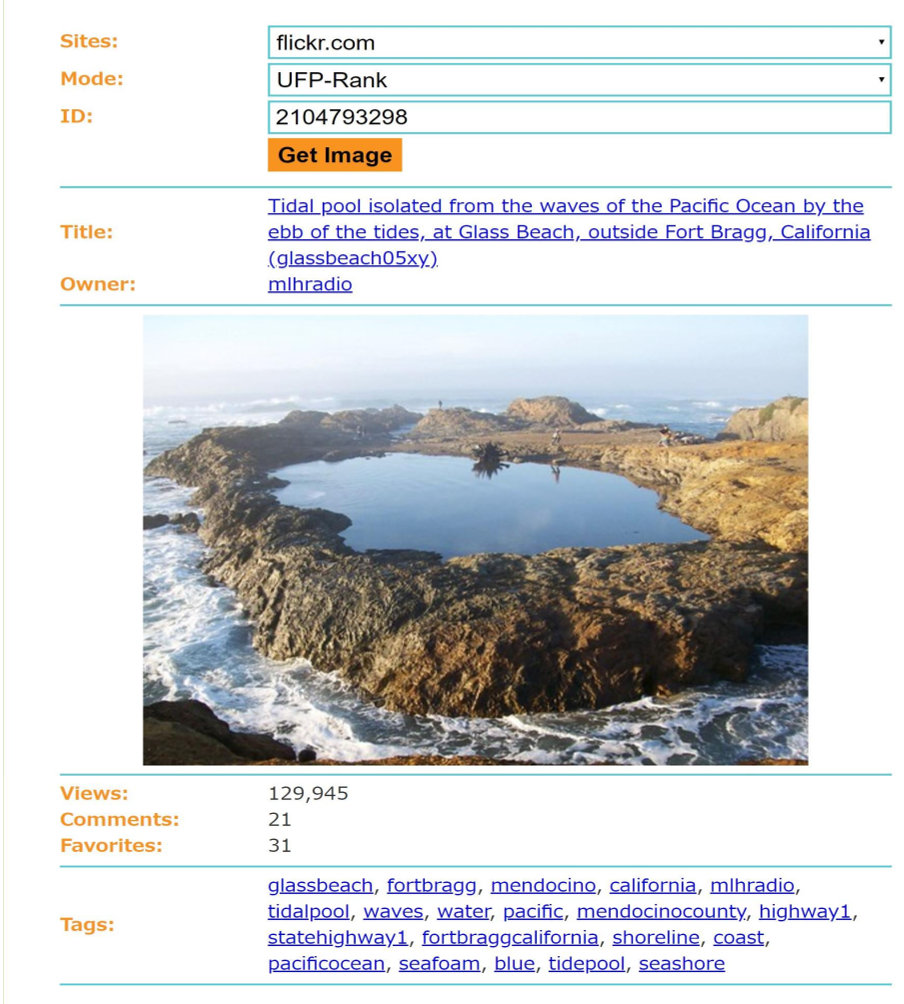 The Tagging Support System interface showing real-time predictions for views, comments, and favorites based on selected tags.
Experiments: Real-World Verification
Many papers stop at offline simulations. These authors went further, performing an online evaluation on Flickr by uploading 1,000 images and tracking them for 10 days.
Key Findings:
- UFP-product-Rank vs. Baseline: The proposed method crushed the baseline MCS (Computer Vision API) by 280%.
- User Awareness Matters: Even simple user-aware baselines (U-Rank) outperformed semantic-only models, proving that user behavioral data is a "gold mine" for engagement prediction.
- Saturation is Real: The study confirmed that simply adding more tags isn't a silver bullet; it's the quality and co-occurrence that drive the algorithm.
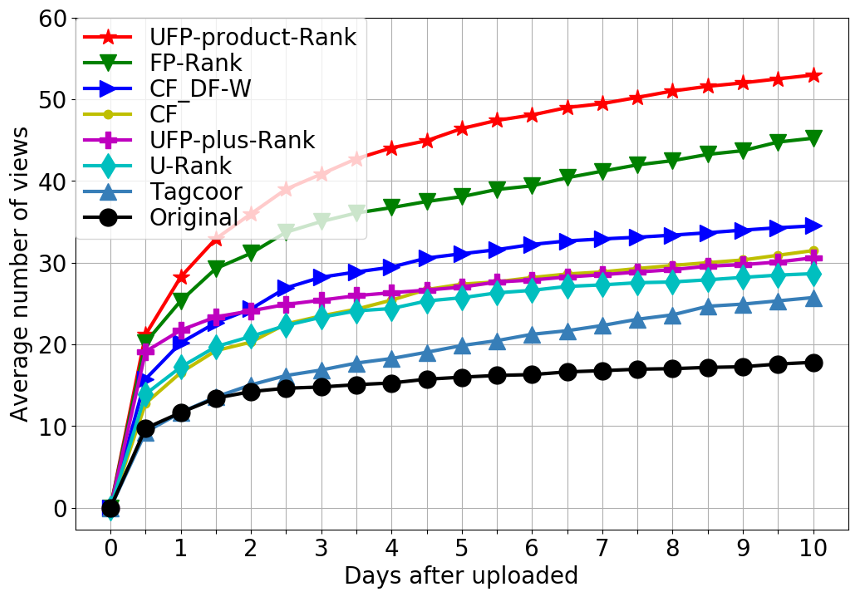 The UFP-product-Rank (darkest bar) shows a clear advantage in generating views over a 240-hour period compared to FP-Rank and standard CF methods.
Critical Insight: The "Cold-Start" Solution
One of the most impressive aspects of this work is its handling of the cold-start problem. By using an off-the-shelf CV API to generate initial tags for a new image and then using those as seeds for the UFP-Rank engine, the system can effectively boost the popularity of brand-new content that has no historical data.
Conclusion & Future Outlook
The UFP-product-Rank system marks a transition from "Descriptive Tagging" to "Strategic Tagging." It acknowledges that social media visibility is a complex interplay between the content's DNA and the user's social standing.
Future Work: The authors aim to expand this into content creation—effectively telling a user not just what to tag, but what to photograph or post to maximize their social footprint. For developers building the next generation of CMS or social dashboards, integrating user-specific popularity tensors is no longer optional—it's the key to the algorithm.