
Decoding Digital Footprints: A Comparative Study of User Profiling via Facebook Page Categories
3689_User preferences profiling based on user behaviors on Facebook page categories.
This paper explores user preference profiling by analyzing Facebook "like" and "share" behaviors across various page categories. The research evaluates and compares the efficacy of Support Vector Machines (SVM), Naïve Bayes (NB), and Artificial Neural Networks (ANN) in predicting user interests.
TL;DR
This research investigates how our "likes" and "shares" on Facebook can be transformed into accurate interest profiles. By comparing Support Vector Machines (SVM), Naïve Bayes (NB), and Artificial Neural Networks (ANN), the study demonstrates that categorical social interactions are powerful predictors of individual preferences, offering a pathway for more personalized social computing.
Context & Motivation: Why Your "Likes" Matter
In the era of information overload, platforms struggle to understand what users actually want. Most prior work focused on textual analysis or demographic data. However, the Facebook Page Category represents a pre-labeled, high-level semantic tag that captures user intent with minimal noise. The challenge lies in which mathematical framework can best handle the sparsity and variability of these social interactions to build a reliable "User Profile."
Methodology: The Math Behind the Preference
The authors break down the profiling task into a classification problem, examining three distinct algorithmic perspectives:
- Naïve Bayes (Probabilistic): Uses the posterior probability to predict a user's interest category based on the frequency of interactions.
- Artificial Neural Networks (Connectionist): Employs a multi-layer perceptron to learn non-linear relationships between "like" counts and interest clusters.
- Support Vector Machines (Geometric): Aims to find the "Maximum Margin Hyperplane" that separates different user segments in a high-dimensional category space.
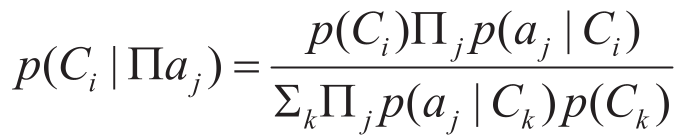 The probabilistic framework of Naïve Bayes used to calculate category likelihood.
Experimental Insights & Results
The study analyzed user behaviors across four primary metrics: likes in distinct categories, shares in distinct categories, and total counts including duplicates.
Key Findings from the Data:
- Diversity of Interest: On average, users engage with 38.86 distinct categories, suggesting that user interests are broad rather than niche.
- Behavioral Variance: There is a significant gap between "Liking" and "Sharing." While users like many pages (Avg: 90.39), they are much more selective with shares (Avg: 13.74), making "shares" a higher-weight feature for profiling.
Performance Comparison
| User Behaviors | Average | Standard Deviation |
|---|---|---|
| Likes (Distinct) | 38.86 | 10.40 |
| Shares (Distinct) | 9.33 | 7.96 |
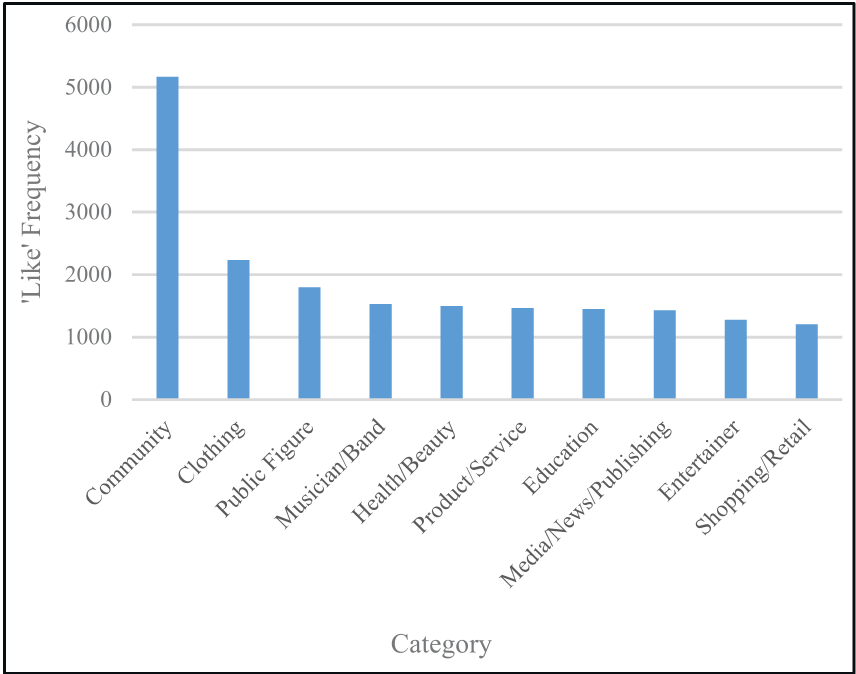 Visual distribution of user behavior metrics showing the concentration of social actions.
Critical Analysis: Is One Model Enough?
The paper highlights that while NB is computationally efficient, it suffers from the "independence assumption," which doesn't always hold true in social behavior (e.g., liking "Rock Music" is highly correlated with "Concert Venues"). SVM often outperforms in these scenarios due to its ability to handle high-dimensional feature spaces without overfitting, provided the kernel is chosen correctly.
Limitations
- Static Snapshots: The research looks at aggregate counts but does not account for the temporal decay of interests (what you liked 5 years ago might not reflect current preferences).
- Platform Specificity: The model is heavily tuned to the Facebook ecosystem; its transferability to short-video platforms like TikTok (where interaction is passive) remains unproven.
Final Takeaway
This study confirms that social category data is a goldmine for profiling. For developers building recommendation engines, focusing on the categories of liked entities rather than just the entities themselves provides a robust Inductive Bias that improves classification accuracy across SVM and ANN architectures.