
MCULK: Bridging the Identity Gap Across Multiple Social Platforms
User Profile Linkage Across Multiple Social Platforms
This paper introduces MCULK, a multi-platform User Profile Linkage (UPL) framework designed to unify identities across three or more social networks. Unlike pairwise methods, MCULK utilizes a similarity graph construction combined with localized clustering to achieve state-of-the-art performance in resolving "platform uncertainty."
TL;DR
Standard User Profile Linkage (UPL) often breaks down when moving beyond two platforms. MCULK solves this by shifting from binary matching to a similarity graph clustering approach. By optimizing the process with Locality Sensitive Hashing (LSH) and a refined split-and-merge clustering logic, it achieves SOTA accuracy while being orders of magnitude faster than traditional iterative methods.
Problem & Motivation: The "Platform Uncertainty" Trap
In the modern digital landscape, a single user is rarely confined to one platform. While we might have a Twitter for news, an Instagram for photos, and a LinkedIn for work, current UPL research still largely obsesses over pairwise linkage (Platform A vs. Platform B).
When you try to scale pairwise results to m platforms, you encounter two major walls:
- High Computational Cost: Comparing every pair across platforms leads to complexity.
- Incorrect Linkage Chains: If A matches B, and B matches C, a single error in one pairwise link can cause a "chain reaction," incorrectly merging unrelated users into a massive, erroneous cluster.
The authors identify "Platform Uncertainty"—the fact that users exist on an unpredictable subset of services—as the primary obstacle that simple pairwise logic cannot handle.
Methodology: From Similarity Graphs to Consistent Clusters
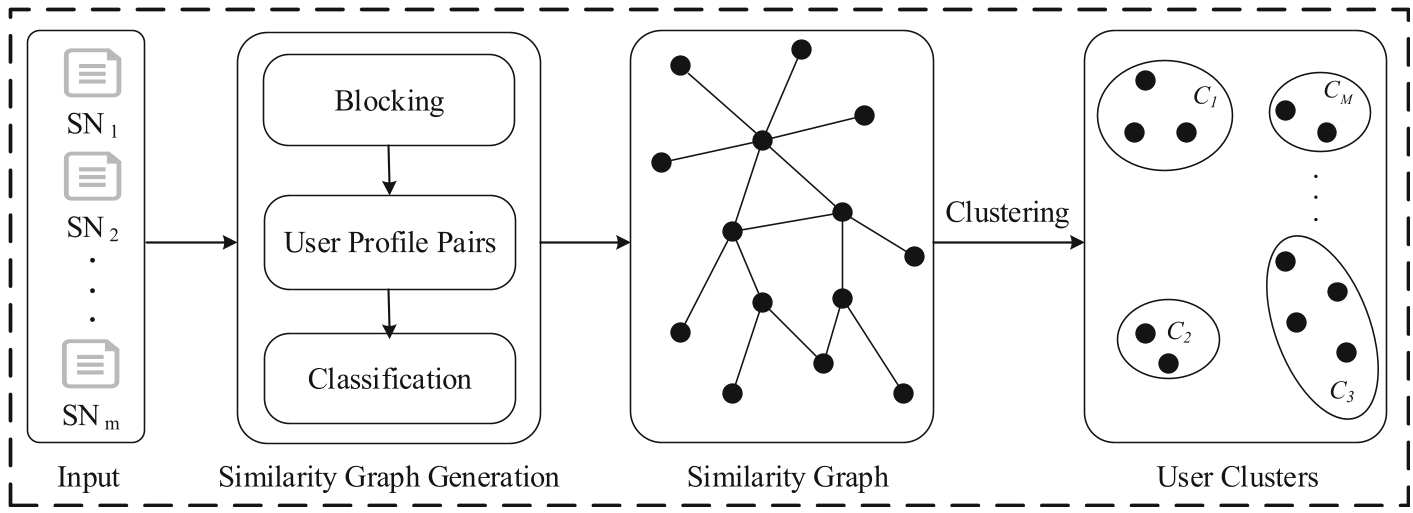
MCULK (Multi-platform Cluster User Linkage) approaches the problem in two distinct phases:
1. Efficient Similarity Graph Generation
To avoid the quadratic explosion, the model uses MinHashLSH (Locality Sensitive Hashing). Profiles are "bucketed" based on the q-gram similarity of their usernames and display names. Only profiles within the same bucket are passed to a pre-trained Logistic Regression classifier. This produces a weighted undirected graph where nodes are profiles and edges represent the probability of belonging to the same human.
2. Adaptive Clustering Logic
The "magic" happens in how the similarity graph is partitioned:
- Initial Clustering: Uses connected components but strictly enforces source-consistency (a cluster cannot contain two profiles from the same platform).
- Splitting: If a cluster’s internal similarity is too low (below threshold ), it is broken apart to ensure high precision.
- Merging: It creates "representatives" for incomplete clusters and attempts to merge them using index-based lookups, ensuring that we don't miss links between platforms that were not directly compared in the LSH phase.
Experiments & Results: Speed Meets Precision
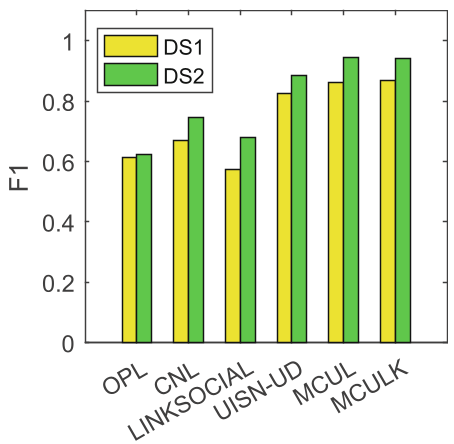
The researchers tested MCULK on two massive datasets (DS1: Google+, Twitter, Instagram; DS2: A 100k+ profile dataset across four sources).
SOTA Comparison
In terms of F1 Score, MCULK consistently outperformed established methods like OPL and UISN-UD. More importantly, it solved the "complete cluster" problem where users on all platforms must be linked correctly.
Efficiency Breakthrough
The performance trade-off is virtually non-existent. On the DS2 dataset, MCULK completed the linkage task in 0.092 seconds, while the competition took up to 49.9 seconds. This represents a massive leap in scalability for production environments.

Critical Insight & Conclusion
The core takeaway from this work is that UPL is a clustering problem, not a sequence of classification problems. By treating the data as a graph, MCULK maintains a global view of identity that pairwise methods lack.
Limitations: The model relies heavily on username and name similarity. If a user adopts completely distinct personas (e.g., "TechWizard" on Twitter vs. "JohnDoe" on LinkedIn), the q-gram blocking might miss them.
Future Outlook: The authors suggest incorporating User Generated Content (UGC) and Friendship Networks as the next frontier. Imagine a model that links you not because your name matches, but because your writing style or your social circle is identical across platforms. This work provides the architectural foundation for that reality.