
Deciphering the Digital Persona: A Survey on Tag-Based User Profiling
A user profile modelling using social annotations: a survey
This paper provides a comprehensive survey of user profile modelling using social annotations (tags) within social networks. It categorizes methodologies for constructing tag-based profiles, traces the evolution of social ontologies like FOAF and MUTO, and evaluates how these models enhance recommendation systems through the treatment of tag ambiguity and user dynamics.
TL;DR
As social networks evolve from consumption hubs to contribution-heavy ecosystems, the "Social Tag" has emerged as the primary vehicle for user intent. This survey explores how architectures transition from static User Profiles to dynamic, tag-based models. By integrating ontologies (like FOAF) and semantic filtering, systems can bypass the "noise" of free-form tagging to deliver high-precision recommendations.
The "Disorientation" Problem
In the early Web 2.0 era, users were often lost in a sea of unorganized resources. Social annotations (tags) were introduced as a solution, but they brought their own set of challenges:
- Ambiguity: Is a "Java" tag referring to the programming language or the island?
- Spamming: Users over-tagging to gain visibility ("SpamFactor").
- Flux: User interests change rapidly; a profile built yesterday might be obsolete today.
Methodology: From Tripartite Matrices to Ontologies
The core of social modeling lies in the Tripartite Model: . This maps the relationship between the User (U), the Tag (T), and the Resource (R). However, representing this as a 3D matrix is computationally expensive.
1. The Schematic Shift
The paper categorizes representation into two main types:
- Vector Models: Treating a user as a weighted vector of tags (e.g., TF-IDF style weights).
- Ontological Models: Using structured vocabularies like FOAF (Friend Of A Friend) to define relationships and SCOT (Social Semantic Cloud of Tags) to provide structure to folksonomies.
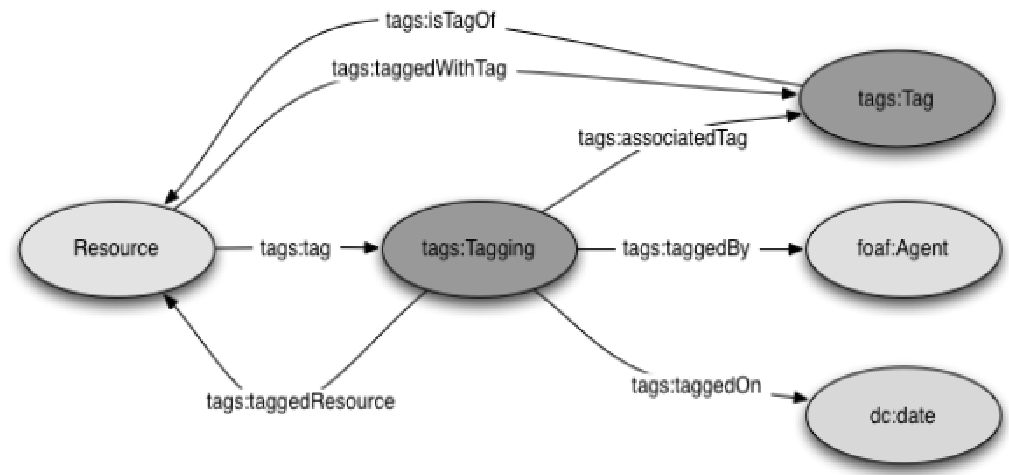 Figure 1: Representation of the tagging activity by the Tags ontology, connecting users to resources through concepts.
2. Semantic Enrichment
To solve the ambiguity problem, the authors suggest "Meaning Of A Tag" (MOAT) and WordNet-based classification. This allows tags to be categorized into "Synonym tags," "Contextual tags," or "Subjective tags," ensuring the recommender system understands the intent behind the keyword.
Comparing Recommender Architectures
The survey provides a critical comparison of how different systems (like iCITY, TOAST, and iDynamicTv) handle the "Tag-User-Resource" loop.
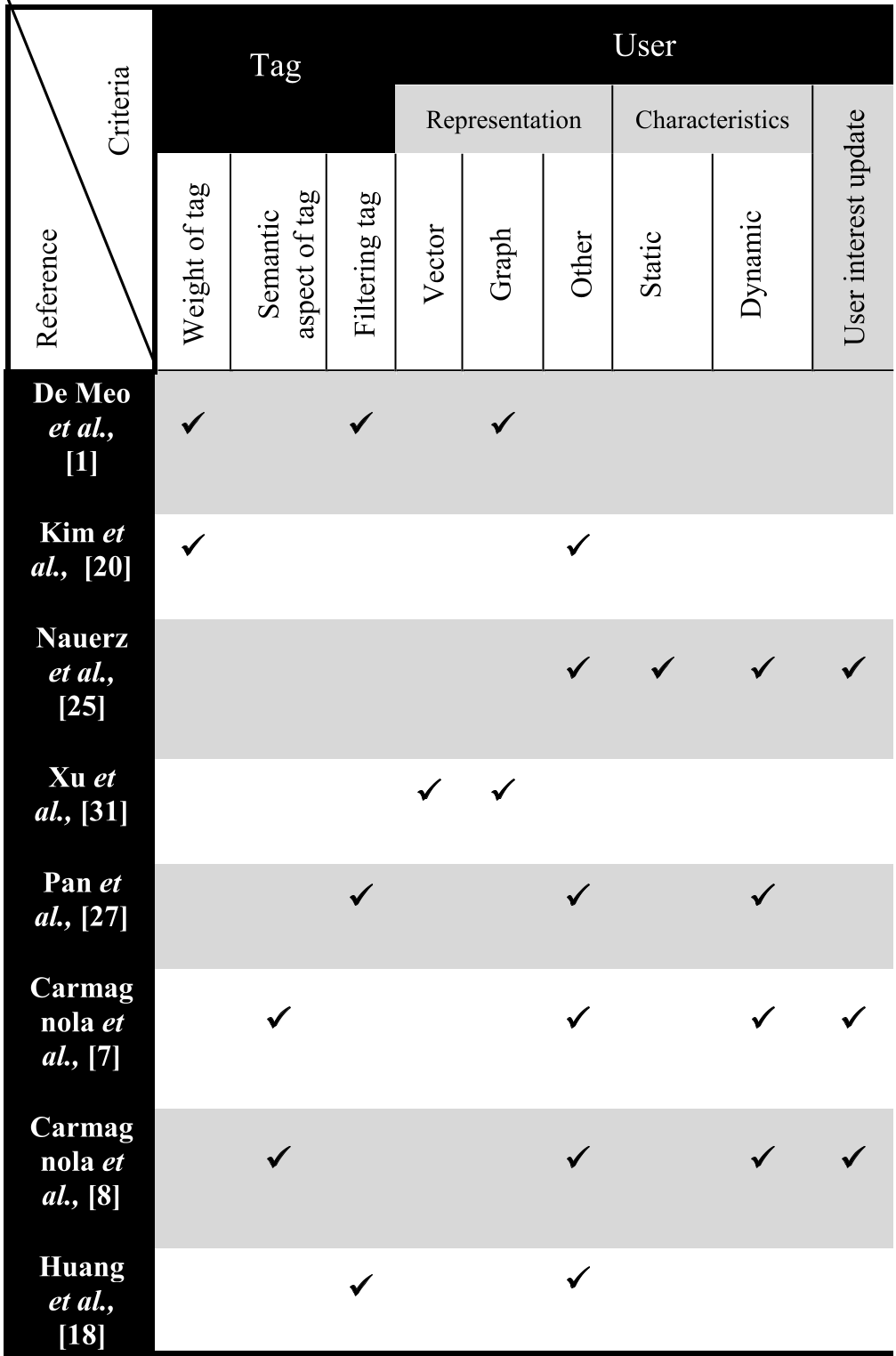 Table 3: Comparison of approaches based on tag weighting, semantic treatment, and user interest updates.
Key Insights from the Comparison:
- Filtering is Rare: Most systems fail to filter "bad" or "noisy" tags, relying instead on raw frequency.
- Dynamic Updates: Only a few systems (like Nauerz et al.) actively update the user interest profile as behaviors change over time.
- Hybrid Efficiency: The most successful systems utilize both static (demographic) and dynamic (behavioral) data points.
Critical Analysis & Conclusion
The paper concludes that while tag-based profiling is powerful, it is currently fragmented. The future of social recommendation lies in the modular unification of these tags and ontologies.
Takeaway for Practitioners: When building a recommendation engine, don't just treat tags as strings. Treat them as nodes in a semantic graph. By combining FOAF profiles with filtered, weighted social annotations, you can build a system that is resilient to spam and responsive to the volatile nature of human interests.
Future Outlook: The integration of cross-system profile enrichment (e.g., using Twitter data to bootstrap a music recommendation profile) represents the next frontier in solving the "Cold Start" problem.