
Beyond Static IDs: Multi-Role Profiling for Smarter Social Access Control
User Profiling for Policy Management in Social Communities
The paper introduces a multi-role User Profiling Methodology integrated with a Profile-Based Policy Management model for social communities. It leverages Semantic Web technologies, specifically extending FOAF and Relationship ontologies, to enable fine-grained access control based on complex user identities.
TL;DR
In modern social communities, a single user often wears many hats—a "Student," a "Researcher," and a "Board Member." Traditional access control systems fail to distinguish between these facets. This paper introduces a Semantic Web-based profiling methodology that extends FOAF (Friend of a Friend) to support multi-role management and integrates these profiles directly into security policies using the Rei language.
Problem & Motivation: The "Single Identity" Trap
Most social networks assume a user is a monolithic entity. However, privacy and access requirements are often tied to who the user is representing at a specific moment.
The authors identify two critical gaps:
- Limited Expressiveness: Standard FOAF profiles don't easily support numerical intervals (e.g., an age range) or specific choice sets required for policy logic.
- Disconnected Policies: Access control lists (ACLs) are usually separate from user data, making it hard to create rules like "Only a High School Student can view this educational resource."
The core insight here is that User Profiles are images of users, and these images should change based on the viewer's perspective and the system's needs.
Methodology: The Multi-Layered Semantic Approach
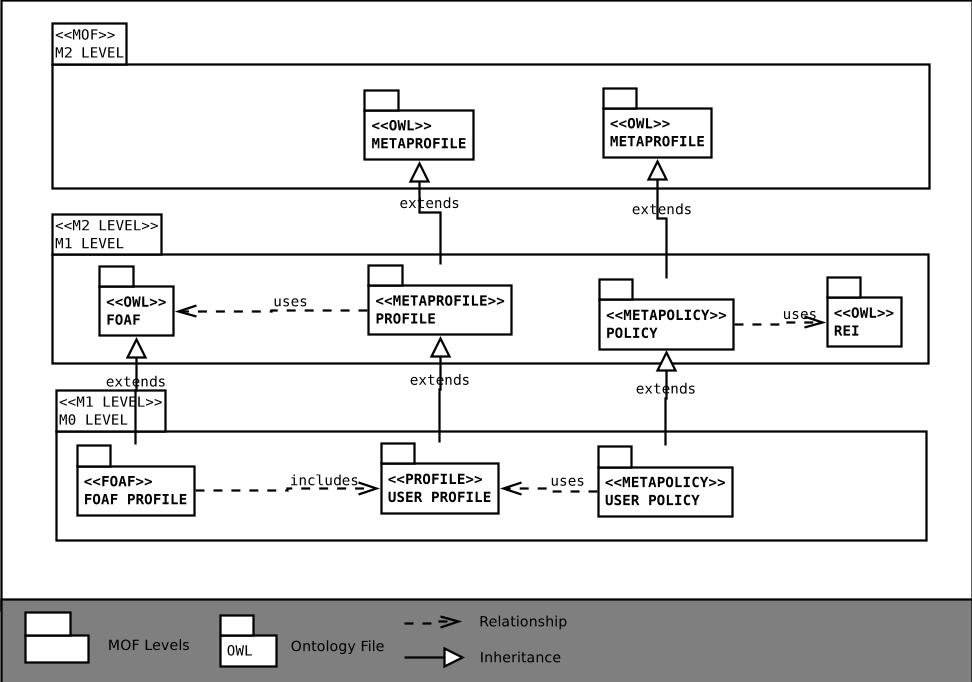
The researchers utilize the OMG Meta-Object Facility (MOF) to build a three-tier architecture that bridges the gap between raw data and executable policy:
- M2 (Meta-Meta-Profile): Defines how data types move beyond simple strings—adding intervals and choice sets.
- M1 (Meta-Profile): Provides templates for roles like "Board Member."
- M0 (Profile Instances): The actual FOAF document representing the individual user.
Architecture Integration
By extending the RELATIONSHIP ontology, the authors create a "semantically rich" profile. Unlike the standard Rei policy language which uses generic variables, this model injects these ontological profiles directly as the actor of an action.
Experiments & Results: Making it Actionable
The implementation was carried out using a robust tech stack:
- Ontology Design: Protégé.
- Policy Engine: Rei Policy Language.
- Reasoning: Java with the Jena Semantic Web Framework.
- Querying: SPARQL and SWRL (Semantic Web Rule Language).
The system proved that by utilizing Profile-based Policy Representation, social networks can automate complex decisions. For example, a rule can verify if a user's profile includes an "Age Interval" property that satisfies a policy requirement before granting access to specific media.
Critical Analysis & Conclusion
Takeaway
The real value of this work is the decoupling of the user from a single ID. By treating profiles as dynamic objects that feed into a policy engine, the authors provide a blueprint for more personalized and secure social networking environments.
Limitations & Future Work
While the semantic foundation is strong, the paper primarily focuses on the theoretical framework and initial implementation. The authors plan to:
- Extend object-type intervals (not just data-types).
- Improve the performance of the reasoning engine (Jena) when handling massive social graphs.
In an era where digital identity is becoming more complex (think Sovereignty and Web3), this profile-based approach offers a necessary layer of granularity.