
BNPM-MF: Bridging Bayesian Nonparametrics and Matrix Factorization for Smarter Social Recommendations
User Recommendation Based on Network Structure in Social Networks
This paper introduces Bayesian Nonparametric Mixture Matrix Factorization (BNPM-MF), a hybrid user recommendation framework that combines automated network structure detection with collaborative filtering. By integrating a Bayesian nonparametric model with Matrix Factorization (MF), it achieves state-of-the-art results on several social network datasets.
TL;DR
Recommending friends in social networks is famously difficult due to the "sparsity" of data and the hidden complexity of network structures. Traditional models either guess the number of communities or ignore the specific structural nuances of different groups. BNPM-MF solves this by using a Bayesian Nonparametric approach to automatically "sense" the network's architecture and then applying Matrix Factorization to these discovered subgroups, leading to a significant boost in recommendation accuracy (MAP/NDCG) across real-world datasets like Twitter and Facebook.
Problem & Motivation: The "Blind Guessing" of Network Structures
In social network analysis, we know that people tend to form groups (communities) or interact in specific patterns (bipartite structures). However, most existing recommendation algorithms suffer from two major flaws:
- The Parameter Trap: Two-phase methods require researchers to manually set the number of groups (). In a real network with millions of users, guessing is nearly impossible.
- The Performance Gap: While some advanced probabilistic models (like IRM) can find these groups automatically, they are often not optimized for the actual task of recommendation, failing to provide the high-precision ranking lists that Matrix Factorization (MF) offers.
The authors' insight was simple yet powerful: Let the model discover the groups first, then let Matrix Factorization optimize within those groups.
Methodology: The Best of Both Worlds
The BNPM-MF model follows a clear, two-stage workflow to handle the complexity of social graphs.
1. Automated Structure Discovery
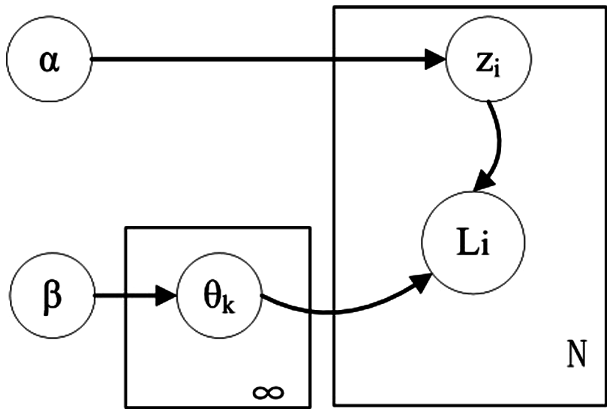
Instead of fixing the number of groups, the model uses a Chinese Restaurant Process (CRP). Imagine an infinite number of tables (groups) in a restaurant; as new users (customers) arrive, they can either join an existing table or start a new one based on a probability distribution. This allows the model to determine the scale of the network dynamically.
2. Localized Matrix Factorization
Once the groups () are identified, the network is partitioned into blocks. The model then applies Implicit Feedback Matrix Factorization (IF-MF) to these specific blocks. By mapping head users and tail users into a latent space , the recommendation score is calculated as a simple inner product: This "local" factorization captures nuances that a global model would likely smooth over or ignore.
Experimental Evidence: SOTA Performance
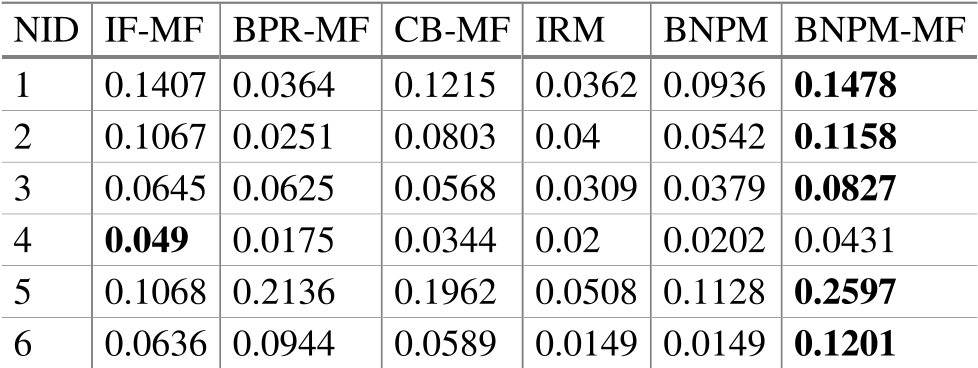
The researchers tested the model on six diverse datasets, including citation networks (Cora) and massive social platforms (Twitter).
Key Findings:
- Superiority over Baselines: In almost every metric (MAP and NDCG), BNPM-MF outperformed standard MF techniques and strictly probabilistic models.
- The Twitter Surge: On the Twitter dataset, BNPM-MF outperformed the popular BPR-MF and IF-MF models by a wide margin, proving its scalability and effectiveness on dense, real-world social data.
Latent Factor Sensitivity
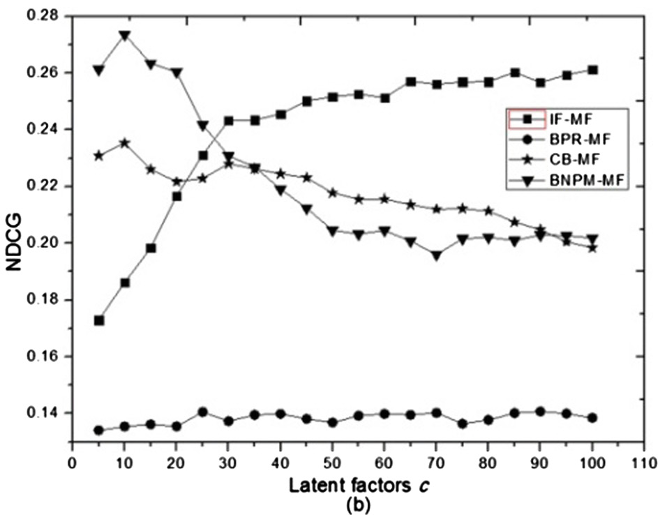
A crucial observation from the experiments (see Figure 3 in the paper) is that while global MF models require a high number of latent factors () to reach plateau performance, structured models like BNPM-MF can achieve high accuracy with significantly fewer factors because they operate on more homogeneous subgroups.
Critical Analysis & Conclusion
Summary
BNPM-MF successfully bridges the gap between structural discovery and mathematical optimization. By removing the need to pre-specify the group number, it makes the system significantly more robust for real-world deployment where network topology is constantly evolving.
Limitations
- Computational Overhead: While the "two-phase" approach is effective, the initial Bayesian nonparametric grouping stage can be computationally expensive on extremely large graphs before the MF phase even begins.
- Cold Start: The paper focuses on relationship-based recommendation; it remains to be seen how this structure-first approach integrates with content-based features for brand-new users.
Future Outlook
The move toward "Nonparametric" architectures is a significant trend in AI. As social networks become more dynamic, models that can "grow" their parameters and structural understanding without human intervention—as BNPM-MF does—will likely become the industry standard for personalized discovery.