
User Self-controllable Profile Matching: Balancing Privacy and Precision in Social Discovery
User self-controllable profile matching for privacy-preserving mobile social networks
The paper introduces a "User Self-controllable Profile Matching" protocol for mobile social networks, leveraging Garbled Bloom Filters (GBF) and Paillier homomorphic encryption. It enables users to perform privacy-preserving fine-grained matching using custom-weighted Manhattan distance metrics.
TL;DR
In the world of Proximity-based Mobile Social Networks (PMSN), finding like-minded peers usually comes at the cost of leaking sensitive personal data. This paper presents a protocol that allows users to find "proximate" matches using weighted Manhattan distance—giving users the power to decide which attributes (like age, interests, or location) matter most—while keeping both the names and values of their profile items encrypted. Crucially, it breaks the efficiency bottleneck of prior works, making complex matching feasible on mobile devices.
Background: The Conflict of Privacy vs. Precision
When you walk into a cafe, your phone might use Bluetooth/WiFi to find someone with similar interests. However, traditional "Private Set Intersection" (PSI) only tells you if you have the exact same interest (e.g., "Swimming"). Real social proximity is more nuanced. You might want to meet someone near your age, or someone whose interest level in a topic is close to yours.
Previous solutions suffered from two major flaws:
- Uniform Weighting: They treated a 1-unit difference in "Gender" the same as a 1-unit difference in "Age," which is socially inaccurate.
- Efficiency Leaks: Many protocols scaled poorly as the range of possible values grew, leading to massive battery and data drain on mobile phones.
Methodology: How it Works
The authors combine two heavy hitters in cryptography: Garbled Bloom Filters (GBF) and Paillier Homomorphic Encryption.
1. Hiding the "What": Garbled Bloom Filters
Before comparing values, users need to know which items they have in common without revealing the ones they don't. Alice encodes her interest names into a GBF. Bob can only see the intersection.
2. The Weighting Game: Secure Weighted Distance
The core innovation is the three-step algorithm to compute: Alice assigns a weight to each item. For example, she can set "Age" weight to 10 and "Music" to 1.
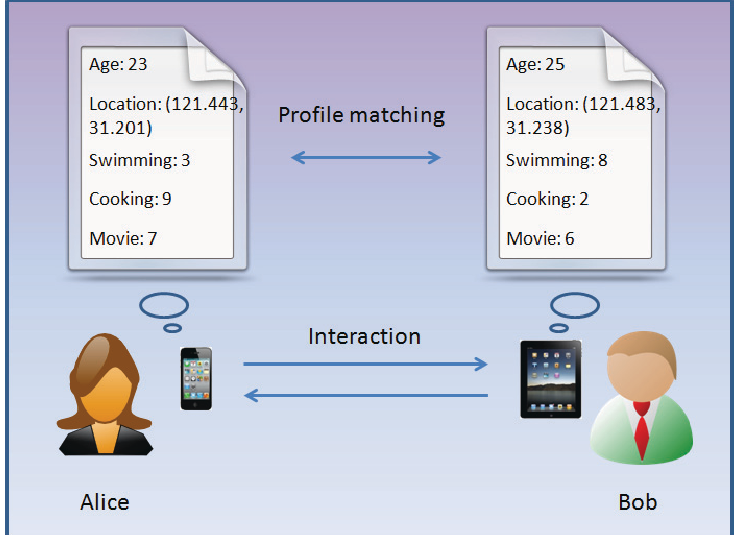 Fig 1: The interaction model between mobile users and the trusted authority.
3. Blinding the Data
To ensure Bob doesn't learn Alice's values even though he holds the private key to decrypt the results, Alice uses Blinding Factors. She multiplies the differences by large random numbers . When Bob decrypts the intermediate result, he sees a random-looking number, yet he can still determine if or (based on the distance from the plaintext modulus ) to help Alice complete the absolute value calculation.
Experiments & Results
The researchers compared their protocol against the baseline established by Zhang et al.
- Computational Efficiency: In the baseline, for every profile item, the complexity was multiplied by the maximum possible value (). In the proposed protocol, the complexity is linear to the number of items () and independent of how large the values are.
- Communication Overhead: As increases, the baseline's data usage grows exponentially relative to the proposed method.
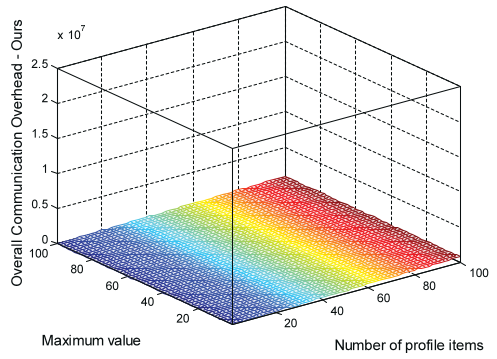 Fig 2: Comparison showing the superior scalability of the proposed protocol over existing SOTA (Zhang et al.) as attribute ranges increase.
Critical Insight & Future Outlook
Takeaway: The "Self-controllable" aspect is the real winner here. By allowing the weight and the threshold to remain private to Alice, the system empowers the user to define their own "Social Distance" without revealing their personal logic or biases to the network.
Limitations: The model assumes "Semi-honest" users (they follow the rules but try to peek). In a real-world "Malicious" environment, a user could craft fake profiles to probe others' data incrementally. Future iterations will need to integrate Zero-Knowledge Proofs (ZKP) to ensure users aren't lying about their data ranges, though this will likely re-introduce the computational overhead the authors worked so hard to reduce.