
P2P Survival of the Fittest: How Selfishness Can Actually Save File-Sharing Systems
User selfishness vs. file availability in P2P file-sharing systems: Evolutionary game theoretic approach
This paper investigates the emergence of effective file caching in P2P file-sharing systems using Evolutionary Game Theory (EGT). By modeling node interaction as a "caching game" under processing load and storage capacity cost models, it demonstrates that a robust system with high file availability can be maintained even when nodes act selfishly.
TL;DR
In a P2P network, every node is a "selfish agent" trying to minimize its costs (storage and CPU) while maximizing its benefits (accessing files). Conventional wisdom suggests this leads to a "tragedy of the commons" where no one caches anything. This paper uses Evolutionary Game Theory (EGT) to prove that if we frame caching as a specific type of game—particularly one based on storage capacity—the system naturally evolves toward high file availability and low latency, regardless of how selfish the users are.
Background: The Free-Rider Problem
Traditional Peer-to-Peer (P2P) systems like Gnutella or BitTorrent suffer from "free-riders"—nodes that download but never upload or cache. Past solutions relied on complex reputation systems or digital payments. However, in anonymous networks, these are difficult to enforce. The authors ask a radical question: Can we design the system so that the autonomous, selfish behavior of nodes leads to a healthy, cooperative state?
Methodology: The Caching Game
The authors model the decision to cache a file as a game between two nodes. They compare two specific cost models:
- Processing Load Model: Costs increase the more others access your file (variable cost).
- Storage Capacity Model: Costs are fixed once the file is stored (fixed cost).
They then apply Replicator Dynamics to see how the population of nodes shifts over time. Unlike standard game theory which assumes a "static" Nash Equilibrium, EGT looks at how strategies (Cache vs. No-Cache) spread through a population as nodes "imitate" their more successful (higher payoff) neighbors.
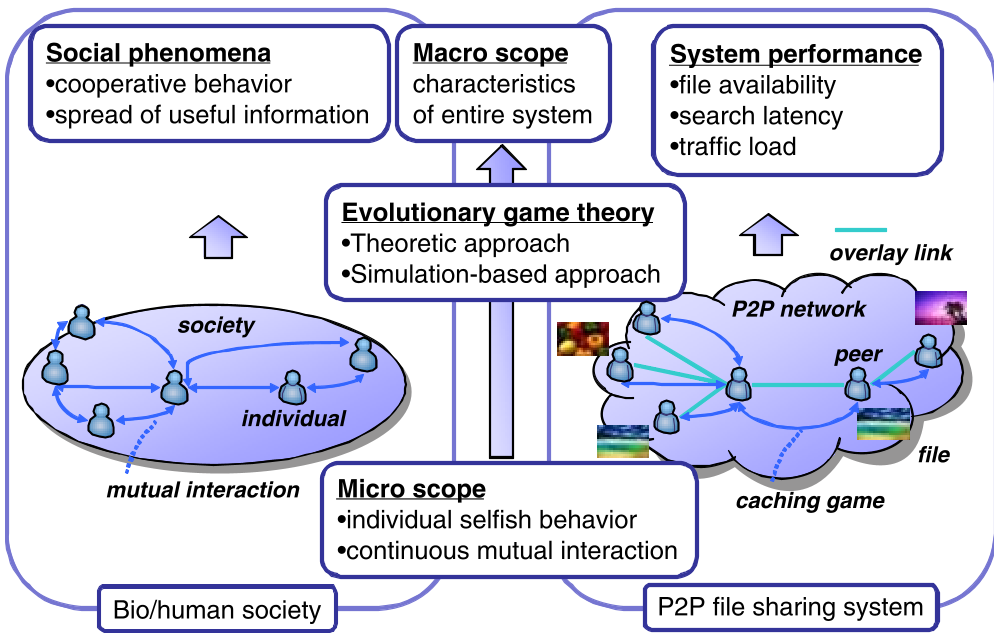
Key Insights: Why Storage-Based Caching Wins
The most striking finding is the difference between the cost models.
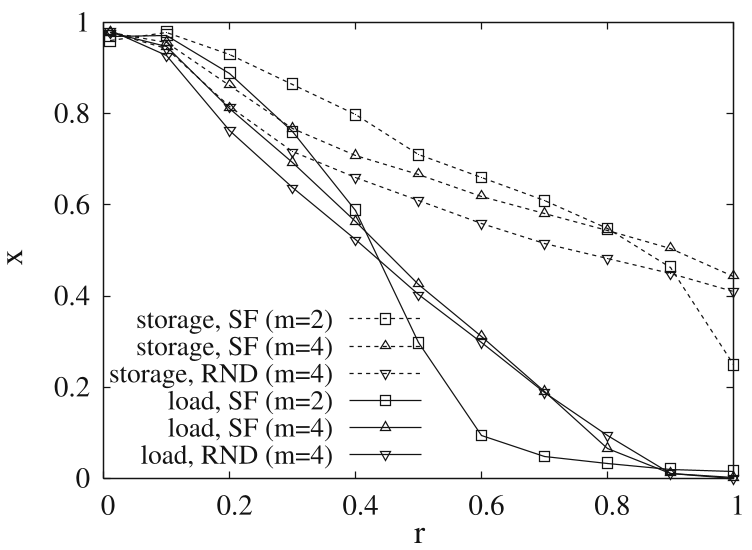
- In the Processing Load model, as demand for a file drops, the incentive to cache vanishes, and the file eventually disappears from the network.
- In the Storage Capacity model, even when demand is extremely low, a significant percentage of nodes continue to cache the file.
Mathematically Speaking:
For the storage model, the ratio of cooperators () at equilibrium is: where is the cost-to-benefit ratio. Even at high , remains positive, ensuring the file never truly disappears.
Simulation Results: Network Topology & Load Balancing
The authors didn't just look at math; they ran simulations on Scale-Free (like the real internet) and Random networks.
- Self-Organizing Search Latency: The search latency (hop count to the nearest provider) stays low in the storage model because files are distributed widely.
- Natural Load Balancing: Surprisingly, in Scale-Free networks, "high-degree nodes" (hubs) actually cache less than regular nodes. The "selfish" game logic prevents hubs from being overwhelmed, as regular nodes take up the slack to maximize their own local payoffs.
Critical Analysis & Conclusion
Takeaway
The genius of this work lies in shifting the focus from punishing free-riders to tuning the environment so that cooperation is a natural evolutionary outcome. The "Storage Capacity" model acts like a "Snowdrift Game" where it’s better to do the work yourself than have no one do it at all.
Limitations
- Single File Focus: The paper primarily analyzes a single-file scenario. In reality, nodes manage thousands of files with varying popularities.
- Static Costs: The model assumes costs and benefits stay constant over time, whereas in real networks, bandwidth costs can fluctuate wildly depending on time of day.
Future Outlook
This evolutionary approach is highly relevant for today's Decentralized Web (Web3). As we move toward protocols like IPFS, understanding how to balance "user selfishness" with "network availability" via EGT could replace heavy-handed incentive tokens with more elegant, self-sustaining protocols.