
EURB: Decoding Social Influence through Rating Behaviors and Schedules
User-Service Rating Prediction by Exploring Social Users' Rating Behaviors
The paper introduces EURB (Exploring Users’ Rating Behaviors), a recommendation framework using Probabilistic Matrix Factorization. It integrates unique factors including User Personal Interest, Interpersonal Interest Similarity, Rating Behavior Similarity (via a novel "rating schedule"), and Interpersonal Rating Behavior Diffusion to outperform SOTA baselines on Yelp and Douban datasets.
TL;DR
Most recommender systems look at what you like. The EURB (Exploring Users’ Rating Behaviors) framework goes deeper, looking at how and when you rate. By introducing the concept of a Rating Schedule and a novel Behavior Diffusion metric, the authors have created a Matrix Factorization (MF) model that outperforms traditional methods on Yelp and Douban by effectively bridging the gap between social circles and temporal habits.
Problem & Motivation: Beyond Simple Similarity
Standard Collaborative Filtering (CF) is often "blind" to the social context, making it brittle when data is sparse (the "Cold Start" problem). While previous social-based models tried to fix this by adding "trust" or "influence," they ignored a fundamental human truth: habits are temporal.
The authors realized that two users might like the same movies, but if one rates movies every Monday and the other only on weekends, their behavioral "signatures" are different. Furthermore, social influence isn't binary; it diffuses differently through "direct," "mutual," and "indirect" friends.
Methodology: The "Rating Schedule" and Behavior Diffusion
The core innovation of EURB lies in two behavioral factors fused into a Probabilistic Matrix Factorization framework:
1. The Rating Schedule (Behavioral Habits)
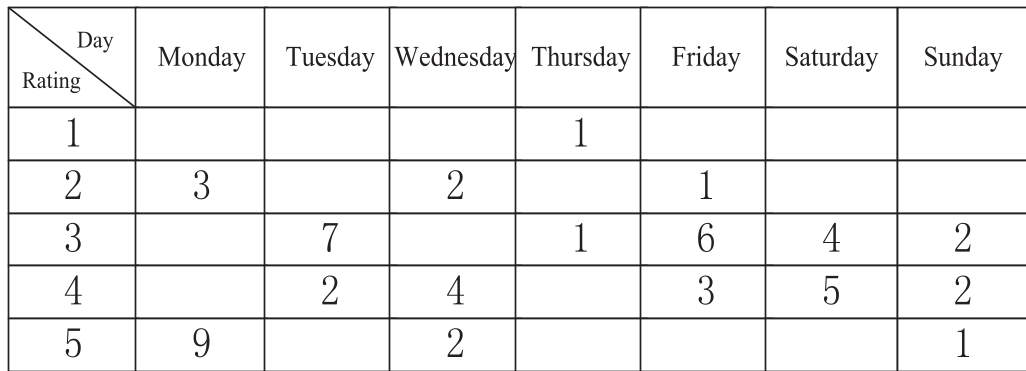
The authors envision a "curriculum schedule" for ratings. They define a matrix where rows represent the rating value (1-5 stars) and columns represent the day of the week.
- Intuition: If your rating schedule is similar to a friend's, it implies a shared lifestyle or consumption habit, which serves as a stronger constraint for the latent feature vector .
2. Rating Behavior Diffusion
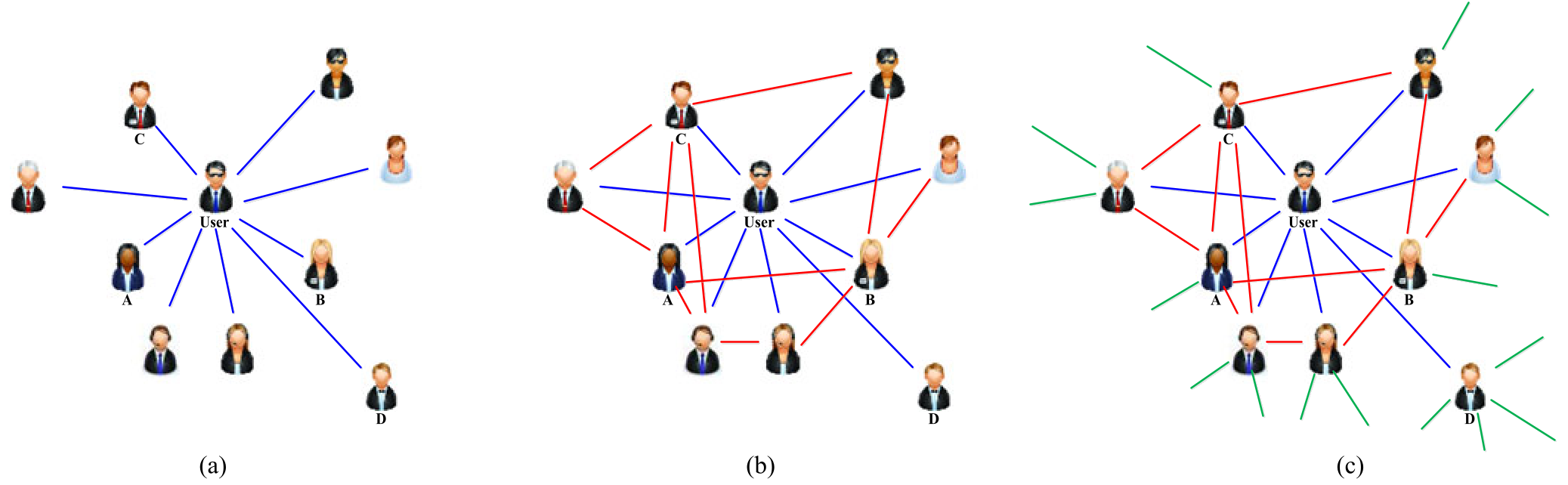
Influence isn't just about who you know; it's about the "smoothness" of the signal. The authors split social circles into direct, mutual, and indirect friends. They calculate diffusion smoothness () based on:
- Social Proximity: The ratio of mutual friends to the total social circle.
- Temporal Sync: How close in time were the ratings for the same item ().
- Expertise: Does the friend have a high volume of ratings in that specific category?
Unified Objective Function
To keep the model efficient, the authors proposed a unified constraint: Instead of separate terms for every social factor (which increases complexity), they average the weights of Diffusion (), Behavior Similarity (), and Interest Similarity (), significantly reducing the computational cost per iteration.
Experiments & Results
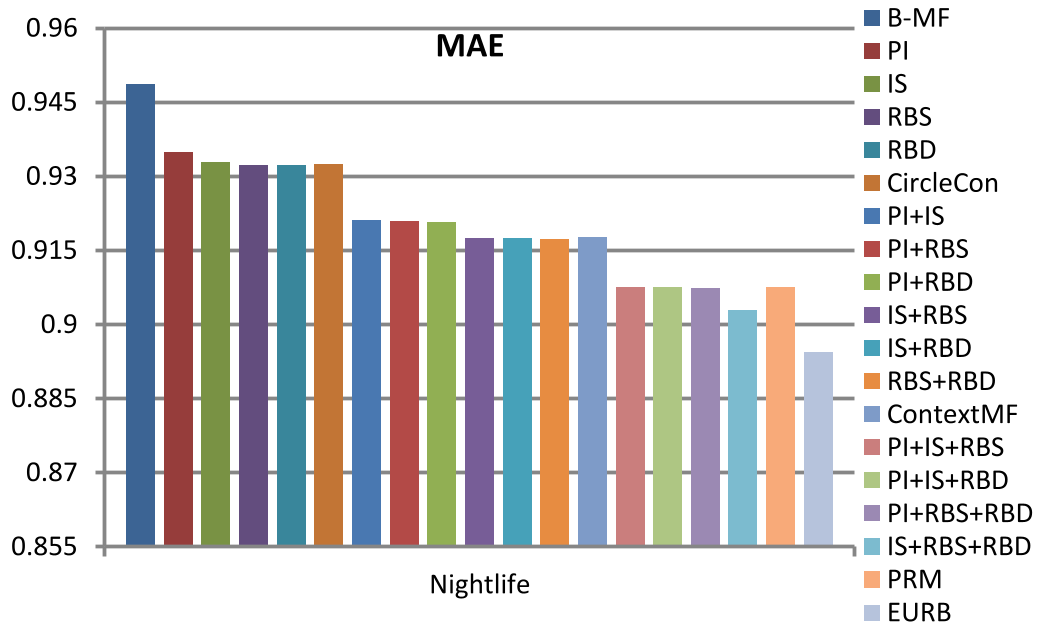
The model was tested against BaseMF, CircleCon, and Context MF across various Yelp categories (Restaurants, Nightlife, etc.) and Douban Movie data.
- Accuracy: EURB consistently achieved lower MAE and RMSE across all test sets. For instance, in the Yelp "Shopping" category, it showed a visible performance lead over the PRM baseline.
- Efficiency: By fusing the interpersonal factors, the "Improved EURB" reduced the average iteration cost (time) from 0.2334 min to 0.1369 min (approximately 40% faster) compared to the original formulation, with negligible loss in accuracy.
Critical Analysis & Conclusion
Takeaway: The real value of this paper is the formalization of "Behavioral Habits" as a temporal schedule. It proves that social recommendation is most effective when it considers the proximity of actions (time and score) alongside the proximity of people (social graph).
Limitations:
- The "Rating Schedule" is currently fixed to a weekly/monthly/yearly grid. With the rise of real-time streaming services, a more continuous temporal modeling approach might be needed.
- The dataset used is somewhat dated (Yelp/Douban). Modern datasets with more "implicit" feedback (clicks/shares) would further test the robustness of the Behavior Diffusion metric.
Future Outlook: As we move toward Graph Neural Networks (GNNs), the diffusion logic presented here could be translated into personalized graph attention mechanisms, where "edge weights" are dynamically calculated using the temporal and expertise factors proposed in EURB.